Bus Tray Solutions
Get premium quality cable management systems directly from the manufacturer.
- ISO 9001 Certified Quality
- Factory Direct Pricing
- Fast Global Delivery
Request A Quote
Fill out the form below to receive our catalog and pricing.


Get premium quality cable management systems directly from the manufacturer.
Fill out the form below to receive our catalog and pricing.

Galvanized vs Stainless Steel Cable Tray: Which Should You Choose? Choose galvanized steel cable tray for dry or mildly corrosive indoor service where low first cost is the main priority. Choose stainless steel cable tray for washdown, coastal, chemical, or…

Aluminum vs Steel Cable Tray: Which Material Is Better for 2026 Projects? Aluminum vs steel cable tray is usually decided by load performance, support spacing, corrosion exposure, and maintenance consequences—not material price alone. In most 2026 projects, aluminum is the…

Indoor vs outdoor cable tray systems differ because the design basis changes. Indoors, trays are usually selected around cable weight, fill, access, and fire behavior. Outdoors, the same tray must also resist UV, rain, wind uplift, corrosion, and wider temperature…

What Is FRP and Fiberglass Cable Tray, and Where Do Non-Metallic Systems Make Sense? FRP and fiberglass cable tray is a non-metallic cable management system made from glass-fiber-reinforced resin. It is most useful where corrosion, washdown, salt exposure, or chemically…

Aluminum cable tray is a metal cable management system used to support and route power, control, and data cables where low dead load and good atmospheric corrosion resistance matter. In many projects, it weighs about 30% to 50% less than…

When Does Stainless Steel Cable Tray Actually Justify the Cost? Stainless steel cable tray is justified when the system must retain corrosion and mechanical performance over its full service life, not just pass handover inspection. Under IEC 61537, the decision…

Galvanized steel cable tray for general industrial use is a zinc-coated steel support system for routing power, control, and instrumentation cables in open runs. It is commonly used where engineers need moderate corrosion resistance, predictable structural capacity, and easier inspection…

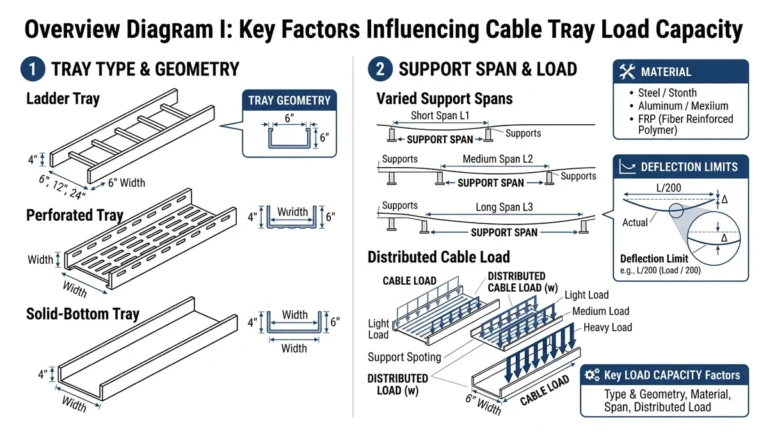
What Is Cable Tray Support Distance? Cable tray support distance is the center-to-center spacing between supports that a tray spans under a stated load, typically about 1.5 m to 3.0 m for standard systems. For buyers and specifiers, that number…

Cable tray clips are small retention components used in cable management systems to secure covers, dividers, bonding parts, accessories, or, in some cases, cables to a cable tray or cable ladder. They do not usually carry the primary tray load.…

Cable tray clamps are mechanical fasteners used to secure a cable tray, cable ladder, cover, splice plate, or cable bundle to the supporting structure. In real installations, they transfer dead load, vibration, uplift, thermal movement, and sometimes fault-related forces through…