Quick Answer: How to Choose Ladder, Perforated, or Solid Cable Tray in 2026
Use ladder cable tray when heat dissipation and easy cable drops dominate, typically for power feeders ≥50 mm² over spans of 2–6 m. Choose perforated tray for mixed control/power where some shielding and support of small cables are needed. Favor solid-bottom tray in dirty or EMC-sensitive areas, accepting heavier weight, shorter spans, and higher ampacity derating.
Core Engineering Differences Between Ladder, Perforated, and Solid Bottom Trays
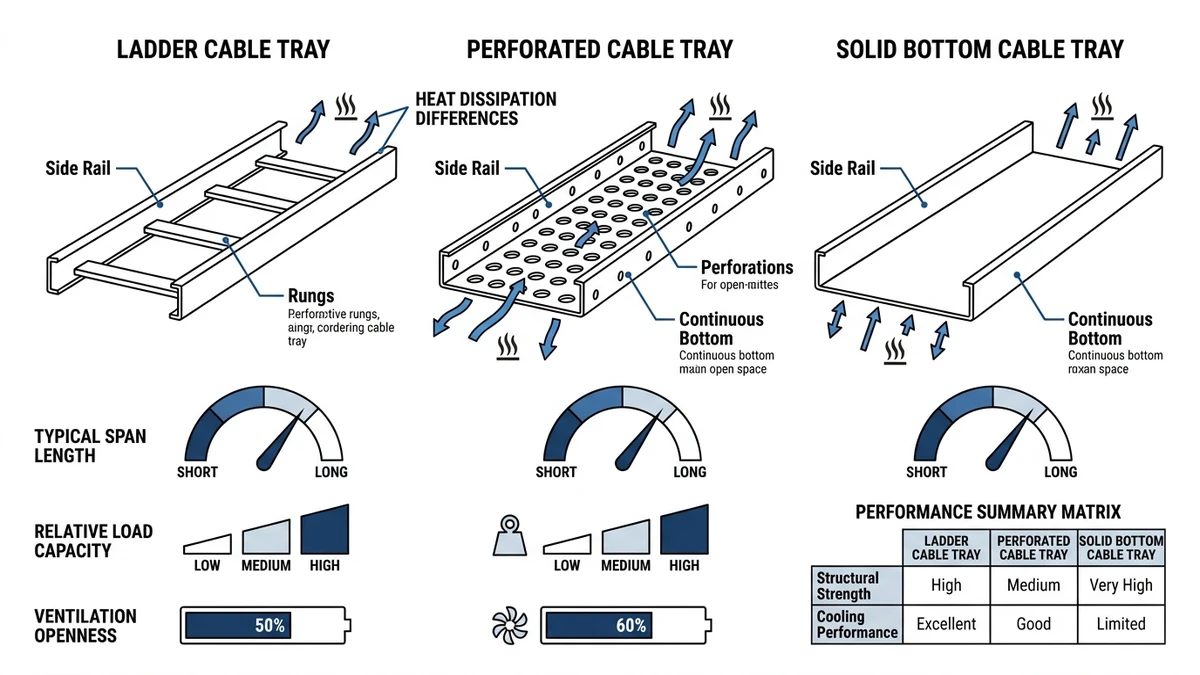
For a given cable management system, the core engineering differences between ladder, perforated, and solid bottom trays are driven by three mechanisms: load–deflection behavior, thermal dissipation, and environmental shielding. These directly change allowable span (e.g., 2.5–4.0 m), cable ampacity derating (often 5–25 %), and long-term corrosion and cleaning requirements.
Structural Load and Span Behavior
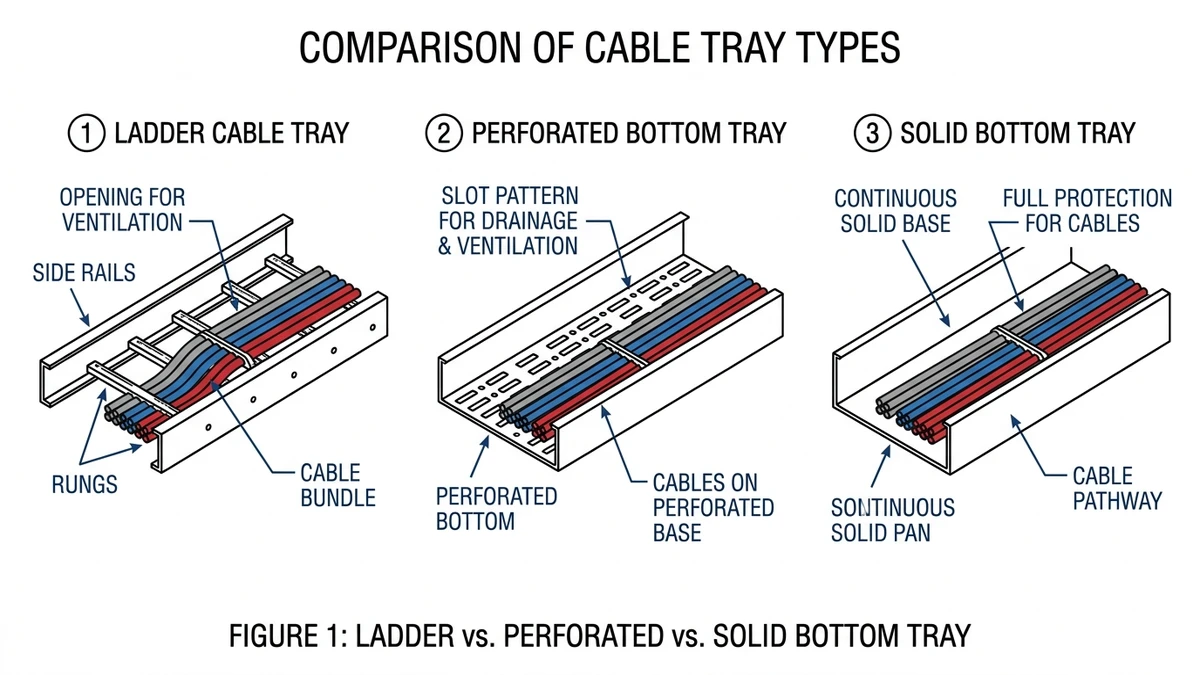
Ladder cable trays act as small trusses: side rails carry bending, rungs carry shear, so metal is concentrated where it is most efficient. For a 600 mm wide tray to IEC 61537, a 3.0 m span with 100 kg/m uniformly distributed load typically limits midspan deflection to about L/200, and ladder usually achieves the highest load class for a given material thickness. Perforated trays distribute material across the bottom, often needing shorter spans (e.g., 2.5 m for the same 100 kg/m) to meet similar deflection limits, while solid-bottom trays of similar stiffness add more self‑weight, increasing demand on hangers and seismic bracing over long runs.
Thermal Management and Ampacity
Thermal performance is governed by exposed cable surface and airflow. Ladder trays with ~70–90 % open area often require only 0–10 % ampacity derating versus free‑air ratings, so feeder sizes and breaker settings can remain close to open‑air designs. Perforated and especially solid-bottom trays trap more heat; manufacturer data commonly shows 10–20 % derating for perforated and 20–30 % for solid-bottom with covers, which can force upsizing (e.g., from 3 × 240 mm² to 3 × 300 mm²) or lower protective device settings for the same load and ambient.
Environmental Shielding and Cleanliness
Ladder trays offer minimal shielding: dust, liquids, and small debris can enter but also fall through, suiting clean indoor spaces where inspection is easy. Perforated trays provide partial protection while still allowing drainage and airflow, extending cleaning intervals in mildly dusty plants compared with exposed ladder. Solid-bottom trays give the best containment against falling debris and fine dust but can trap moisture and condensate, so designers often specify drain/vent holes or manage runs in short sections to reduce corrosion and insulation tracking risks.
Comparison Matrix: When to Favor Each Type
Parameter
Ladder Tray
Perforated Tray
Solid Bottom Tray
Typical open area
70–90 %
30–50 %
0–10 % (with optional vents)
Structural efficiency
Highest for given thickness
Moderate
Moderate–high but heavier
Typical span at 100 kg/m
3.0–4.0 m
2.5–3.0 m
2.5–3.0 m
Ampacity derating vs free air
0–10 %
10–20 %
20–30 % (higher with covers)
Contamination shielding
Low
Medium
High
Best suited for
Heavy power, long spans, easy access
Mixed power/control, moderate shielding
Sensitive/small cables, dirty or outdoor
Design takeaway: choose ladder where load and thermal performance dominate, perforated where compromise is acceptable, and solid-bottom only where containment or shielding justifies heavier construction, tighter spans, and deliberate thermal derating.
Matching Tray Type to Cable Types, EMC, and Fire Strategy
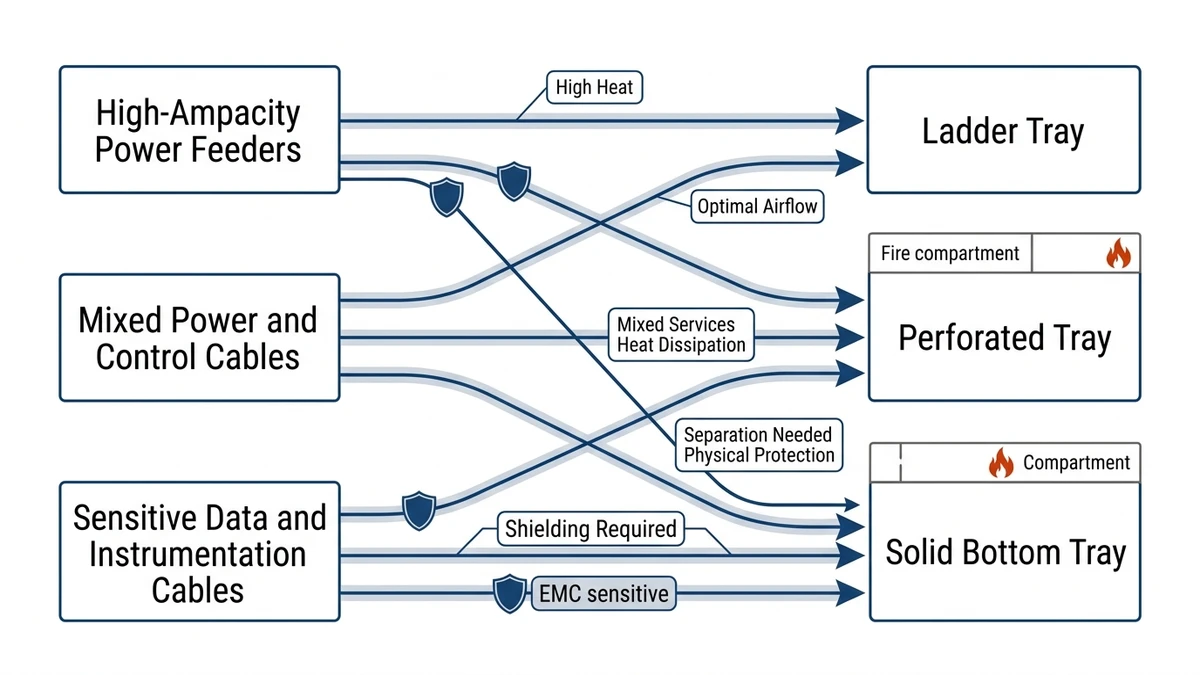
In 2026 specifications, tray type should follow cable type, EMC sensitivity, and fire/smoke strategy. The same 300 mm wide route can justify a different tray selection once you change from LV power feeders to control or life-safety circuits.
By Cable Type and Thermal Loading
For large LV/MV power cables (≥50 mm², 0.6/1 kV and above), ladder trays are usually preferred because open rungs give the best convection and keep ampacity derating low, whereas perforated or solid-bottom trays in the same duty can raise conductor temperatures enough to force upsizing. For mixed power and control on the same route, ladder or perforated trays with dividers help separate heat sources from small cables and reduce induced voltages. Small control, instrumentation, and data cables (≤2.5 mm², Cat 6A, fiber) are better supported on perforated or solid-bottom trays, with ladder only used where mesh inserts or closer supports prevent small cables from sagging or deforming.
By EMC and Signal Integrity
In high‑EMI environments such as VFD rooms, UPS areas, or 11 kV switchgear, solid-bottom or dense perforated trays with bonded covers provide a more continuous metallic path that can improve shielding and bonding for sensitive circuits. For general LV power distribution, ladder trays are usually adequate, with EMC performance driven more by cable screening, bonding, and physical separation from sensitive circuits than by tray type alone.
By Fire and Smoke Strategy
Where life‑safety and fire alarm circuits are used, robust metallic supports are required, and ladder trays often perform well for mechanical integrity and post‑fire inspection. However, solid-bottom trays can trap hot gases and burning debris, which may conflict with smoke control objectives unless carefully detailed. For penetrations and compartmentation, ladder and perforated trays make it easier to apply tested fire‑stopping around individual or grouped cables, while solid-bottom trays may need systems that treat the tray body as part of the fire barrier.
Practical Decision Rules
Favor ladder trays for heavy LV/MV power, long spans, and routes where heat and mechanical robustness dominate. Favor perforated trays for mixed services, moderate EMC concerns, and areas where smaller cables need continuous support with some drainage and airflow. Favor solid-bottom trays for EMC‑sensitive signal bundles, dirty or wash‑down environments, and locations where falling debris or liquids must be kept off cables, provided thermal derating, drainage, and fire‑stopping are explicitly addressed.
Field Scenarios: Applying Ladder vs Perforated vs Solid Trays in Real Projects
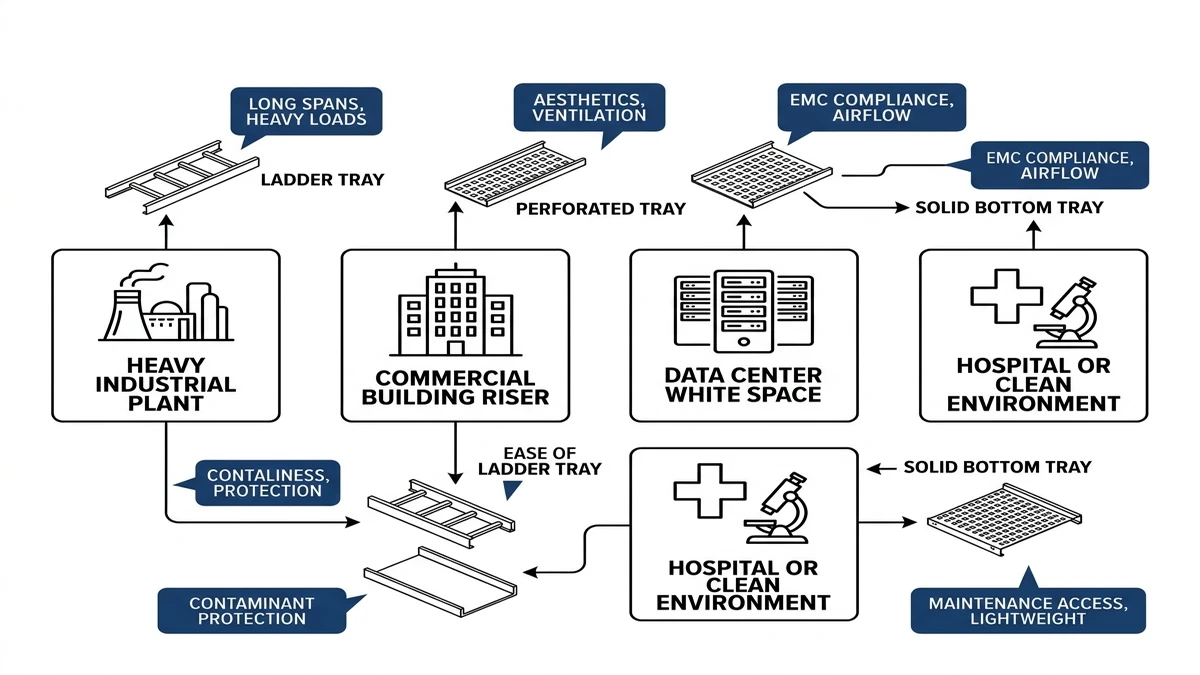
In real layouts, the decision between ladder, perforated, and solid-bottom trays is driven by environment, cable mix, and maintenance strategy more than by catalogue labels. Below are three typical scenarios and how tray selection changes fill, support spacing, and ampacity derating.
In a motor control center with several parallel 240 mm² power cables per run and loads around 60–80 kg/m on 600 mm trays, ladder trays typically allow 3–4 m spans while keeping derating modest so breaker settings and cable sizes stay efficient. Perforated trays are usually reserved for short sections that interface with small control cables or for vertical drops where continuous support helps maintain bending radius and cable organization.
Scenario 2 – Process Plant with Dust and Drips (Mixed Cables)
In outdoor process pipe racks with ~4 m supports, ladder trays remain best for large MV feeders needing airflow and frequent changes, and their openness aids visual inspection after leaks. Perforated trays are commonly used for smaller instrument and control cables, preventing kinks and slip‑through while still allowing drainage, whereas solid-bottom trays are generally avoided on long outdoor runs because of water pooling, higher derating, and the tendency for ad‑hoc drain holes that undermine corrosion protection.
Scenario 3 – Cleanroom or Food Plant (Hygiene and Containment)
Over hygienic production lines, solid-bottom trays simplify wash‑down and containment by limiting openings where product or cleaning fluids can fall onto cables and by helping segregate LV control from higher‑voltage feeders. The trade‑off is higher tray mass and worse heat removal, so designers often either oversize conductors or cap fill at lower percentages to maintain temperature margins, using perforated trays mainly in secondary, less hygiene‑critical routes.
[Expert Insight] Structural and Thermal Coordination
When upgrading from perforated to solid-bottom trays or adding covers on an existing layout, verify that increased self‑weight and wind/seismic effects do not exceed hanger or support capacities, as total load per hanger can rise by 20–25 %. For heavily loaded ladder runs, also confirm that cable clamps, rung spacing, and span length work together so that the limiting factor is not cable jacket damage or clamp failure before the tray reaches its rated capacity.
How Xinma Helps Coordinate Tray Type, Loading, and Support Details in Specifications
Several design consequences repeat across projects:
Ladder trays typically allow longer spans (about 3.0–4.0 m) than perforated or solid-bottom trays for the same 150 kg/m design load.
Solid and perforated bottoms usually drive higher ampacity derating (about 5–20 %) and sometimes larger tray widths to keep cable temperature within limits.
Covers and outdoor exposure add mass and wind uplift, which tightens support spacing, hanger sizing, and seismic bracing requirements.
Mixed systems (ladder trunks with solid-bottom drops, perforated branches, and partial covers) complicate fittings, bonding continuity, and fire‑stopping.
These are exactly the areas where Xinma’s engineering support is useful, because the choice between ladder, perforated, and solid-bottom cable tray should be checked as one integrated cable management system, not as isolated catalogue items.
Xinma can help your team:
Verify load class against actual cable weight (kg/m) and required span (up to around 6 m in some structures), using tray types from our ladder cable tray range and general cable tray portfolio.
Cross‑check thermal derating versus fault level, breaker settings, and short‑circuit ratings, particularly when moving from open ladder to perforated or solid-bottom systems documented in our technical articles on cable tray systems.
Match fittings and reducers when transitioning tray types while maintaining bonding and IEC 61537 compliance, using suitable cable tray accessories.
Adjust support layouts, seismic bracing, and hardware details when you change tray type, add covers, or revise fill, coordinating with our busway solutions where shared supports or parallel routing are planned.
Align tray dimensions and fill ratios with your cable list using the guidance in our post on cable tray dimensions and sizing, so structural, thermal, and EMC assumptions are consistent across drawings and protection settings.
In multi‑system corridors, a small change like swapping a 300 mm ladder section for a 300 mm perforated section under a chilled‑water pipe can affect ampacity, hanger spacing, and fire‑stopping details, so capturing these interactions early usually prevents rework on site.
[Expert Insight] Standards, Testing, and Validation
For metallic tray systems, IEC 61537 defines load testing and deflection criteria; designers should request test curves, not just a single “maximum load” value, to interpolate for the spans and loads actually used. Authoritative information is available from the IEC webstore at: IEC 61537 publication page
Where trays support safety‑related circuits, coordination with installation rules similar to those in IEC 60364 often matters more than tray type; verify fire resistance, bonding, segregation, and cable selection at the system level rather than treating a heavier tray as a substitute for proper fire design.
Frequently Asked Questions
How do I choose between ladder and perforated cable trays for power distribution?
Use ladder trays when spans are long and cable loads are high, because they carry more load per kilogram of steel and keep ampacity derating low; move to perforated trays when you introduce smaller control cables on the same route and need continuous support, accepting slightly shorter spans and higher thermal derating.
When is a solid-bottom cable tray really necessary?
Solid-bottom trays are usually justified where contamination, EMC sensitivity, or wash‑down cleaning dominate; they are most useful under process lines, in cleanrooms, and near high‑EMI equipment, but should be avoided for long, heavily loaded power feeders unless drainage and derating have been carefully evaluated.
How does cable tray type affect cable ampacity calculations?
Tray type changes the effective cooling around cables, so ladder trays often allow using free‑air ampacity with minor corrections, while perforated and solid-bottom trays can require 10–30 % derating, which may force either larger conductors or reduced protective device settings to keep steady‑state temperatures in range.
What span should I use for cable tray supports?
Support span should be selected from the manufacturer’s load–deflection data rather than a simple rule of thumb; for typical industrial trays carrying 75–150 kg/m, designers often end up between 2.5 m and 4.0 m, with ladder trays at the upper end and solid-bottom systems toward the lower end due to higher self‑weight.
Can I mix ladder, perforated, and solid-bottom trays on the same route?
You can mix tray types along one route, but each transition should be checked for mechanical continuity, bonding, and thermal changes; in practice this means coordinating fittings, verifying that support spacing suits the weakest section, and recalculating ampacity where a segment changes from open ladder to a more enclosed construction.
How does cable tray selection interact with fire-stopping around penetrations?
Tray selection affects how easy it is to seal around cables at walls or floors; ladder and perforated trays allow more flexible fire‑stopping around individual cables, while solid-bottom trays often need tested systems that treat the tray body as part of the barrier, so these details should be fixed during design rather than left to site improvisation.
Kevin Zheng
Kevin Zheng is a manager linked to Shanghai Xinma Busway & Cable Tray Co., Ltd. He writes technical content on cable tray systems, installation practice, sizing logic, load classes, and related standards for industrial and infrastructure applications.