For many commercial and industrial power routes, the copper vs aluminum busway decision is made too late, after drawings, supports, and quotations are already moving. That creates avoidable questions during EPC review, MEP coordination, and site inspection: Is the selected rating adequate, is the route too heavy, are losses acceptable, and are the joint details clear enough for installation? This guide treats conductor material as a specification and procurement decision. Both copper and aluminum busway can be valid when the assembly is correctly rated, tested, installed, and inspected.
Copper vs Aluminum Busway: Fast Engineering Comparison
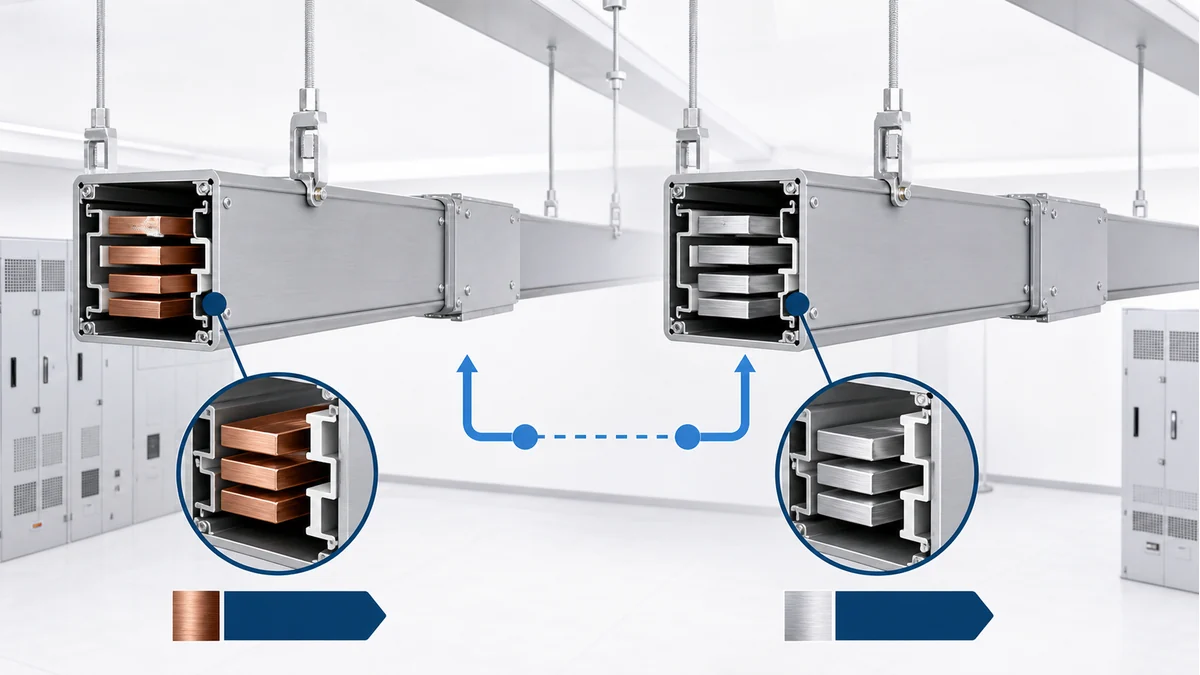
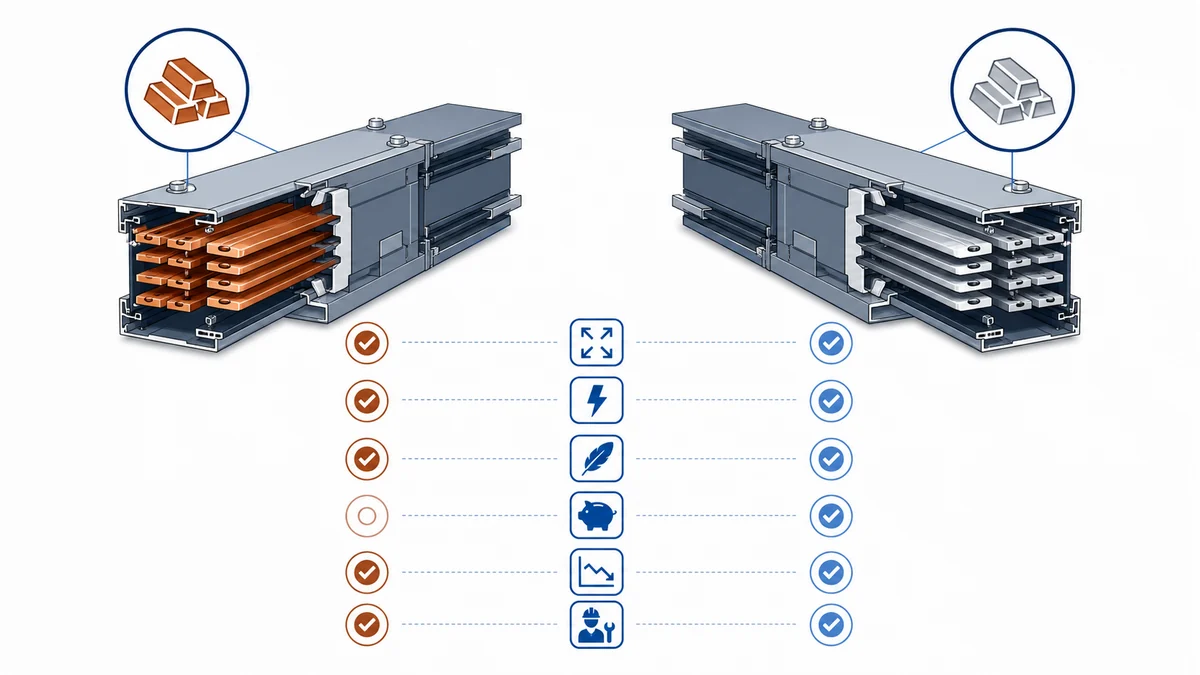
Copper busway usually favors compactness and lower resistance, while aluminum busway often favors weight and budget control.
Copper has higher conductivity than aluminum, so a copper busway can often achieve a required rating with a more compact conductor arrangement. That helps when electrical rooms are crowded, voltage drop is sensitive, or route space is fixed by switchgear, ceiling services, or riser openings.
Aluminum busway is usually selected when first cost and weight reduction are more important. A correctly designed aluminum assembly can meet the same current rating, but it may need a larger conductor section or different enclosure geometry. This is why the comparison should use manufacturer data, not metal preference.
A busway is a tested system, more than a conductor. Review rated current, enclosure type, insulation system, joint pack, temperature rise data, short-circuit withstand, tap-off arrangement, IP requirement, fittings, supports, and installation instructions. If the reader still needs the basic system definition, Xinma’s guide to what is bus duct covers the terminology. For international busbar trunking context, project specifications often reference IEC 61439-6, but the project team should verify the exact edition, local code basis, test evidence, and manufacturer documentation before approval.
Fast checkpoints are simple: choose copper when compact size, lower resistance, or tighter voltage drop review matters most. Consider aluminum when route weight, lifting, and budget control are stronger drivers. For either material, check joint access, torque marking, phase sequence, enclosure continuity, and tap-off compatibility before energization.
Cost Comparison: Purchase Price, Sizing, Losses, and Installed Budget
In a copper vs aluminum busway comparison, conductor material affects first cost, but it is not the whole installed budget. Aluminum often reduces the conductor cost. Copper may justify a higher purchase price when it reduces section size, lowers losses, or solves a congested route.
Compare the full bill of materials: straight sections, elbows, offsets, joint packs, end feed units, flanges, tap-off boxes, hangers, special brackets, spare parts, and test documents. A cheaper conductor can lose part of its advantage if the design needs larger sections, extra supports, or more difficult lifting. A higher conductor cost can be reasonable if it avoids route changes or keeps a project inside the approved electrical room envelope.
Loss review also belongs in the cost discussion. Copper’s lower resistance can reduce voltage drop and heat loss in some routes. Aluminum busway is normally sized to meet the specified rating, but long or heavily loaded routes should be checked against supplier voltage drop and loss data.
Anonymized, estimated experience signal: in a Southeast Asia commercial tower tender review in 2025, the team compared aluminum and copper busway for about 320 m of mixed riser and horizontal distribution. Over a 6-week quotation cycle, the aluminum option showed roughly 12 percent lower supplied-system budget, while the copper option kept two congested electrical room routes narrower. The final choice depended on support loads and voltage drop, not material cost alone.
For early alignment on system scope, Xinma’s guide to busbar electrical systems helps separate bare busbars from enclosed busway, bus duct, and busbar trunking packages.
Weight and Route Coordination: Handling, Risers, and Support Loads
Weight is one of the clearest practical differences. Aluminum busway is usually lighter than copper busway for the same project duty, although the final installed weight still depends on rating, enclosure design, IP requirement, joint packs, fittings, tap-off units, and support accessories.
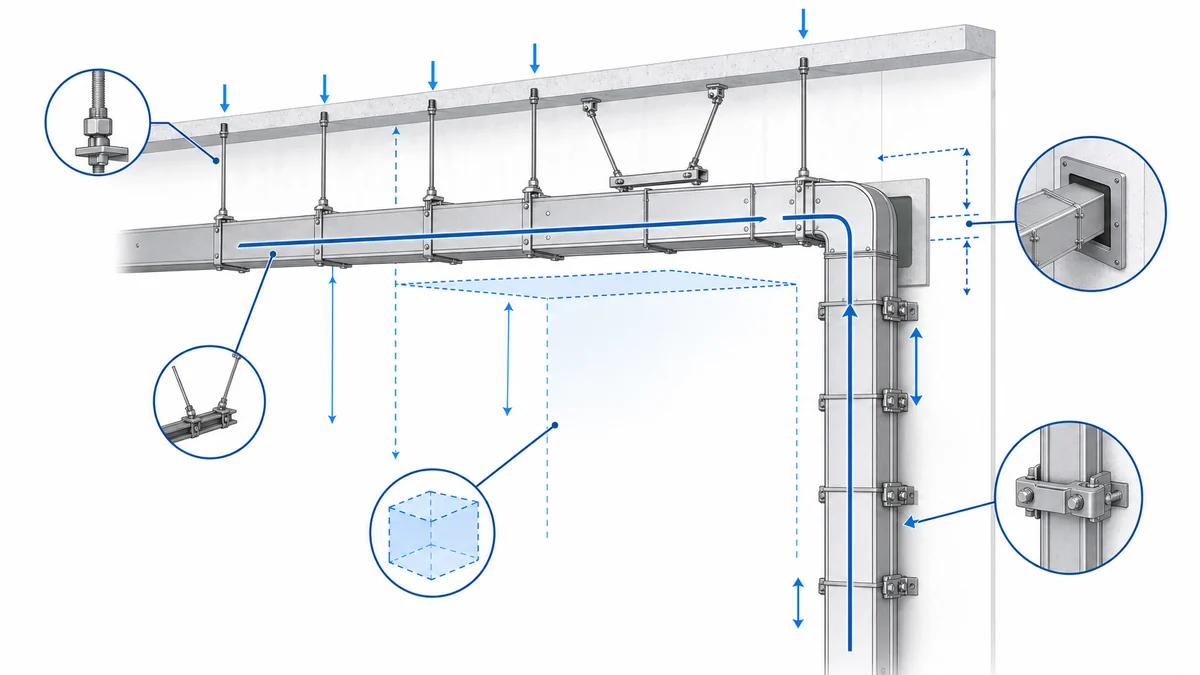
Busway conductor material affects route weight, lifting method, support loads, riser clamps, and inspection access.
Lower route weight can help in long horizontal runs above corridors, production lines, and plant rooms where hanger loads and ceiling congestion are already tight. It can also reduce handling effort when sections must be lifted through narrow openings or aligned above operating equipment. In risers, lighter sections may simplify staging, but riser clamps, floor sleeves, fire stopping, and inspection access still need a full coordination review.
Copper busway may be preferred where compactness, loss reduction, or project standardization matters more than weight. Its higher mass should still be checked against slab inserts, steel brackets, trapeze supports, shared support frames, and seismic bracing design. Do not assume a cable tray or pipe support layout can carry a busway route without verification.
Anonymized, estimated experience signal: on a high-rise commercial fit-out in Southeast Asia in 2024, the design team compared copper and aluminum feeder risers during shop drawing review. Selecting aluminum for several non-critical riser runs reduced estimated supported weight by roughly 25 to 35 percent versus the copper comparison package. The review took about three weeks, including support markups and lifting sequence notes.
For approval, request manufacturer weight data by catalog number and by assembled route. Reflect the final conductor material in support drawings, installation method statements, and receiving inspection checklists.
Performance Comparison: Current Rating, Voltage Drop, Heat Rise, and Connections
Copper can often carry the same current with a smaller conductor section, depending on the manufacturer’s design. Aluminum busway is not a lower-rating product by default. It is sized and configured to meet the specified rating, temperature rise limit, enclosure design, and installation condition. The comparison comes down to the size, loss level, route impact, and inspection requirement the project can accept.
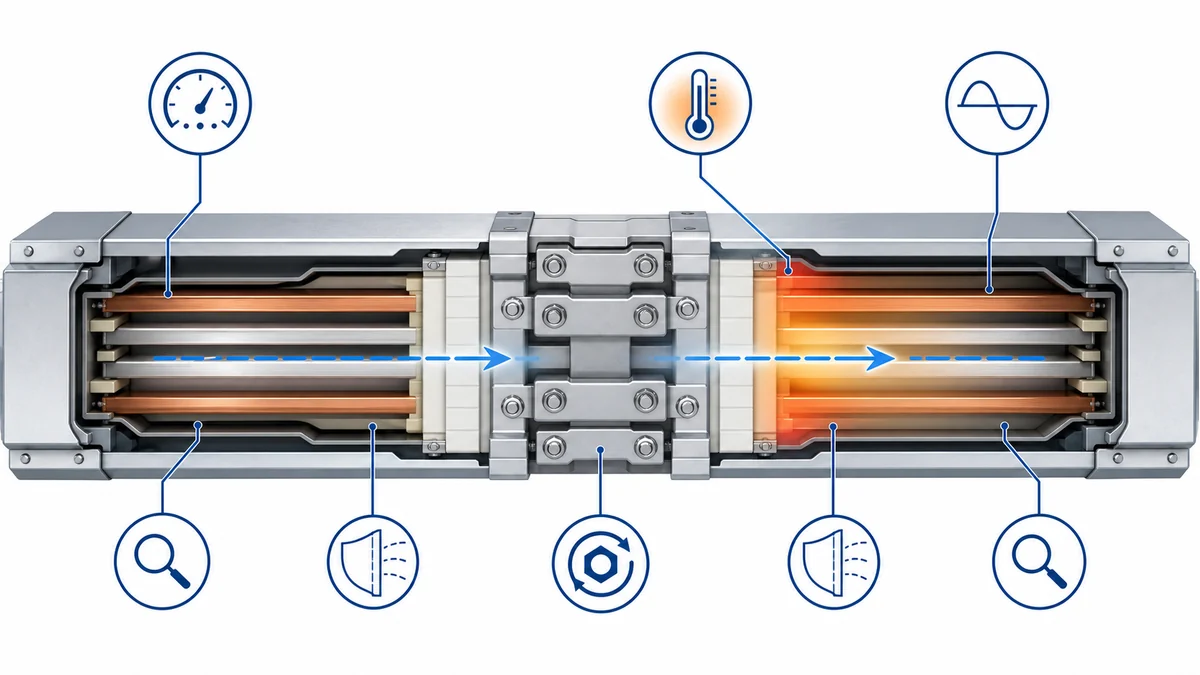
Performance review should connect current rating, voltage drop, heat rise, joint quality, torque control, and inspection access.
Start with the load schedule, diversity assumptions, upstream protection, ambient condition, and future expansion allowance. Then confirm the selected busway rating against tested product data. Xinma’s busway current rating selection guide is useful when load profiles, spare capacity, and route conditions are still being reconciled.
Voltage drop is often the decisive performance check. On short feeder runs, the difference may be small enough that layout, budget, and delivery dominate. On long risers or continuous high-load circuits, impedance and voltage drop should be checked against the project limit. Aluminum may require a larger conductor section or a higher rating selection to meet the same target.
Heat rise depends on conductor resistance, enclosure design, joint condition, ambient temperature, and loading profile. Copper’s lower resistance can help, but the complete tested assembly matters more than conductor material alone. A well-designed aluminum busway can perform reliably when selected and installed within its documented limits.
Connections need special attention. Joint packs, contact plating, surface condition, alignment, bolt torque, and insulation barriers affect long-term performance. Aluminum also requires controlled contact design and oxidation management, which should be handled by the manufacturer’s joint system rather than site improvisation.
Conservative site inspection example: on an anonymized commercial riser project in 2025, about 40 busway joints were checked during a 2-week commissioning period. Three joints required rework for torque marking or cover alignment before energization. No conductor material defect was recorded; the issue was installation control.
How to Choose Between Copper and Aluminum Busway for a Project
Use a structured review before deciding copper vs aluminum busway. Both materials can be suitable when the product is correctly rated, tested, installed, and inspected. The selection should follow project inputs.
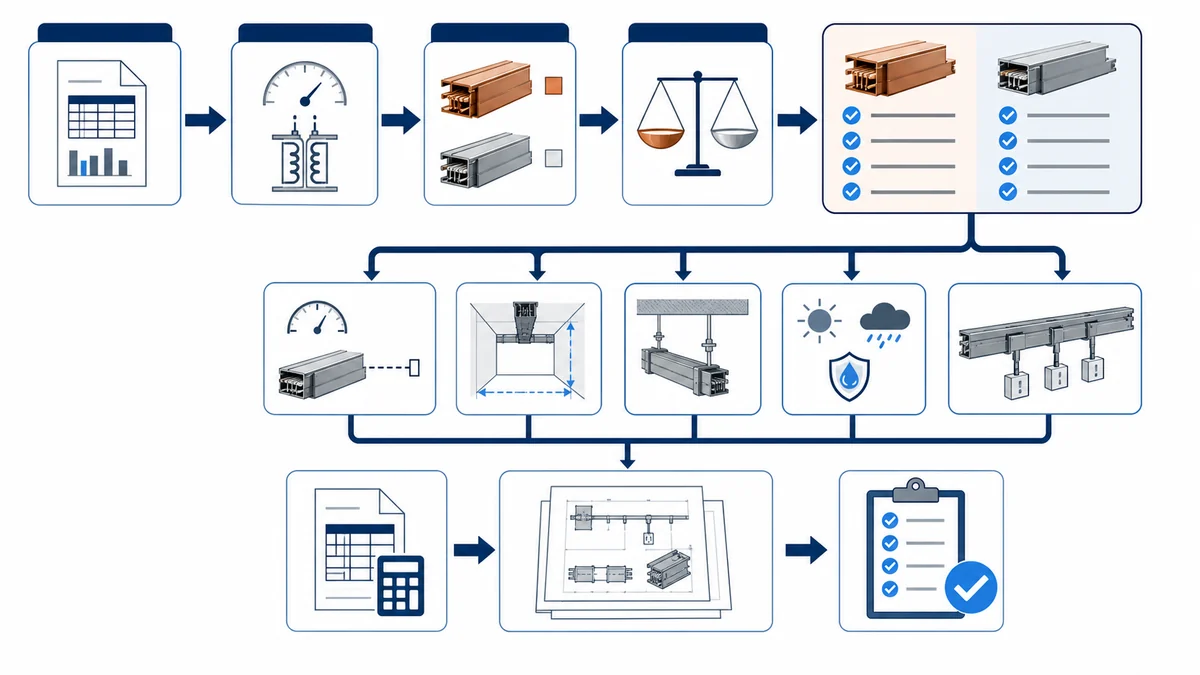
A structured selection workflow compares load, route length, space, support limits, environment, tap-off plan, and quotation scope.
Confirm the load and rating. Start from the single-line diagram, demand load, spare capacity, protective device coordination, neutral requirement, and future expansion.
Check route length and voltage drop. Request voltage drop and loss data for the actual route length, conductor material, load profile, and ambient condition.
Review available space. Aluminum may require a different section size, while copper may help in tighter routes. Use manufacturer dimensions, not assumptions.
Check support and handling limits. Review hanger spacing, bracket loads, slab or steel fixing points, riser clamps, lifting method, and access for later maintenance.
Review the installation environment. Indoor, outdoor, humid, dusty, corrosive, or high-temperature areas affect enclosure selection, IP rating, joint protection, and inspection intervals.
Compare quotations by system scope. Check straight lengths, elbows, offsets, joint packs, tap-off boxes, end feeds, supports, spare parts, drawings, exclusions, and test documents.
For coordinated procurement, Xinma can align busway selection with cable tray routes, fittings, accessories, and seismic bracing components as related product families. The operational value is consistency in model codes, finish choices, support geometry, clamp and tap-off access, BOM review, delivery lots, and site inspection records. That coordination is especially useful when power routes, tray routes, and bracing points share the same ceiling zone.
The final choice should be written into the technical submittal. If cost and weight are the main drivers, aluminum busway is often reasonable. If compact size, lower losses, or high-load performance are priorities, copper busway may be preferred. Final approval should be based on project data, manufacturer drawings, and inspection access.
Frequently Asked Questions
Is copper busway always better than aluminum busway?
No. Copper has higher conductivity and can help when space is tight, voltage drop is sensitive, or loss review matters. Aluminum busway can still meet the same duty when it is correctly sized, tested, installed, and inspected. The better choice depends on current rating, route length, available space, support limits, budget, and maintenance capability.
Does aluminum busway need a larger size for the same current rating?
Often, aluminum requires a larger conductor section because its conductivity is lower than copper. That does not mean every aluminum busway has a much larger housing. Enclosure design, insulation, heat dissipation, phase arrangement, IP rating, and short-circuit requirements also affect dimensions. Compare certified supplier data for the actual rating.
Which busway material is better for long routes?
For long routes, copper may be preferred when voltage drop, losses, or compact routing are the main concerns. Aluminum may be reasonable when weight reduction, handling, and initial budget matter more. Engineers should request voltage drop and loss data for the actual route length, load profile, conductor material, and ambient condition.
What should inspectors check at copper and aluminum busway joints?
Inspectors should check approved joint packs, clean contact surfaces, alignment, insulation parts, bolt torque, phase sequence, enclosure continuity, IP components, labels, covers, support spacing, and maintenance access. For both materials, look for poor contact, deformation, missing hardware, overheating marks, or unapproved field modification.
How should procurement compare copper vs aluminum busway quotations?
Compare quotations on the same technical basis: rated current, voltage, conductor material, neutral and protective conductor arrangement, short-circuit rating, IP rating, route drawings, tap-off units, joints, supports, accessories, test documents, delivery scope, spare parts, and exclusions. A lower unit price is not always the lowest installed cost.
Kevin Zheng
Kevin Zheng is a manager linked to Shanghai Xinma Busway & Cable Tray Co., Ltd. He writes technical content on cable tray systems, installation practice, sizing logic, load classes, and related standards for industrial and infrastructure applications.