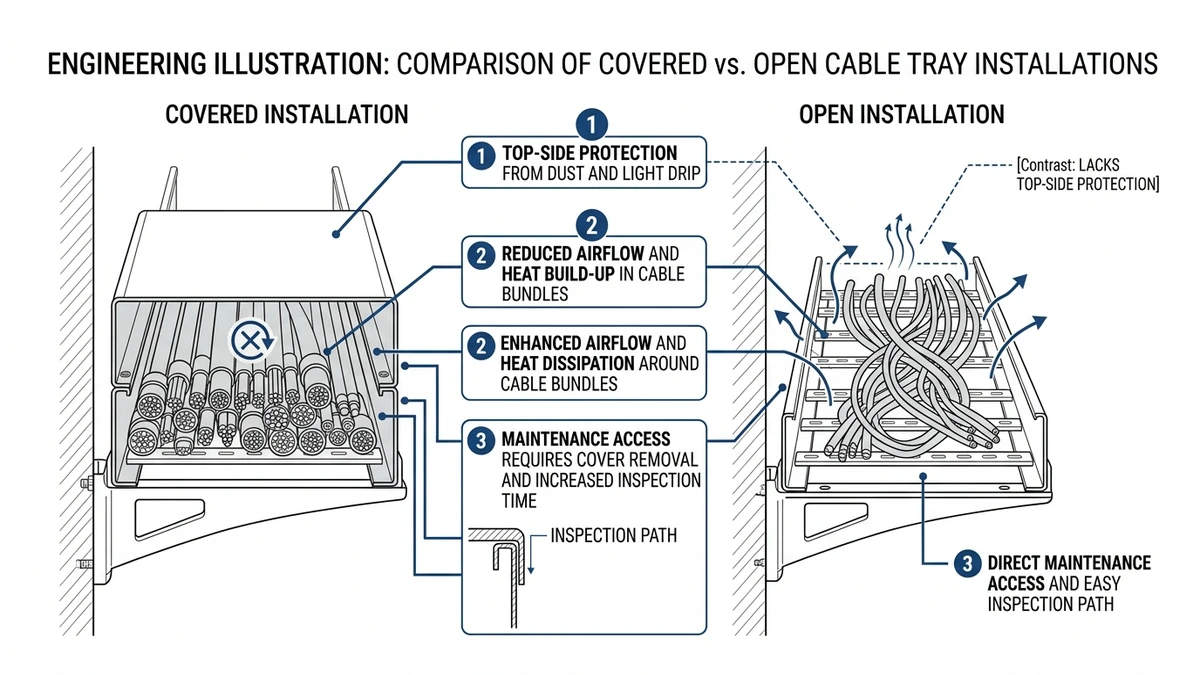
Cable tray covers change three design conditions at once: protection, heat dissipation, and maintenance access. Under IEC 61537, a cover is not just an accessory; it changes what reaches the cables, how heat leaves the bundle, and how quickly technicians can inspect or modify the run. In practice, solid steel covers can improve protection against dust, debris, and drips, but they can also raise cable temperature by several °C and slow access along each tray section.
For specifiers, the question is not whether a cover is “better,” but whether it solves the main site hazard without creating a bigger thermal, structural, or maintenance penalty elsewhere. IEC 61537 governs cable tray and ladder mechanical requirements, while cable thermal rating still has to be checked at system level using the applicable cable rating method. For reference, see the IEC 61537 publication page.
Related video: Cable Tray Covers: Balancing Protection, Heat Dissipation, and Accessibility
What Hazards Do Cable Tray Covers Actually Protect Against?
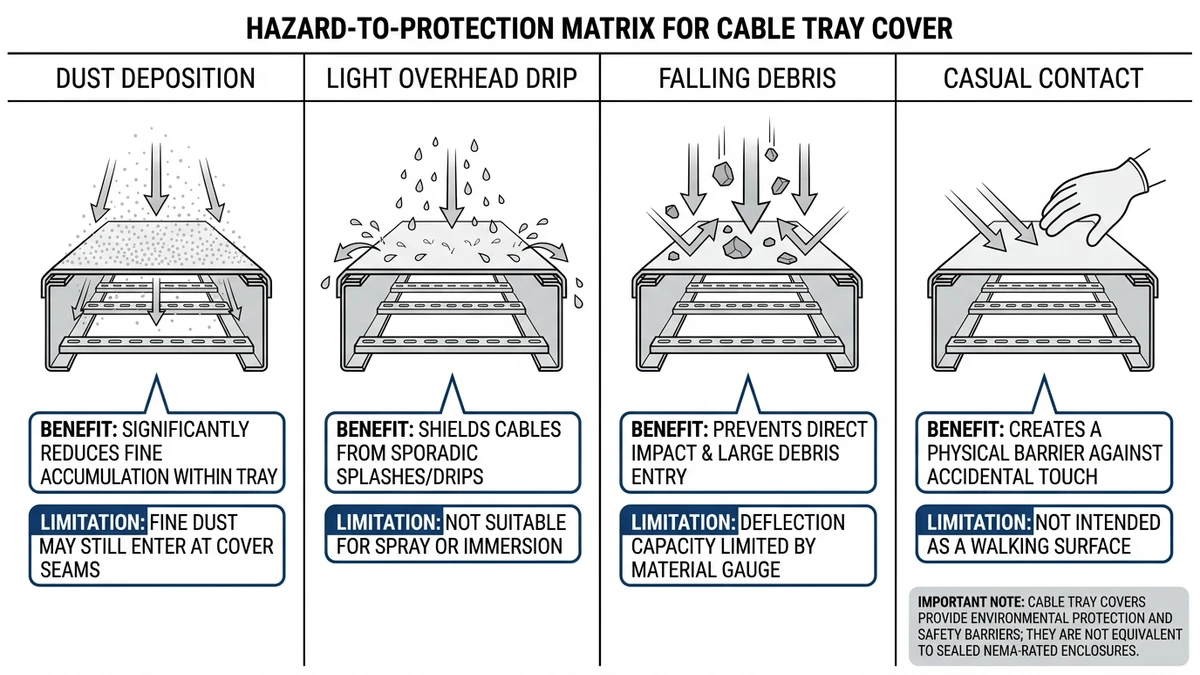
Cable tray covers protect against external exposure, but they do not turn a tray into a sealed enclosure unless the full assembly is designed and tested that way. In most projects, the real benefits are against falling debris, dust, UV exposure, wind-blown contamination, incidental contact, and light splash or dripping water.
A cover should be matched to the actual hazard. Solid covers give the strongest barrier against fallout and sunlight, while ventilated covers mainly block larger debris and preserve more airflow.
Hazard-to-benefit matrix
Hazard / exposure
How the cover helps
Typical limit or condition
Design consequence
Falling debris from overhead steel, piping, or ceiling work
Solid covers intercept dropped nuts, scale, concrete dust, and light tools before they strike cable jackets
Most effective for small vertical impact; not a substitute for guards against heavy dropped loads above about 2 kg
Favor covered tray below mezzanines, pipe racks, and retrofit zones with active overhead work
Dust and dirt accumulation
Reduces settling on cable surfaces and inside the tray
Useful in cement, mining, woodworking, and warehouse environments with continuous airborne particulates
Cleaning intervals may extend from monthly to quarterly, but inspection becomes slower
UV exposure and weathering
Shades polymeric cable jackets from direct sunlight
Most relevant on outdoor runs with multi-year exposure
Helps limit jacket aging and can reduce direct solar heating by several °C
Wind-blown debris and leaves
Limits entry of litter and coarse debris
Long outdoor runs above 20 m tend to collect more material
Reduces blockage around cable bundles and lowers cleaning frequency
Incidental personnel contact
Adds a barrier against casual touching of cable surfaces
Not equivalent to a touch-safe enclosure under all codes
Useful on walkways and service platforms, but lockout and guarding rules still apply
Splash or drip contamination
Blocks vertical drips from process lines or roof leaks
Works for occasional drips, not liquid-tight service
Good below HVAC condensate lines; poor choice for frequent washdown
Rodents and birds
Partially deters entry by reducing open access
Depends heavily on splice gaps and open sides
Requires end closures and fit-up discipline if pest exclusion matters
What covers do not reliably prevent
Cable tray covers usually do not provide a tested ingress protection rating unless the tray-cover assembly is specifically certified as an enclosure system. They also do not prevent internal cable problems such as overload heating, short-circuit damage, or insulation aging from excessive conductor temperature.
Use covers where the dominant risk is external and repetitive. They are a poor substitute for solving internal thermal loading, frequent cable changes, or fast inspection needs.
Figure 1. Cable tray covers mainly address dust, light drip, falling debris, and casual contact rather than sealed-enclosure protection.
[Expert Insight]
Dust reduction depends on end closures and fitting transitions; open gaps still admit contamination.
On rooftops, covers can reduce both debris and UV exposure, but the thermal penalty may offset part of the benefit on heavily loaded trays.
For washdown or chemical spray, a covered tray is usually the wrong containment concept.
How Covers Change Heat Dissipation and Cable Operating Conditions
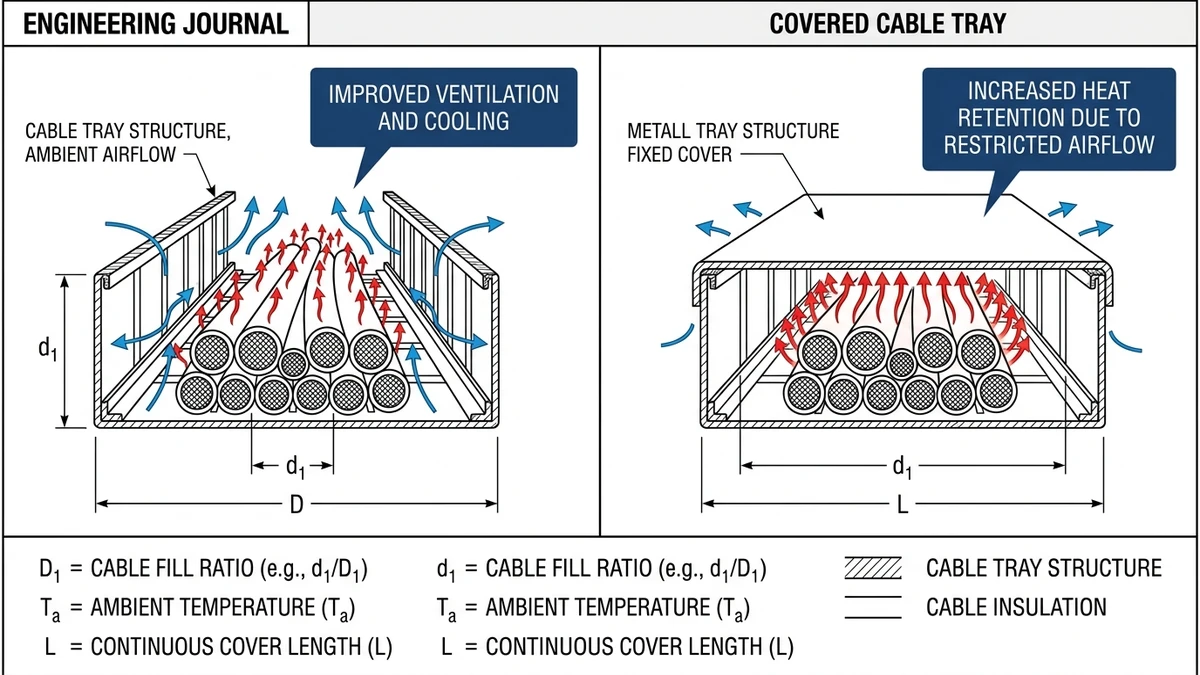
A cable tray cover reduces convective cooling, so it can raise cable temperature and shrink ampacity margin. The effect is usually modest on lightly loaded signal trays, but it matters on power runs with high fill, warm ambient conditions, or limited spacing between circuits.
This is the main trade-off: better environmental protection, less natural ventilation. If covers are added after cable sizing was based on open-tray conditions, the installed system may no longer match the original rating assumptions.
What thermal conditions change when a cover is added
Adding a cover reduces air exchange above the cable bundle and can increase local heat buildup, especially at dense cable clusters or long covered spans. Outdoor metallic covers may also add solar heat gain on exposed routes.
Parameters engineers should check before specifying
Review load current, conductor temperature rating, tray fill, tray geometry, cover type, ambient temperature, solar exposure, loaded conductor count, spacing, ventilation gap, and covered run length. Thermal performance depends on the combination, not one parameter in isolation.
Design logic: use when, avoid when, check before specifying
Use solid covers where debris, dust, or drips are the main hazard and the tray still has thermal margin after review. Avoid long solid-covered runs on high-fill feeders unless the cable rating method confirms acceptable conductor temperature; in many cases, a wider tray, lower fill, ventilated cover, or local shielding is a cleaner solution.
Worked example: where a few °C matter
Consider a 600 mm ladder tray carrying several loaded power circuits at about 50% fill in a 45 °C process area. If a solid cover raises cable temperature by only a few °C, that may consume the remaining design margin and make the covered section the thermal worst case.
Figure 2. Covered tray sections reduce natural airflow around loaded cables, which can increase thermal review and derating requirements.
[Expert Insight]
When a route already operates close to its temperature limit, a cover is often the change that triggers derating.
Short local covers over high-risk zones often outperform continuous covers because they limit thermal penalty to the area that needs protection.
A noticeably warmer cover surface is a practical clue that a closer thermal review is justified.
How Maintenance Access Changes When a Tray Is Covered
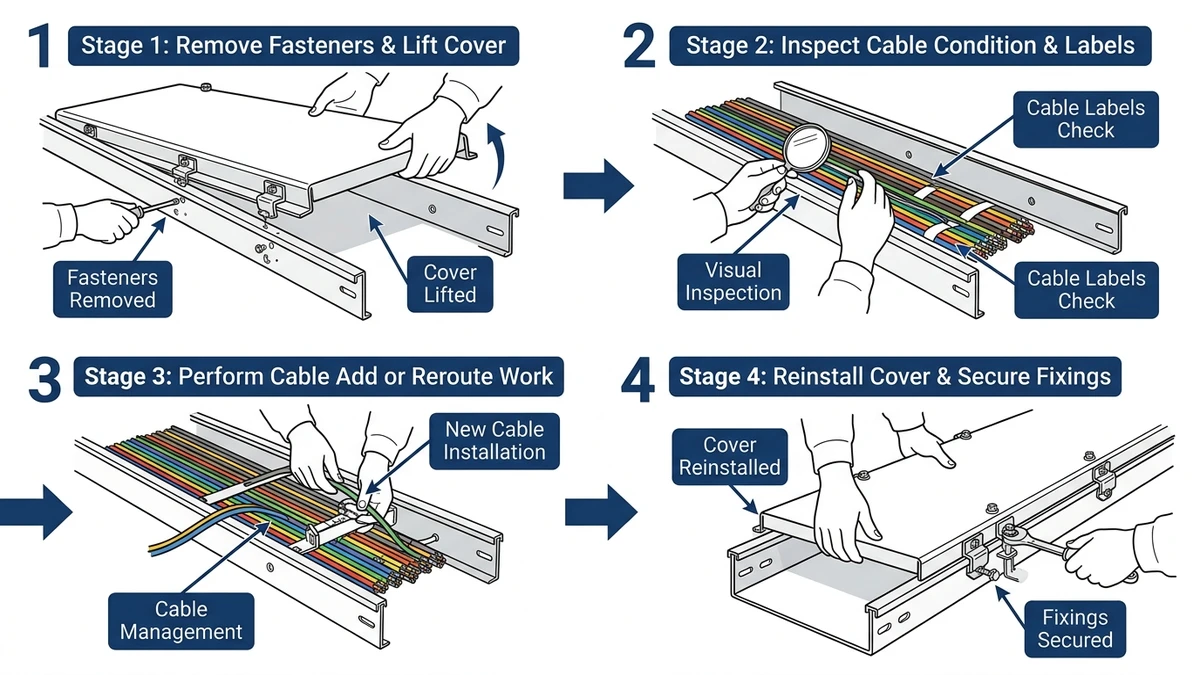
Covered tray improves protection but slows maintenance because inspection, cable additions, testing, and fault tracing all start with cover removal and reinstallation. What looks minor in design review often becomes a labor, clearance, and outage issue in the field.
The practical impact depends on tray location and how often the route changes. Stable feeder paths tolerate covers better than instrumentation, control, or data routes that need regular intervention.
What changes mechanically and operationally
Open tray allows direct viewing of routing, fill, and jacket condition, while covered tray requires overhead removal clearance and handling space for each section. In tight spaces, the available clearance above the tray often determines whether maintenance is routine or disruptive.
Maintenance impact checklist
Verify removal clearance above the cover; typically allow at least 150 mm, and more on wider trays.
Check cover section length and weight before specifying continuous runs; shorter sections reduce handling effort but increase part count.
Identify high-change zones such as instrumentation drops, control routes, and data cabling; these usually need faster access than fixed feeders.
Confirm whether access requires tools; hinged or tool-light details can reduce intervention time.
Plan reinstallation control; loose or misaligned covers can rattle under vibration or create partial openings.
Review outage implications where covered trays pass above operating equipment.
Inspect fastening hardware for corrosion or seizure on outdoor runs after roughly 12-24 months of exposure.
Mark frequent access points so crews open only local sections rather than a full run.
Maintenance trade-off: engineering comparison, not feature list
Covers are usually acceptable where contamination is the main failure driver and cable changes are rare. Where troubleshooting speed or frequent modifications matter, repeated opening and refastening can become the dominant maintenance penalty.
Figure 3. Covered tray maintenance requires additional steps for cover removal, inspection, cable changes, and secure reinstatement.
Covered vs Open Cable Tray: Which One Fits the Environment Better?
Covered vs open cable tray is mainly an environmental and thermal choice. Covered tray is stronger against dust, debris, UV, and dripping water, while open tray gives better airflow, faster inspection, and easier cable changes.
The right answer depends on the most credible failure mode on that route: external contamination or internal heat buildup.
Parameter-by-parameter comparison
Parameter
Covered cable tray
Open cable tray
Environmental protection
Better against dust, debris, dripping liquids, and UV
Limited barrier protection
Heat dissipation
Lower natural ventilation; thermal review is usually required in warmer or high-fill runs
Better airflow and more ampacity margin
Maintenance access
Slower; each intervention needs cover removal or opening
Fast inspection and cable tracing
Mechanical loading
Higher dead load; cover mass typically adds about 2-8 kg/m depending on width and material
Lower dead load and simpler support checks
Outdoor suitability
Strong option where weathering or falling objects are credible risks
Better only where contamination risk is low and ventilation or drainage is the priority
Security and contact limitation
Better resistance to casual interference
Lower barrier to incidental contact
Best fit
Dusty process areas, tunnels, rooftops, pipe rack zones
Data halls, indoor service corridors, frequently modified control routes
Decision logic
Use covered tray when external exposure is likely to shorten cable life, increase cleaning burden, or create avoidable maintenance risk. Use open tray when thermal margin is tight, tray fill may grow over time, or inspection access is operationally important.
Avoid one blanket rule across a mixed route. A 30-100 m run often crosses different exposure zones, so selective coverage usually performs better than continuous cover throughout.
Applying These Trade-Offs to a Real Project Specification
Cable tray covers should be specified as part of the system, not added after the main design is complete. Once a cover is introduced, environmental protection, thermal derating, support loading, and maintenance access all need to be checked again.
Good specifications usually define where covers are needed, what type is required, and what consequences must be verified before issue.
Start with the exposure map, not a default accessory list
Identify the actual hazard zones first, such as outdoor sections, runs below process piping, or dusty plant areas, and specify whether covers are continuous or local. Where dimensions and fill growth are still being developed, cross-check tray sizing assumptions early against tray width and sidewall selection guidance.
Coordinate structural and electrical consequences
A steel cover can add about 3-8 kg/m depending on width and thickness, affecting hanger sizing, support spacing, and seismic review; include that weight in the same support model used for tray support and bracing coordination. Electrically, reduced convection may require derating review, especially on high-fill power trays where a small loss of thermal margin can matter.
Check fittings, hold-downs, and access details before issue
Straight sections are usually simple to cover, but bends, tees, reducers, and offsets are where fit-up problems appear. Outdoor runs also need hold-down coordination for wind uplift, so confirm compatibility at bends, tees, and other tray fittings and compare field access assumptions against this practical tray installation guide.
Technical close-out that stays useful
Before final issue, ask whether the cover solves a defined exposure problem without creating a hidden thermal or maintenance penalty elsewhere. That answer is most reliable when tray, cover, supports, and access points are reviewed together rather than as separate details.
Final Self-Check Before You Specify Cable Tray Covers
Cable tray covers are not neutral accessories. A 0.8-1.5 mm steel cover or a 3-5 mm FRP cover can change dead load, ampacity margin, and intervention time across the cable management system.
Protection check
Start with the real exposure. If the route is outdoors, under process equipment, or exposed to falling debris, UV, or recurring dust, a cover may materially improve protection; in a clean indoor electrical room, it may add little reliability value.
Thermal check
Confirm whether the cover reduces thermal margin enough to justify derating review. Covered horizontal runs above roughly 40-50% fill deserve closer attention, especially when ambient temperature is around 40 °C or higher and cable loading is already near design current.
Access and load check
Check maintenance and structure together. Covers slow inspection and modifications, and even an added 2-6 kg/m over a long run can affect support spacing, fitting loads, or seismic restraint, so specify them only where the hazard clearly justifies the thermal and access trade-off.
Frequently Asked Questions
When should I use a solid cover instead of a ventilated cable tray cover?
A solid cover is usually the better choice where dust, falling debris, UV exposure, or dripping contamination is the main concern. A ventilated cover is often easier to justify when some protection is needed but cable heat rejection still matters.
Do cable tray covers reduce cable ampacity?
They can, because covers usually restrict airflow and increase heat retention around the cable bundle. The effect depends on fill ratio, load current, ambient temperature, and whether the cover is solid or ventilated.
Are covered cable trays suitable for outdoor installations?
They often work well outdoors where debris, weathering, and sunlight exposure are credible risks. The specification still needs to account for wind uplift, corrosion of fasteners, and possible thermal penalty on sun-exposed runs.
How much extra load does a cable tray cover add to supports?
The added load varies with material, width, and thickness, but it is commonly several kilograms per meter rather than negligible weight. That extra dead load should be included in support spacing and restraint checks, especially on wider trays.
Do cable tray covers make maintenance significantly harder?
They usually make access slower rather than impossible. The real impact depends on clearance above the tray, cover section length, fastening method, and how often the route needs cable changes or troubleshooting.
Can cable tray covers provide full water or dust sealing?
Not in most standard tray applications. If a project needs enclosure-level sealing, the designer should verify whether the full assembly is tested for that duty rather than assume the cover alone provides it.
Thermal/access cover guide: connect to the canonical cover page
This article should remain the detailed heat and access spoke. Use the canonical cover guide for the broader protection and selection path.
Kevin Zheng is a manager linked to Shanghai Xinma Busway & Cable Tray Co., Ltd. He writes technical content on cable tray systems, installation practice, sizing logic, load classes, and related standards for industrial and infrastructure applications.