Cable tray covers are removable metal or nonmetal panels installed over a cable tray or cable ladder to reduce exposure to dust, falling debris, UV, and light weathering. Under IEC 61537, they change exposure, access, and thermal behavior; they do not turn an open tray into a sealed raceway. In practice, a 1.0 mm to 2.0 mm cover can improve physical protection, but it also adds weight, slows maintenance access, and may require ampacity review where thermal margin is tight.
The real decision is not whether covers are “better,” but whether the hazard reduction is worth the penalties in heat dissipation, inspection time, and support loading. That trade-off should be made route by route, not applied uniformly across a facility.
What Do Cable Tray Covers Protect Against in Real Installations?
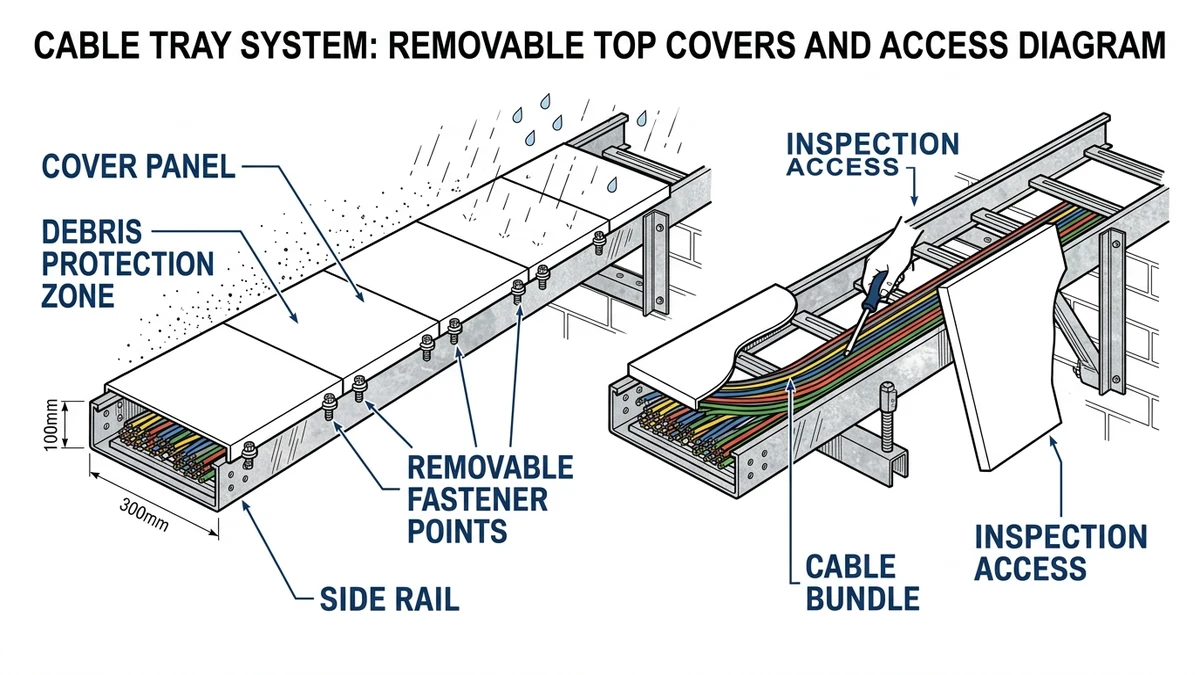
Cable tray covers mainly protect against falling debris, contamination, and weather-driven exposure from above. They help most when the threat is external and predictable, and less when the route needs frequent access or already runs close to thermal limits.
Falling debris and overhead work
Where trays run below steelwork, grating, piping, or maintenance platforms, covers help prevent dropped bolts, concrete chips, or tool fragments from striking cable jackets. The main benefit is impact shielding, but it comes with added dead load and slower inspection.
Dust, fiber, and process contamination
In cement, textile, woodworking, and similar areas, covers reduce settled debris from overhead sources and keep cable tags and jackets cleaner between shutdowns. They do not fully stop fine particle ingress at joints, splice gaps, or fittings, so the gain is reduced contamination, not dust-tight performance.
Rain, splash, and washdown
Outdoor tray and ladder runs benefit from covers mainly against vertical rainfall, light splash, and dirt washed off nearby structures. A simple top cover is not a watertight or IP-rated enclosure, especially where wind-driven rain or hose-down cleaning at 3 bar to 5 bar is present. Ingress protection should be specified for the tested assembly, not assumed from the tray cover alone.
UV and incidental contact
Covers reduce direct solar exposure on cable jackets and can limit casual contact or snagging during nearby work. But they can also reduce convective cooling and, if dark-colored, increase solar heat gain, so the protection benefit must be balanced against thermal effect.
What covers do not reliably protect against
Cable tray covers do not make tray systems equivalent to conduit, duct, or sealed trunking. Their actual performance depends on overlap, fastening, fitting continuity, and installation quality.
Use covers when the main risk is debris, moderate contamination, splash, or UV.
Avoid assuming covers solve dust-tight or water-tight requirements.
Check whether the route also needs frequent access, heat rejection, or wide fitting transitions.
Figure 1. Cable tray covers shown in indoor and outdoor routing conditions where debris, weather, and contact exposure affect specification choices.
How Do Cable Tray Covers Affect Access, Inspection, and Maintenance Time?
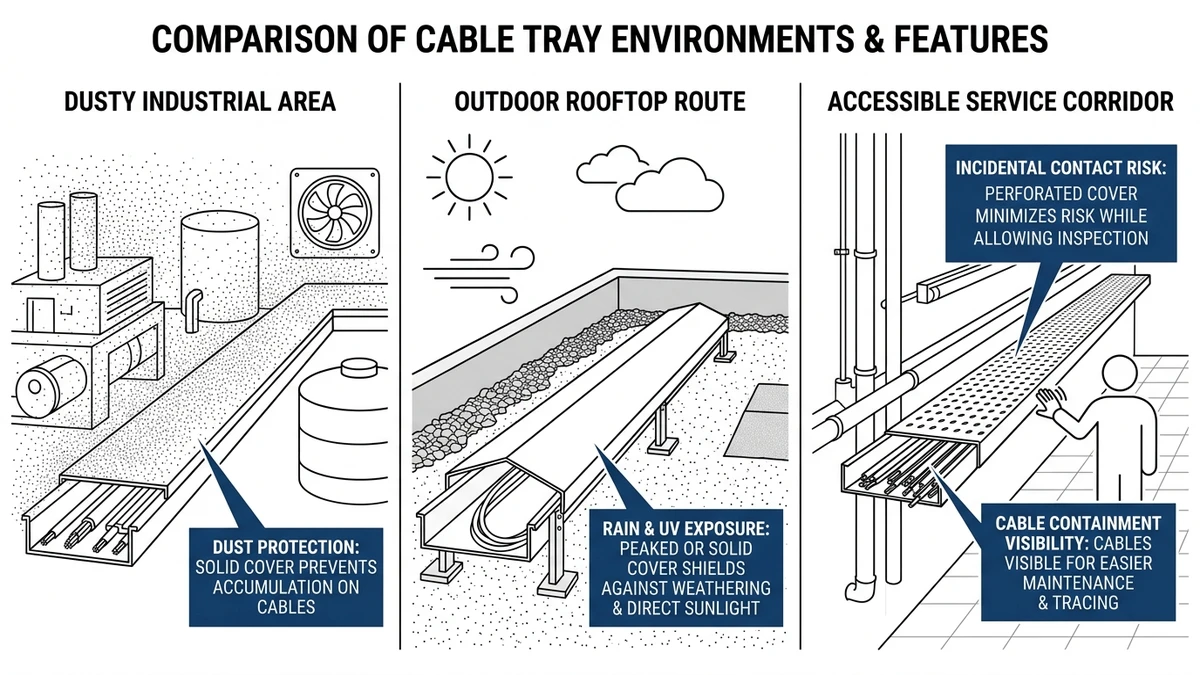
Cable tray covers improve protection, but they slow access. Every cover adds a removal and reinstallation step before technicians can inspect cable condition, verify fill ratio, identify circuits, or add new cables.
A useful planning assumption is that a visual check taking about 2 minutes on an open tray may take 10 minutes to 20 minutes at the same point once fixed covers, loose fasteners, working height, and reinstallation are included.
Engineering comparison: covered vs uncovered tray
Parameter
Covered tray
Uncovered tray
Design consequence
Routine visual inspection
Slower; cover must be removed or opened
Immediate line-of-sight access
Accept longer inspection effort only where contamination risk justifies it
Fault finding
Slower identification and thermal spotting
Faster tracing and condition check
Covered runs benefit from clearer cable labeling and planned access points every 6 m to 12 m
Cable additions and rerouting
More labor and repeated hardware handling
Faster moves, adds, and changes
Better suited to stable power routes than high-change instrumentation routes
Protection from dust/debris
Better
Limited
Lower cleaning frequency may offset access penalties in dirty environments
Weather and UV exposure
Better, depending on geometry and overlap
Poorer
Outdoor runs often justify covers if thermal review is acceptable
Risk of lost hardware
Present with loose fasteners
None
Hinged or quarter-turn designs reduce maintenance delays
Inspection quality
Hidden unless opened
Continuous visibility
Covered systems need deliberate opening strategy, not just cover supply
Match cover style to maintenance frequency
If technicians expect to access a route more than once or twice per year, hinged covers or quick-release hardware usually save enough labor to justify the higher initial cost. If access is rare and contamination control is the priority, fixed overlap covers are often more practical.
Use fixed covers when the route is stable, inspection intervals are long, and exposure drives the design.
Use hinged or quick-release covers when troubleshooting, rerouting, or periodic verification is expected.
Avoid fully fixed cover strategies when the tray carries controls or low-voltage systems subject to regular changes.
Check before specifying whether enough working clearance exists to remove cover sections safely at height.
[Expert Insight]
The access penalty is often highest at fittings rather than straight sections, because smaller cover pieces are harder to remove and realign.
Covered trays need strong cable labeling; otherwise, much of the maintenance value is lost.
A lift-off cover that is acceptable at bench height can become costly at 3 m elevation.
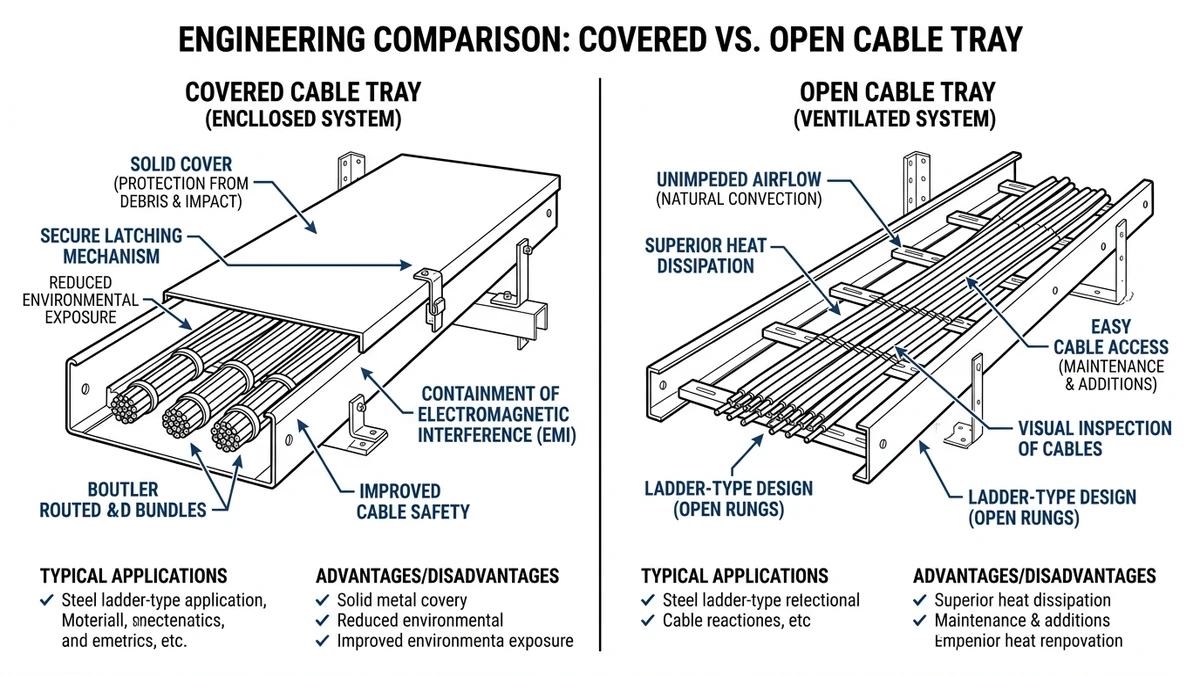
Figure 2. Comparison of covered and open cable tray arrangements highlighting inspection speed, cable tracing access, and retrofit labor implications.
Do Cable Tray Covers Change Ventilation and Cable Performance?
Yes. Cable tray covers reduce natural convection above the cable bundle, which can raise cable operating temperature and reduce usable ampacity. The effect depends on tray type, cable fill, load factor, cover geometry, ambient temperature, and solar exposure.
What changes thermally when a cover is added
A solid top cover usually creates the largest thermal penalty because it restricts buoyant airflow directly above the cables. Internal air temperature can rise by several °C to more than 10 °C, especially on wider trays—around 450 mm to 900 mm—with closely grouped multicore power cables and high fill ratios.
Mechanism → number → design consequence
Mechanism: reduced upward airflow and higher local air temperature around the cable bundle
Typical range: internal temperature rise of a few °C up to more than 10 °C in unfavorable conditions
Design consequence: reduced thermal margin, which may force lower fill, greater spacing, wider tray selection, or conductor upsizing
If tested data for the covered arrangement is not available, treat the cover as a derating condition and verify the cable ampacity accordingly.
Outdoor thermal penalty can be worse than indoor
On outdoor runs, a cover can add solar heat gain as well as restrict convection. Under summer ambient conditions around 40 °C, that combined effect can be more significant than the cover alone, so covered outdoor tray runs generally need a more conservative review than indoor runs.
What to do when thermal margin is tight
If a cover raises cable temperature, the normal response is redesign rather than assumption. Typical options are to reduce fill ratio, separate heavily loaded circuits, increase tray width, use ventilated covers, reduce solar gain, or increase conductor size where justified.
The key point is simple: a cable tray cover is a thermal design variable, not just a protection accessory.
Which Cable Tray Cover Types Fit Different Environments?
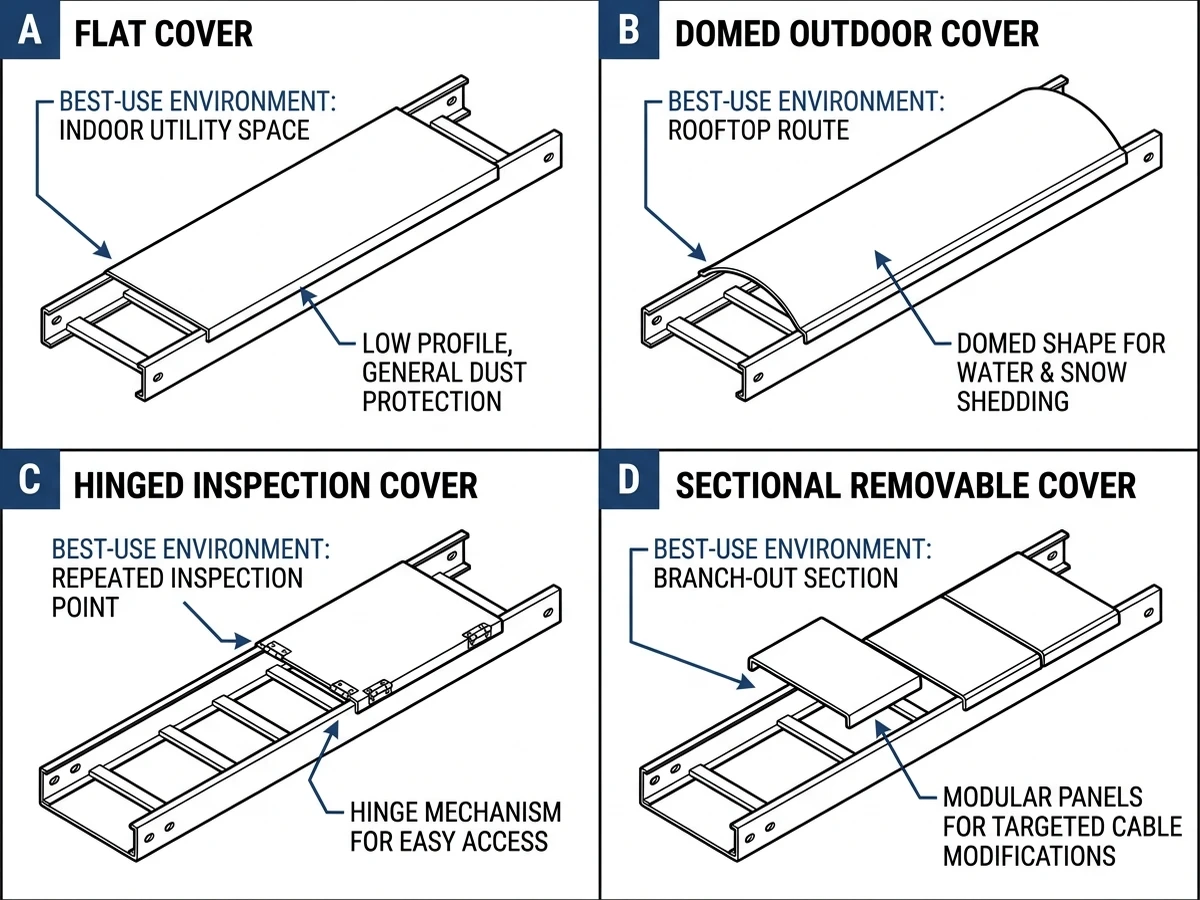
Cable tray cover selection should be based on ingress exposure, access frequency, and thermal penalty. The best choice is usually the one that controls the dominant hazard with the least impact on maintenance and cable performance.
Cover type comparison by environment
Cover type
Best-fit environment
Main advantage
Main limitation
Typical design note
Flat solid cover
Indoor dry areas, plant rooms, light dust
Simple geometry, good falling-debris protection
Slower access; higher thermal penalty than ventilated options
Common on 100 mm to 600 mm tray widths; review derating if fill exceeds 40%
Domed or peaked cover
Outdoor exposed runs, rooftops
Better rain shedding and stiffness; less water pooling
Higher profile and more wind area
Review uplift and clamp spacing on supports around 1.5 m to 3.0 m
Hinged cover
High-maintenance control and instrumentation routes
Fast re-entry and inspection
More hardware; hinge durability matters outdoors
Useful where access is monthly or quarterly
Latching or clamp-down cover
Outdoor industrial zones, vibration areas
Better retention under vibration and wind
Slower to remove than hinged types
Better where mechanical security matters more than access speed
Ventilated or perforated cover
Warm indoor spaces needing partial shielding
Less thermal buildup than solid covers
Limited dust and weather protection
Suitable where heat dissipation is tight and shielding needs are moderate
Non-metallic cover
Corrosive or chemically aggressive areas
Corrosion resistance and electrical isolation
UV aging and lower impact strength unless rated
Confirm temperature class and outdoor suitability above 50 °C ambient if exposed
Trade-off logic, not feature listing
A domed cover is better than a flat one only when runoff and stiffness matter enough to justify added wind area. A hinged cover is better only when repeated access saves enough labor to offset the higher cost and hardware complexity.
Use flat solid covers when overhead debris and light contamination are the main concerns on stable indoor routes.
Use domed covers when outdoor runoff matters and support design can absorb the higher uplift and profile.
Use hinged covers when maintenance access is part of normal operation.
Use ventilated covers when some shielding is needed but thermal margin is limited.
Avoid non-metallic covers when impact exposure or sustained UV is high unless the material is specifically rated.
Check before specifying whether fittings are available with matching cover geometry and fastening details.
[Expert Insight]
Many specification problems start at fittings, not on straight lengths.
Maintenance teams usually prefer fewer cover styles per route.
On exposed runs, retention details can matter more than cover thickness.
Figure 3. Typical cable tray cover forms matched to service conditions, including flat, domed, hinged, and sectional removable designs.
When Should Engineers Specify Covered Tray Routes and When Should They Leave Trays Open?
Engineers should specify covered tray routes when external exposure controls the design. They should leave trays open when heat dissipation, rapid inspection, or regular cable changes matter more.
Use covered routes when exposure is the governing risk
Specify covers where the system is exposed to falling debris, dust, dripping water, wind-blown contamination, or direct sunlight. If a tray is outdoors for more than 10 m to 20 m without shelter or another enclosure, the cover often becomes part of the environmental protection strategy, but dead load, uplift, fastening, and support reaction still need review.
Leave trays open when access or thermal margin governs
Open tray is usually the better choice for power circuits running near ampacity limit and for control or instrumentation routes with regular adds, moves, and changes. If the design has less than about 10% thermal margin, adding covers late can force conductor upsizing or route changes.
A simple route-level framework
Specify covered tray routes when:
debris, dust, splash, or UV is the dominant threat
inspection intervals are long, such as 12 months
the route is relatively stable after commissioning
cover mass, support loading, and thermal derating have been checked
Leave trays open when:
cable routing changes are expected during operations
heat dissipation is critical to cable performance
visual inspection must be fast and frequent
the environment is already clean, indoor, and controlled
Selective coverage often works best: outdoor sections covered, indoor electrical rooms open, and high-change instrumentation runs left accessible.
Applying These Trade-Offs to Cover Selection, Fittings Coordination, and Support Design
Cable tray covers should be specified as part of the full cable management system. Once selected, they change dead load, support span, ampacity review, and fittings continuity.
A solid steel cover can add roughly 3 kg/m to 8 kg/m on a 300 mm to 600 mm tray. Over support spans of 2.5 m to 3.0 m, that added mass can materially change hanger loading and deflection checks, and on exposed routes wind uplift may become another design constraint.
Support and restraint consequences
More mass and more exposed surface area increase reactions at supports and restraints. In practice, long outdoor straight runs often use cover fixing intervals around 1.0 m to 1.5 m, with extra restraint where wind uplift or vibration is credible.
If support spacing is still under review, this coordination should happen before procurement. A late cover addition can invalidate earlier assumptions, which is why tray support layout directly affects load path, deflection, and maintenance access.
Fittings coordination is where systems often fail
Specifications are often coherent on straight sections and inconsistent at fittings. If straights are covered but bends, reducers, tees, and risers are not detailed with matching covers and fastening method, the route loses protection continuity and becomes harder to maintain.
Before standardizing a cover type, verify compatibility with system fittings and connection details. The assembly has to work through direction changes, not just on catalog straight lengths.
Use when / avoid when / check before specifying
Use when:
– the route is exposed and stable
– contamination reduction has measurable maintenance value
– support loads and cable temperature have been reviewed
– fittings can be covered consistently
Avoid when:
– the tray carries frequently modified controls or instrumentation
– the route already operates close to cable thermal limit
– access at height will make routine opening disproportionately costly
Check before specifying:
– tray width, fill ratio, and expected cable additions
– support spacing and revised load calculations
– fastening method under wind or vibration
– fitting-by-fitting continuity
– whether an open tray, ladder, or alternative distribution path would coordinate better with the electrical design
For broader system planning, this is usually the point where specifiers compare cable tray system options, review route sizing with a practical tray dimension guide, and decide whether some high-current runs are better served by busway distribution for concentrated loads. If the route remains tray-based and needs exposed-run protection, the final decision should align cover type with tray geometry—for example, on ladder tray configurations used on outdoor power runs—so support, fittings, and maintenance procedures all stay coordinated.
The technical reason to involve the manufacturer is system validation: confirming cover compatibility at bends and risers, checking added load and deflection, and reviewing whether the covered configuration still meets the intended operating and maintenance conditions.
Frequently Asked Questions
Do cable tray covers make a tray waterproof?
Not typically. They can reduce direct rain and debris from above, but water can still enter through ends, joints, and fittings unless the full assembly is designed and tested for that exposure.
How do I choose between a solid cover and a ventilated cover?
Choose a solid cover when debris or contamination control matters more than heat dissipation. Choose a ventilated cover when some shielding is useful but cable temperature margin is limited.
Are hinged cable tray covers worth the extra cost?
They often are on routes that need repeated inspection, troubleshooting, or cable changes. Where access is rare, fixed covers may be more economical.
Do covered tray runs need different support design?
Often yes. Covers add weight and can increase wind exposure, so support spacing, hanger load, and retention details may need to be recalculated.
Can I use covers only on part of a cable tray route?
Yes, selective coverage is often the most balanced approach. It can protect exposed outdoor or dirty sections while preserving open access in clean indoor areas.
What should I check before adding covers late in a project?
Review cable temperature margin, support loading, fitting compatibility, and maintenance access first. Late changes can affect conductor sizing, support details, and installation labor.
Related video: Cable Tray Covers: Balancing Protection, Heat Dissipation, and Accessibility
Cable tray covers cluster: protection, access, heat, and installation links
Use this page as the canonical cover guide. It should connect cover selection to the installation/support hub, outdoor and material choices, and the thermal/access article.
Kevin Zheng is a manager linked to Shanghai Xinma Busway & Cable Tray Co., Ltd. He writes technical content on cable tray systems, installation practice, sizing logic, load classes, and related standards for industrial and infrastructure applications.