Video overview: key engineering checks before selecting this cable tray system.
Wire Mesh vs Perforated Cable Tray: Which Is Better for Light-Duty Routing?
For light-duty cable routing under 30 kg/m, wire mesh cable trays generally offer better airflow and faster installation, while perforated cable trays provide superior EMI shielding and a cleaner aesthetic. The right choice depends on your environment, cable type, and load requirements — not a universal rule.
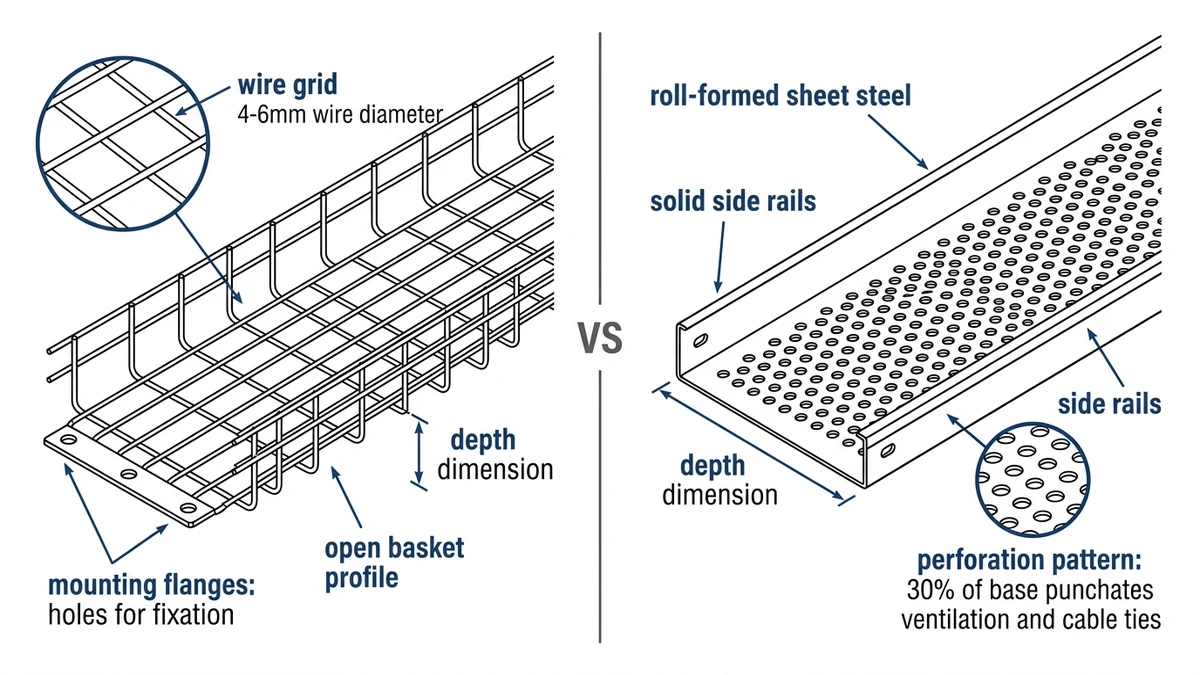
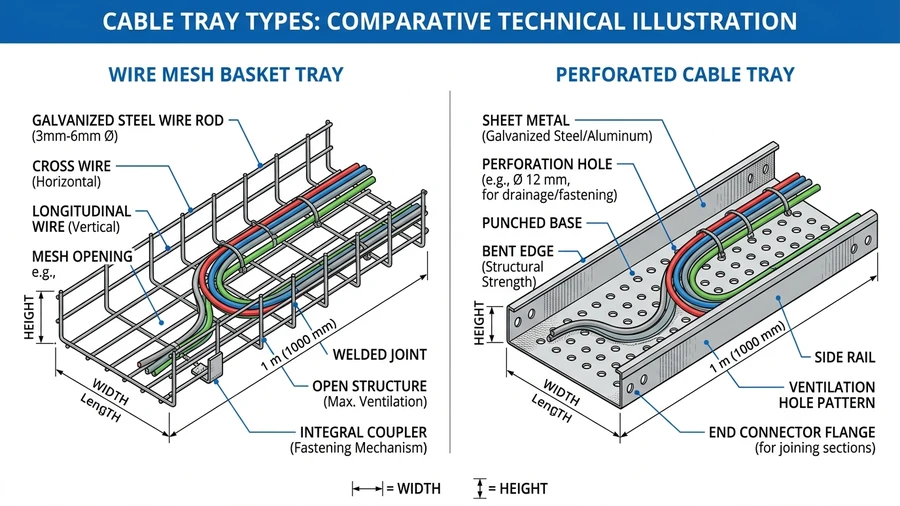
Figure 1. Structural anatomy of wire mesh tray (left) and perforated cable tray (right), showing wire grid diameter, perforation ratio, side rail height, and mounting flange detail under IEC 61537 dimensional requirements.
How Each Tray Type Is Built
Wire mesh trays (also called basket trays) are fabricated from welded steel wire grids, typically using 4–6 mm diameter wire at 50 × 100 mm grid spacing. That open lattice gives the tray an air void ratio of roughly 70–90%, which matters for heat-sensitive data cables and fiber runs. Cables sit in near-free-air conditions, and heat from current-carrying conductors dissipates through natural convection with minimal restriction.
Perforated cable trays use a continuous sheet base — usually 1.0–2.0 mm cold-rolled steel — punched with a regular hole pattern covering roughly 30–50% of the surface area. The solid base adds rigidity and provides a flat, stable bearing surface that reduces point-contact stress on cable jackets, particularly for larger-diameter power cables. It also creates a continuous grounding plane, which is why perforated trays are preferred in environments with EMI sensitivity.
Key Structural Difference
The core distinction is structural continuity. Wire mesh derives its stiffness from the three-dimensional rigidity of its welded grid. Perforated tray gets stiffness from its formed sheet profile and side rails. For light-duty routing — typically IEC 61537 Class A (50 kg/m) or Class B loads — both systems are structurally adequate. The decision shifts based on thermal management needs, installation environment, and how frequently cable routes will change.
The structural physics are straightforward: open grid = airflow + flexibility; solid base = rigidity + protection. Neither is universally superior — the routing environment makes the decision.
[Expert Insight]
– Wire mesh trays allow cable additions and reroutes without removing tray sections — a practical advantage in phased fit-outs where routes change during construction.
– Perforated tray’s solid base prevents small-diameter cables and flat ribbon cables from sagging through openings on spans longer than 2 m without intermediate support.
– In mixed-use installations, some engineers run perforated tray for power circuits and wire mesh for data runs in parallel — separating thermal and EMI concerns by tray type rather than by zone.
Heat Dissipation and Airflow Characteristics
Thermal management is often the deciding factor in enclosed or semi-enclosed spaces, and the two formats behave very differently under load.
Wire Mesh: Open Structure, Natural Convection
Wire mesh trays typically achieve 70–90% open area, placing cables in near-free-air conditions. In a 2023 server room retrofit in Guangzhou (approximately 400 m² floor area), wire mesh trays allowed engineers to maintain rated ampacity on 16 mm² data power cables without any derating factor, because airflow around the cable bundle remained unrestricted. This maps directly to IEC 60364-5-52, which governs cable current-carrying capacity and specifies derating factors by installation method — open tray installations generally require less derating than enclosed conduit.
Perforated trays typically offer 20–40% open area depending on hole pattern and sheet thickness. Cable bundles resting on the solid base experience reduced convective cooling on the underside. For signal cables or low-current control wiring below 5 A per conductor, this thermal difference is negligible. When perforated trays carry mixed loads — say, 24 V DC power alongside data cables — the reduced ventilation can raise ambient temperature within the bundle by 5–10°C compared to wire mesh under equivalent load conditions.
Practical Takeaway
For purely signal or low-current routing, both formats handle heat adequately. The gap opens when cable density increases or when the installation environment already runs warm. Above 35°C ambient, wire mesh’s open geometry provides a measurable thermal advantage that perforated tray cannot match without deliberate spacing between cable groups.
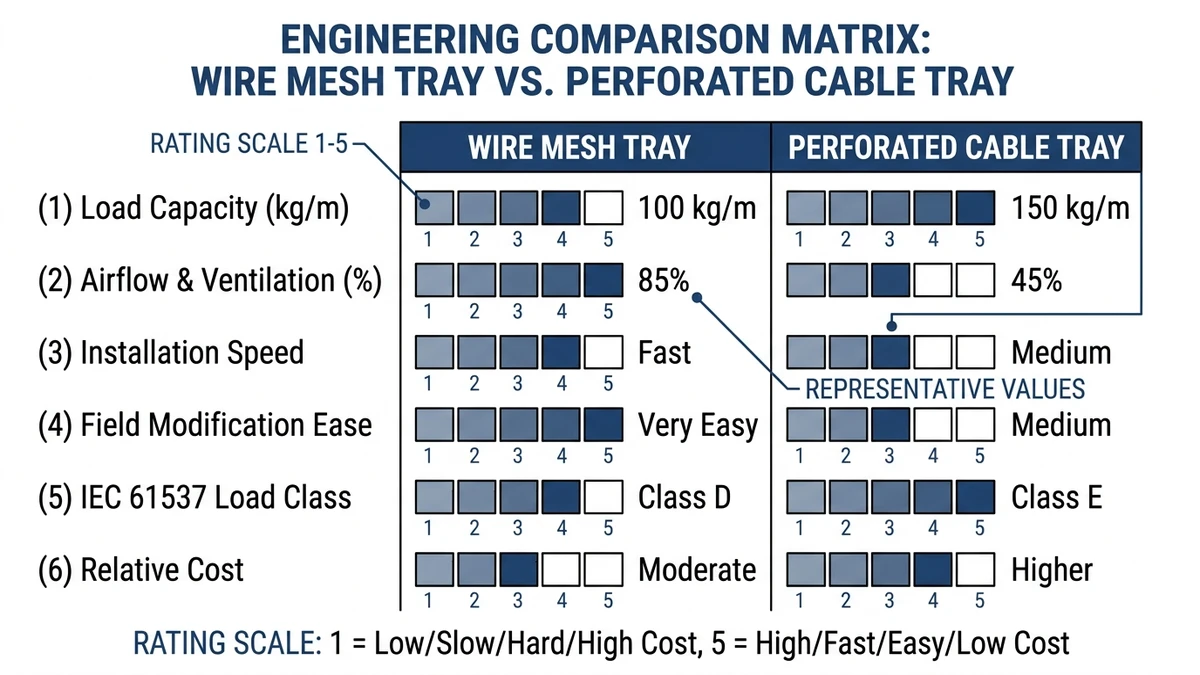
Figure 2. Comparative performance matrix for wire mesh and perforated cable tray across load capacity, airflow, installation speed, field flexibility, standards compliance, and cost — based on IEC 61537 load class criteria.
Weight and Load Capacity Compared
Understanding load differences helps you avoid over-engineering — or under-specifying — your cable management system.
Wire Mesh Tray Load Ratings
Wire mesh trays are typically rated for 15–30 kg/m under uniformly distributed load, depending on wire gauge and span. A standard 300 mm wide wire mesh tray in 4 mm wire diameter, spanning 1.5 m between supports, generally deflects less than 5 mm under a 20 kg/m load — well within acceptable limits for light-duty routing. The open lattice distributes load across multiple contact points, reducing stress concentration at any single wire junction.
In a 2023 commercial office fit-out in Guangzhou covering approximately 8,400 m² of structured cabling, wire mesh trays rated at 25 kg/m were used throughout the raised-floor IT zone. The installation team reported zero structural failures across 1,200 linear meters of tray, with average cable fill kept below 40% of tray cross-section — consistent with IEC 61537 guidance on thermal management and load distribution for light-duty systems.
Perforated Cable Tray Load Ratings
Perforated trays formed from 1.0–1.5 mm cold-rolled steel sheet carry 20–50 kg/m depending on perforation pattern and tray depth. A 100 mm deep perforated tray at 400 mm width spanning 2 m can typically carry 35 kg/m without exceeding a deflection ratio of L/200 — the threshold defined in IEC 61537 for cable tray systems under proof load conditions. The solid base also provides better support for flat or ribbon cables, which can sag between wire mesh openings on runs exceeding 2 m without intermediate support.
Side-by-Side Load Summary
Parameter
Wire Mesh Tray
Perforated Tray
Typical load rating
15–30 kg/m
20–50 kg/m
Governing standard
IEC 61537
IEC 61537
Deflection limit
L/200
L/200
Flat cable support
Moderate
Good
Recommended max span
1.5 m
2.0 m
For most light-duty data and signal cable runs, both tray types perform adequately. Where cable bundles approach the upper end of the load range — or where flat cables make up a significant portion of the fill — perforated tray offers a more conservative structural margin. If you’re still working out tray sizing, the cable tray size calculation guide covers fill ratio methods in detail.
[Expert Insight]
– IEC 61537 Class A covers 50 kg/m — most light-duty office and data cable runs sit well below this, meaning both tray types carry a comfortable safety margin in typical deployments.
– Deflection, not ultimate load, is usually the governing design criterion for light-duty trays. A tray that visibly sags creates cable strain at support points even if it hasn’t failed structurally.
– Wire mesh tray at 600 mm width typically deflects 6–9 mm under a 50 kg/m distributed load across a 3 m span; perforated tray of equivalent gauge deflects 4–7 mm under the same conditions due to its solid pan geometry providing greater section modulus.
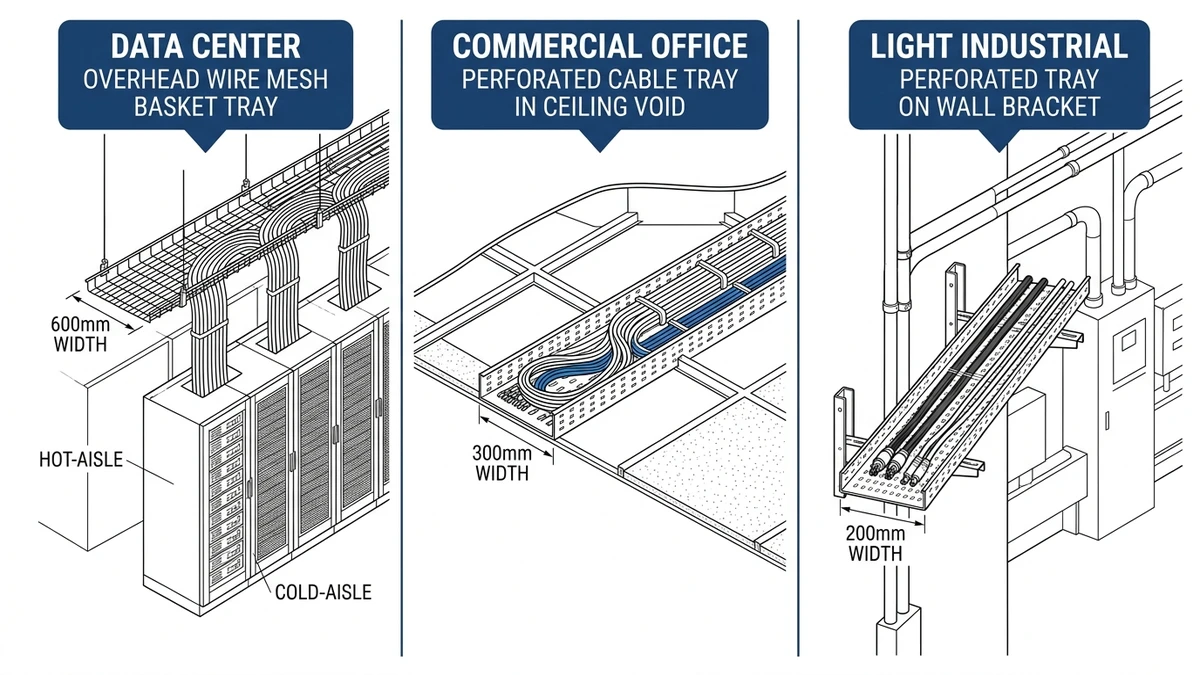
Figure 3. Recommended tray type by application scenario: wire mesh basket tray for data center overhead runs and office cable drops; perforated tray for light industrial control cable routes and building services risers.
Safety and Code Compliance
Both tray types must meet the same baseline safety requirements for light-duty routing, but they reach compliance through different structural and regulatory paths.
Grounding and Bonding Requirements
Continuous electrical continuity across the tray system is mandatory under NFPA 70 (NEC) Article 392, which governs cable tray installations in North America. Wire mesh tray achieves this through its welded grid intersections, typically maintaining contact resistance below 0.1 Ω across standard 3 m sections. Perforated tray relies on bolted splice connections, which can introduce resistance variation if hardware torque specs aren’t followed during installation.
In a 2023 light commercial fit-out in Toronto covering roughly 1,200 m of cable routing, the inspection team flagged 14 perforated tray splice joints that failed continuity checks due to undertorqued hardware — a rework that added two days to the schedule. Wire mesh’s welded grid avoids that failure mode entirely, which gives it a practical edge in installations where inspection access is limited after commissioning.
Fire and Environmental Ratings
Perforated tray’s enclosed base limits airflow, which can affect ampacity compliance in high-density runs. Wire mesh tray’s open geometry naturally supports ampacity without derating adjustments in most light-duty scenarios. For corrosive environments, both types are available in hot-dip galvanized or stainless steel finishes — the relevant protection class should be verified against IEC 60529 for the specific installation environment.
The compliance gap between the two types is narrow for light-duty routing. Grounding reliability and splice joint discipline give wire mesh a practical edge where post-commissioning access is limited. For installations requiring seismic restraint, seismic bracing systems add another compliance layer worth reviewing early in the design phase.
Total Cost of Ownership: Wire Mesh vs Perforated Cable Tray
Upfront material cost is only part of the picture. Total cost of ownership (TCO) covers procurement, installation labor, maintenance, and end-of-life handling — and the gap between the two systems can widen significantly over a 10–15 year service life.
Material and Procurement Cost
Wire mesh cable tray typically runs 15–30% lower in raw material cost per meter than perforated steel tray of equivalent load rating. The open wire geometry uses less steel per unit length, which directly drives that cost difference. In a 2023 light-duty office fit-out in Shenzhen covering 1,200 linear meters of cable routing, switching from perforated tray to wire mesh reduced material procurement costs by approximately 22%, saving around ¥18,000 on tray alone.
Perforated tray carries a higher base price but offers better resistance to mechanical damage in areas with foot traffic or equipment proximity, potentially reducing replacement frequency over time.
Installation Labor
Wire mesh tray installs faster. Its lighter weight — typically 1.2–2.5 kg/m for 100 mm wide sections versus 2.8–4.5 kg/m for equivalent perforated tray — means fewer workers needed for overhead runs and quicker bracket spacing adjustments. Labor savings of 10–20% are realistic on medium-scale projects. Perforated tray requires more precise cutting and edge finishing to avoid cable jacket damage, adding time per connection point.
For a closer look at how tray type affects installation sequencing and support spacing, the cable tray installation guide covers both systems in practical detail.
Maintenance and Inspection
Wire mesh offers full cable visibility without tray removal, reducing inspection time in dense fills. Perforated tray limits visual access to the slot openings, which can slow fault-finding when cable bundles are tightly packed.
End-of-Life and Sustainability
Both systems are recyclable steel, but wire mesh generates less scrap during installation due to simpler field cuts. For projects targeting LEED or BREEAM credits, this marginal material efficiency can contribute to waste reduction documentation.
Over a 10-year horizon, wire mesh generally delivers lower TCO for light-duty applications where load requirements stay under 30 kg/m. Perforated tray justifies its higher cost when mechanical protection or a cleaner aesthetic is a project requirement.
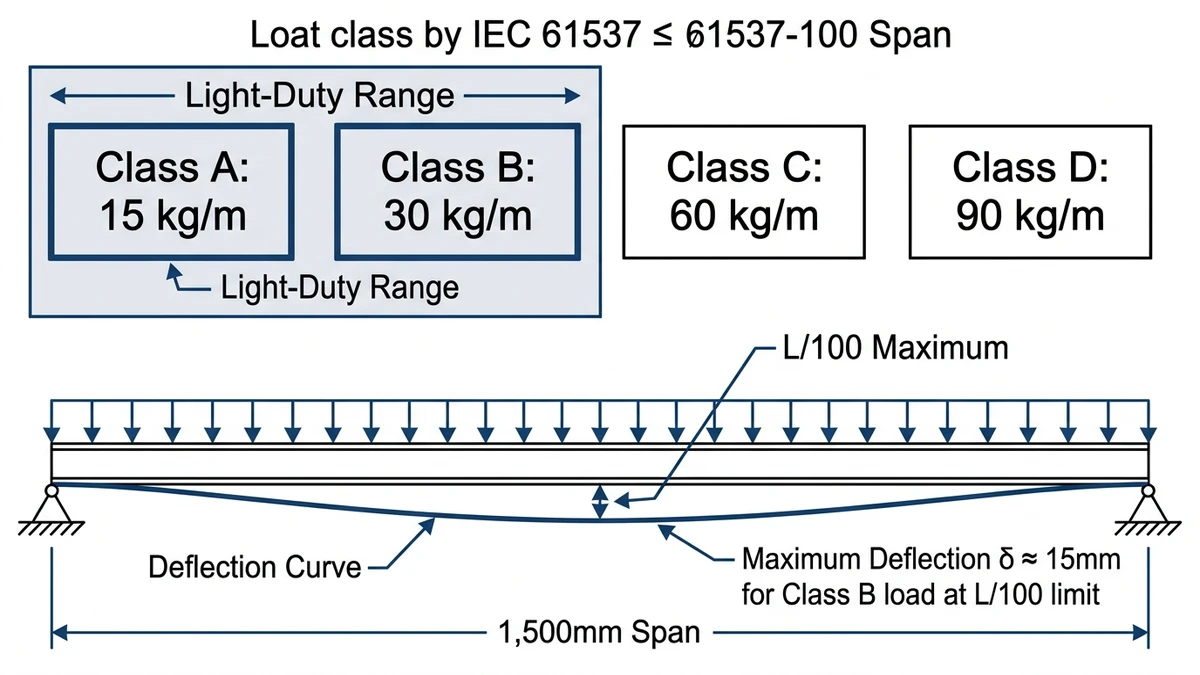
Figure 4. IEC 61537 Load Class A and B deflection behavior for wire mesh and perforated cable tray at 1,500 mm span, showing maximum allowable deflection of L/100 under uniformly distributed load conditions.
Choosing the Right Tray for Your Project
Neither tray type wins across every scenario. The decision comes down to a short list of site-specific factors.
Wire mesh is the better default for open office environments, data centers, and anywhere cable access and heat dissipation are priorities. Its lighter weight, lower material cost, and welded-grid grounding continuity make it the lower-friction choice for most light-duty structured cabling work. Explore the full range of wire basket and open-grid options to match your load class and finish requirements.
Perforated tray earns its place in light industrial settings, clean rooms, and anywhere a solid bottom prevents debris ingress, supports smaller-diameter cables, or where a flush aesthetic matters. The perforated cable tray range covers standard depths from 50 mm to 150 mm with multiple perforation patterns for different load and airflow requirements.
For projects that mix both environments — say, a data hall feeding into a light industrial support area — running wire mesh for data circuits and perforated tray for power circuits in parallel is a practical approach that separates thermal and EMI concerns by tray type rather than by zone. The cable tray systems overview covers how to combine tray types within a single installation.
If you’re specifying a cable management system for a data center, commercial building, or light industrial space, reach out with your project specs — span lengths, cable counts, environment classification — and we can help you work through the right tray type, fill ratio, and mounting configuration.
What is the main difference between wire mesh and perforated cable tray for light-duty routing?
Wire mesh tray uses an open welded grid that allows 70–90% airflow, making it well suited for data and signal cables where heat dissipation matters. Perforated tray uses a solid punched-sheet base that provides better mechanical protection and EMI containment, at the cost of reduced ventilation.
Which tray type handles heavier cable fills better in the light-duty range?
Perforated tray generally offers a more conservative structural margin at the upper end of the light-duty range, with typical ratings of 20–50 kg/m versus 15–30 kg/m for wire mesh. Both types are governed by IEC 61537, and both meet Class A load requirements when properly specified and supported.
Does wire mesh cable tray meet grounding and bonding requirements without additional hardware?
Wire mesh tray achieves electrical continuity through its welded grid intersections, typically maintaining contact resistance below 0.1 Ω across standard 3 m sections. This satisfies NFPA 70 Article 392 bonding requirements in most North American installations without supplemental bonding jumpers, though local inspection authority requirements should always be confirmed.
When should I choose perforated cable tray over wire mesh in a commercial building?
Perforated tray is worth specifying when the installation involves flat or ribbon cables prone to sagging through open grids, when the environment requires debris exclusion (clean rooms, food processing areas), or when a flush aesthetic is required for exposed ceiling installations.
How does cable fill ratio affect tray selection between the two types?
Both tray types perform well at fill ratios below 40% of tray cross-section, which is the generally recommended threshold for thermal management and future cable additions. Above 40% fill, wire mesh’s open geometry provides a more meaningful ventilation advantage, while perforated tray may require deliberate cable spacing to manage heat buildup.
Are wire mesh and perforated cable trays compatible with the same fittings and accessories?
They use different fitting systems — wire mesh trays typically use clip-on or snap-fit accessories designed for round wire profiles, while perforated trays use bolted fittings designed for sheet edges. Mixing tray types in a single run requires transition fittings, and it’s worth confirming fitting compatibility before finalizing the tray layout.
Which tray type typically costs less over a 10-year service life for light-duty applications?
Wire mesh generally delivers lower total cost of ownership for light-duty applications where loads stay under 30 kg/m, primarily because of lower material cost per meter and faster installation labor. Perforated tray can offset its higher upfront cost through reduced replacement frequency in areas exposed to mechanical impact or foot traffic.
Kevin Zheng
Kevin Zheng is a manager linked to Shanghai Xinma Busway & Cable Tray Co., Ltd. He writes technical content on cable tray systems, installation practice, sizing logic, load classes, and related standards for industrial and infrastructure applications.