Address
304 North Cardinal St.
Dorchester Center, MA 02124
Work Hours
Monday to Friday: 7AM - 7PM
Weekend: 10AM - 5PM

Address
304 North Cardinal St.
Dorchester Center, MA 02124
Work Hours
Monday to Friday: 7AM - 7PM
Weekend: 10AM - 5PM

Get premium quality cable management systems directly from the manufacturer.
Fill out the form below to receive our catalog and pricing.

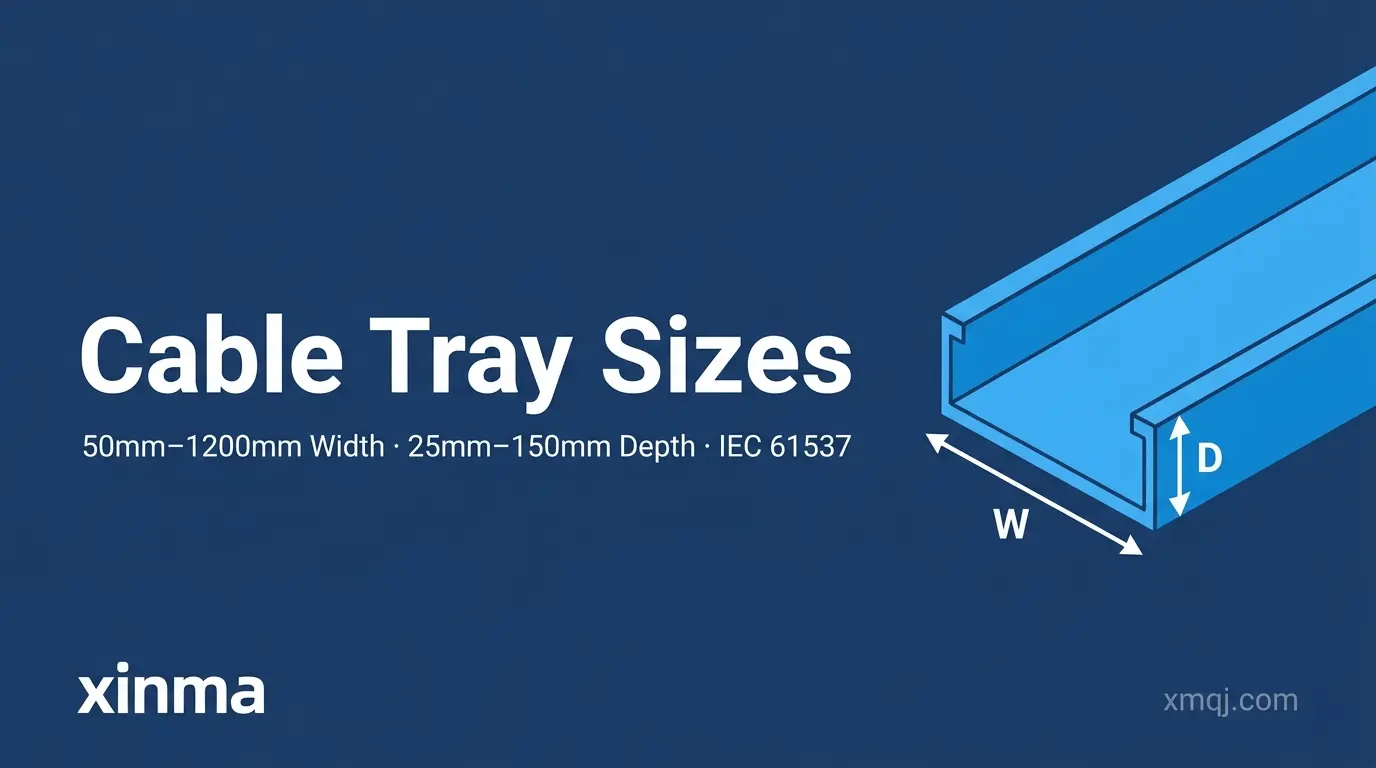
Cable tray sizes are defined by three primary dimensions — width, depth, and length — and selecting the correct combination determines whether a cable management system meets load, fill, and code requirements. Standard widths typically range from 50 mm to 900 mm, usable depths from 50 mm to 150 mm, and sections are most commonly supplied in 3 m lengths. Get these dimensions right at the design stage, and the rest of the installation follows logically. Get them wrong, and the rework cost can dwarf the original material savings.
When engineers refer to cable tray size, they mean the internal usable space available for cable fill — not the outer structural envelope. A tray labeled 300 mm wide may have an actual internal width of 285–295 mm after accounting for rail thickness. This distinction matters because cable fill calculations under IEC 61537 — the international standard governing cable tray and cable ladder systems — are based on usable cross-sectional area, not nominal dimensions.
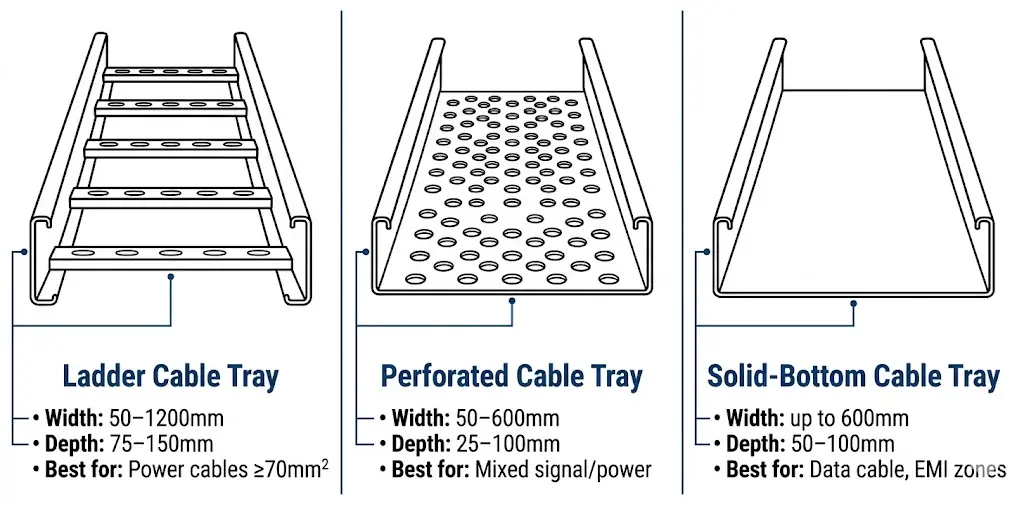
Depth, sometimes called channel height or side rail height, controls how many cable layers can be stacked and directly affects load capacity. A ladder tray with a 100 mm depth typically supports a working load of 50–75 kg/m at a 3 m span; a 150 mm deep tray of the same width can carry 100–150 kg/m under equivalent conditions. That difference becomes critical in industrial riser shafts or power distribution corridors.
In a 2023 pharmaceutical plant project in Suzhou (approximately 18,000 m² of production area), undersized trays — originally specified at 200 mm wide — required a full retrofit to 400 mm when medium-voltage instrument cables were added mid-project. The rework cost exceeded ¥320,000 and delayed commissioning by 11 days. Correct initial sizing, referencing both the current cable inventory and the 20–30% expansion reserve recommended by NEMA VE 1 (the North American standard for metallic cable tray systems), would have eliminated the change order entirely.
Understanding cable tray sizes at the outset prevents fill ratio violations, structural overload, and costly rework — making this foundational knowledge essential before evaluating any specific product or installation method.
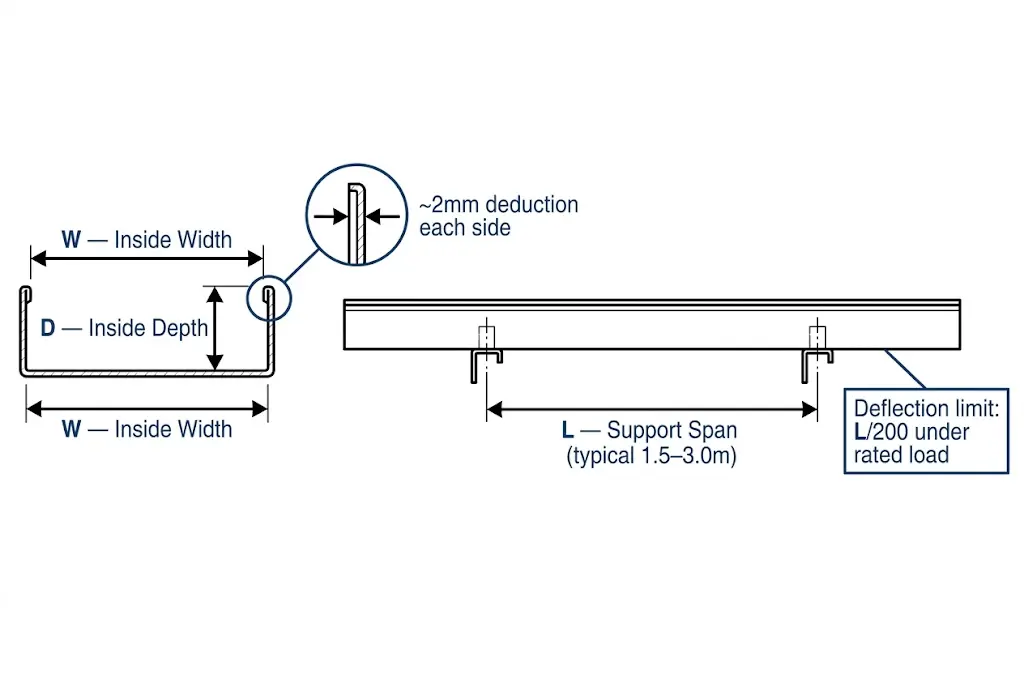
Cable tray size is described by three dimensions: width (interior space between side rails), depth (side rail height governing vertical fill), and length (standard 3 m sections, with 6 m available for unobstructed runs). Width controls how many cables can be laid side by side; depth controls how many layers can be stacked; length determines splice and support spacing. Manufacturers publish nominal dimensions, but usable interior dimensions are slightly smaller — typically 2–4 mm less per side for steel trays — because rail thickness consumes part of the labeled figure.
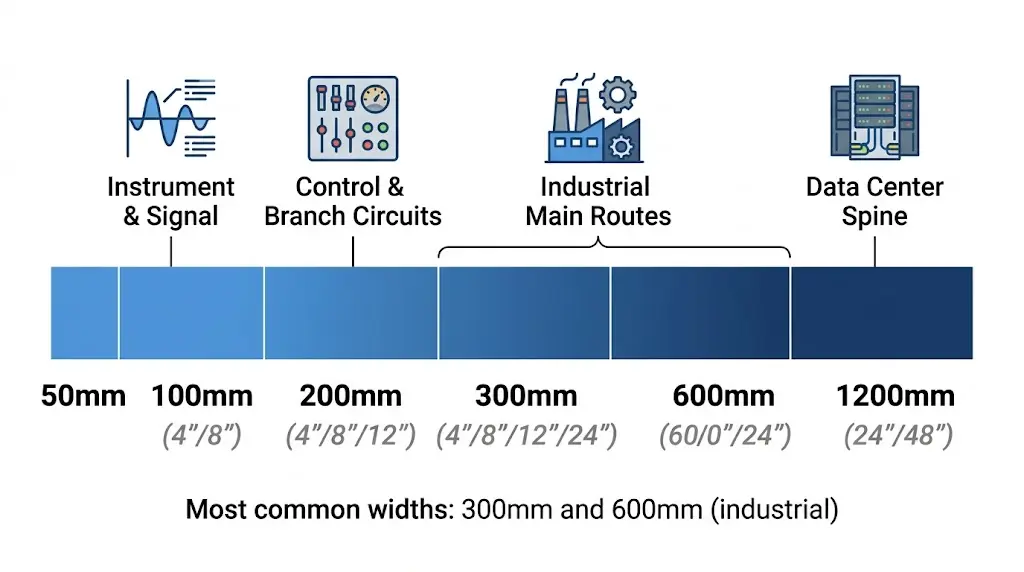
Width is the most critical sizing parameter because it directly limits cable fill capacity. Standard widths under NEMA VE 1 and IEC 61537 run from 50 mm (2 in) for small instrument cable routes up to 900 mm (36 in) for high-density power distribution. The most commonly specified widths in commercial and industrial projects are 150 mm, 300 mm, 450 mm, and 600 mm.
In a 2023 petrochemical expansion project in Shandong covering 12 process units, the engineering team standardized on 600 mm-wide ladder trays for main cable highways. That single decision reduced the number of parallel tray runs by 40% compared to the previous 300 mm configuration — a meaningful reduction in both structural steel and installation labor.
Depth governs stacking layers and structural load class. Shallow trays at 25 mm suit single-layer instrument or data cable routing. Medium depths of 75–100 mm accommodate multi-layer power cable arrangements with adequate separation. Deep trays at 150 mm handle thermal derating management — stacking cables beyond the fill limit in a shallow tray raises conductor operating temperature and reduces ampacity per NEC 310 or IEC 60364-5-52.
When calculating cable fill ratios per IEC 61537 Clause 6, engineers must use actual interior width, not the nominal figure. A nominally 300 mm wide tray typically yields only 292–296 mm of usable fill width after rail material is accounted for. Small difference on paper; meaningful difference when fill calculations are tight.
[Expert Insight]
- IEC 61537 Clause 6 fill calculations reference usable interior area — always request the manufacturer’s internal dimension sheet, not just the catalog nominal size.
- In projects with multiple tray widths, standardizing on two or three widths (e.g., 300 mm, 450 mm, 600 mm) reduces procurement SKUs and simplifies site logistics significantly.
- Steel rail thickness varies by load class: light-duty trays may use 1.5 mm stock, while Class C and D trays typically run 2–3 mm — a difference that affects both usable width and tray self-weight per meter.
- Confirm 6 m section availability early; not all manufacturers stock them in every width and finish combination.
Tray depth — the interior vertical dimension of the sidewall — governs three things simultaneously: how many cable layers fit, how efficiently heat escapes from the bundle, and whether ampacity derating applies. Standard depths run from 50 mm (2 in) for shallow wire management up to 150 mm (6 in) for heavy-duty power routing, with 75 mm and 100 mm covering the majority of commercial and industrial installations.
The relationship between depth and ampacity derating is non-linear. When cables are stacked in multiple layers inside a 150 mm deep tray, the bottom layers experience reduced airflow, raising conductor temperature and forcing engineers to apply derating multipliers under NEC 310.15(B)(3)(a) [VERIFY STANDARD: confirm current NEC clause for cable fill derating in cable trays] or IEC 60364-5-52, which governs wiring system installation methods and current-carrying capacity.
In a 2023 semiconductor fab fit-out in Suzhou (approximately 8,000 m² cable tray network), the project team switched from the initially planned 150 mm deep ladder trays to 100 mm deep trays for medium-voltage control cables. That single change improved natural convection enough to eliminate a 0.78 derating factor, reducing the required cable cross-section from 16 mm² to 10 mm² on 24 V DC distribution runs and cutting cable material cost by roughly 22%.
Shallow trays at 50 mm suit single-layer data and signal cable routing where thermal performance is less critical and the priority is a compact installation profile above suspended ceilings.
Medium trays at 75–100 mm cover the majority of general power distribution scenarios. A 100 mm deep, 400 mm wide ladder tray complying with IEC 61537 Class B loading (100 kg/m) typically accommodates 12–18 runs of 35 mm² power cable in a two-layer arrangement without triggering fill-ratio derating. Most projects never need to go deeper than this.
Deep trays at 150 mm are reserved for main distribution feeders and riser shafts where large-diameter cables — 95 mm² or above — must be routed in quantity. At this depth, mechanical support for cable weight becomes the governing design factor, often requiring support spacing reduced from the standard 1,500 mm interval down to 900 mm to control midspan deflection.
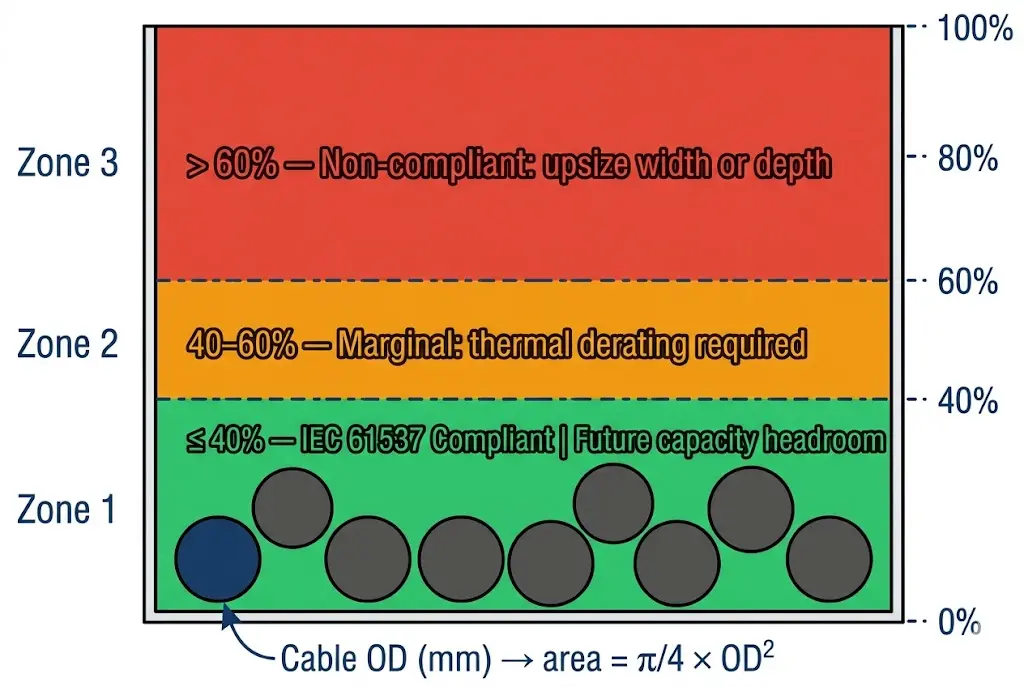
Fill ratio and depth interact directly. IEC 61537 recommends a maximum fill ratio of 40% for power cables to preserve adequate air circulation between conductors. In a tray with 100 mm depth and 300 mm width, the usable cross-section is 30,000 mm²; at 40% fill, up to 12,000 mm² of cable cross-section can be routed before derating becomes mandatory.
Stacking cables beyond two layers in a deep tray raises the effective thermal resistance of the bundle. When three or more layers are present, current-carrying capacity can derate by 15–30% depending on conductor size and insulation type — a range confirmed by IEC 60364-5-52 grouping tables. For medium-voltage feeders or VFD output cables that generate significant I²R losses, maintaining single-layer routing in a 100 mm to 150 mm deep tray avoids derating entirely and simplifies the cable sizing calculation.
As a practical rule, each additional cable layer beyond the first introduces a derating factor typically between 0.70 and 0.85× of the single-layer rated ampacity, depending on cable type and ambient temperature. For example, a 35 mm² XLPE power cable rated at 175 A in open air may be derated to ≤130 A when installed in a third-layer stack inside a 100 mm deep tray without ventilation above.
[Expert Insight]
- Limiting stack height to two layers in a 100 mm deep tray is a reliable field rule that keeps fill ratios, thermal derating, and support spacing all within standard parameters simultaneously.
- In riser shafts, cable self-weight becomes significant over vertical runs exceeding 10 m — specify tray depth with load class verified against the full cable weight per linear meter, not just horizontal span tables.
- A switch from 150 mm to 100 mm depth on medium-voltage control cable runs — as demonstrated in the Suzhou fab project — can eliminate a derating factor entirely, allowing a smaller cable cross-section and reducing both material cost and conduit fill weight.
Selecting the correct cable tray size combines fill ratio calculations, load class requirements, and spatial constraints into a single decision sequence. Undersized trays cause overheating and code violations; oversized trays waste material budget and ceiling space. The three-step framework below eliminates guesswork.
Start with the total cross-sectional area of all cables you intend to route. Under NEMA VE 1, the recommended fill ratio is 40% of the usable interior cross-section for power cables, and up to 50% for control or signal cables in dedicated trays.
Apply it directly: sum the cross-sectional area (mm²) of every cable, then divide by 0.40 to get the minimum required tray interior area. A bundle with a combined fill area of 12,000 mm² requires a tray interior of at least 30,000 mm² — met by a 300 mm wide × 100 mm deep ladder tray (interior area ≈ 30,000 mm²). For a run of twelve 35 mm² power cables (each with an approximately 18 mm OD), the minimum single-layer width calculates to roughly 250 mm, making a standard 300 mm tray the appropriate selection with margin intact.
Tray width determines lateral cable arrangement and segregation. Standard widths map directly to common grouping strategies:
Avoid mixing power and data cables in the same tray without a divider — NEC Article 392 restricts co-routing of conductors operating at different voltage levels unless physical separation is maintained. In practice, a 600 mm wide tray divided with a 2 mm galvanized steel strip creates two 300 mm channels: one for power, one for instrumentation.
Depth governs both fill volume and structural performance. IEC 61537 classifies cable tray systems by load capacity from Class A (50 kg/m) through Class D (200 kg/m), tested at a reference span of 3 m. A 100 mm deep hot-dip galvanized steel ladder tray at 600 mm width generally achieves Class C (100 kg/m) — sufficient for most medium-density industrial cable routing.
Verify the tray’s rated load capacity against its actual support span. A steel ladder tray rated at 75 kg/m at 3 m will deflect significantly more if supports are spaced at 4.5 m. Aluminum trays, being lighter but more flexible, generally require supports no farther than 1,500 mm apart under equivalent loads to stay within the L/200 deflection limit defined by IEC 61537 Class C.
In a 2023 petrochemical plant expansion in Shandong province (12 process units, 85 km of cable), engineering teams standardized on 450 mm wide × 100 mm deep ladder trays for main cable runs. That single-size standardization reduced procurement SKUs by 60% and cut installation time by an estimated 22% compared to the previous mixed-tray specification.
Reserve 25–30% of tray cross-sectional area for future cable additions. A 400 mm wide tray specified with 30% spare capacity at commissioning typically avoids a full tray replacement within the first 10-year asset lifecycle — a replacement that costs 3–5× the original material difference between 400 mm and 300 mm tray. In a 2023 pharmaceutical manufacturing facility in Jiangsu Province (12,000 m² production floor), correctly specifying tray widths and fill ratios at the design stage reduced cable installation rework by 28% and cut support steel costs by approximately ¥140,000 compared to the over-engineered initial layout.
For projects involving non-standard spans, seismic zone requirements, or cable fill density above 40%, a structured tray sizing review against actual cable schedules — rather than rule-of-thumb width selection — consistently prevents the specification errors that surface at commissioning.
Industrial cable tray installations typically use widths between 150 mm and 600 mm, with depths of 75 mm or 100 mm covering most applications. Main distribution highways in heavy industrial facilities — petrochemical plants, power stations, semiconductor fabs — often step up to 600 mm width and 150 mm depth to accommodate large cable populations and maintain adequate fill ratios.
Sum the cross-sectional areas of all cables in the run, then divide by the applicable fill ratio — 0.40 for power cables under NEMA VE 1, or 0.50 for dedicated control or signal trays — to find the minimum required tray interior area. From that area, select the standard width and depth combination whose product meets or exceeds the calculated minimum, leaving additional margin for future additions.
A working target of 40% of the usable interior cross-section is widely applied for power cables, balancing thermal performance with space for future circuits. IEC 61537 and NEMA VE 1 both support this threshold as a practical design limit rather than an absolute maximum, meaning project-specific thermal analysis may permit slightly higher ratios in well-ventilated ladder tray configurations.
Ampacity derating applies when cables are stacked beyond a single layer in a way that traps heat in the lower layers. Each additional layer beyond the first typically introduces a derating factor in the range of 0.70–0.85× of the single-layer rated ampacity, with the exact value depending on conductor size, insulation type, and ambient temperature. Referencing IEC 60364-5-52 grouping correction factors — or NEC 310.15 for North American projects — at the cable sizing stage prevents undersized conductors from reaching installation.
Support spacing depends on tray material, width, depth, and the load class being achieved. Steel ladder trays at 600 mm width are commonly supported at 1,500 mm to 3,000 mm intervals; aluminum trays of equivalent width generally require supports at 1,500 mm or less under the same cable load to stay within the L/200 midspan deflection limit referenced in IEC 61537. Manufacturer span-load tables provide the definitive values for each tray series and load class.
Mixed routing is physically possible but subject to national wiring regulations that typically require a minimum separation — often achieved with a solid metal divider strip — between conductors at different voltage levels. A 600 mm wide tray divided into two 300 mm channels is a common practical solution in industrial motor control center environments, keeping power and instrumentation cables in the same tray run while satisfying segregation requirements.
Reserving 25–30% of usable tray cross-sectional area at commissioning is a widely accepted industry practice, reflecting the reality that cable schedules grow during a facility’s operational life. This spare capacity allowance, combined with a correctly specified tray width from the outset, typically avoids a full tray replacement within the first decade of operation — a retrofit that involves new supports, revised load calculations, and re-termination of already-installed cables.
