Cable tray clips are small retention components used in cable management systems to secure covers, dividers, bonding parts, accessories, or, in some cases, cables to a cable tray or cable ladder. They do not usually carry the primary tray load. Their job is local restraint: controlling vibration, uplift, movement, continuity, and access reliability across support spans that are often 1.5 m to 3.0 m, which matters when checking system performance under IEC 61537 and NEMA-style installation practice.
A clip looks minor on a drawing, but in service it often determines whether a route stays quiet, bonded, accessible, and intact after thermal cycling and repeated maintenance.
Video overview: key engineering checks before selecting this cable tray system.
What Types of Cable Tray Clips Are Used in Practice?
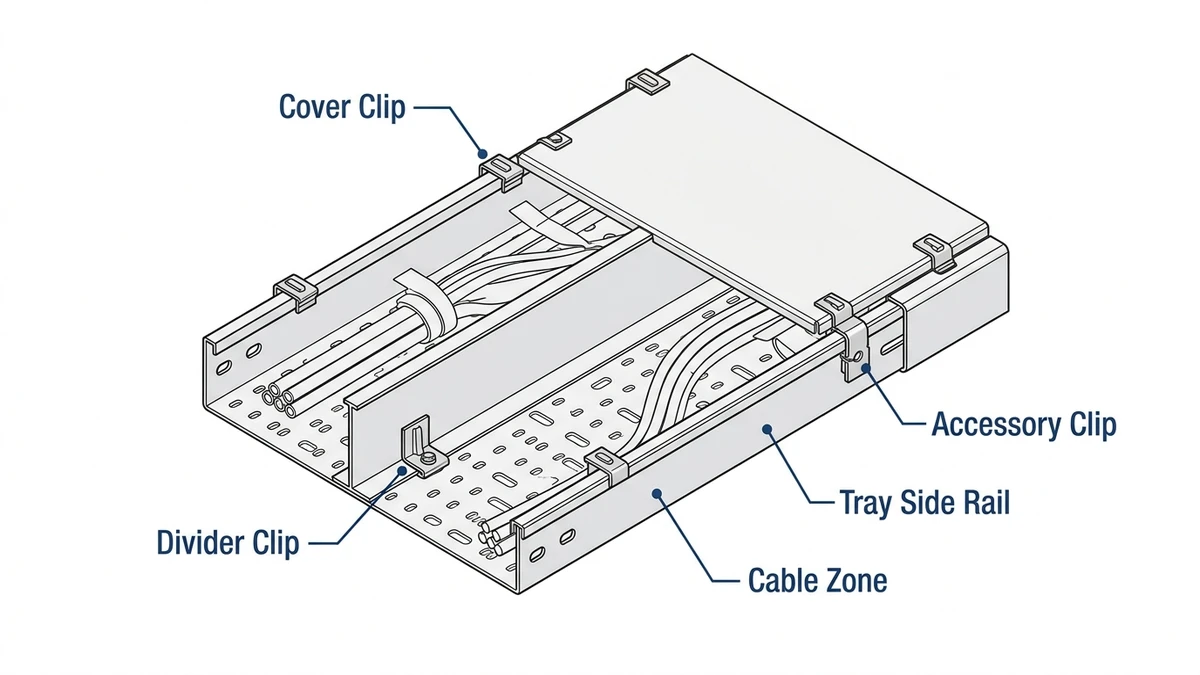
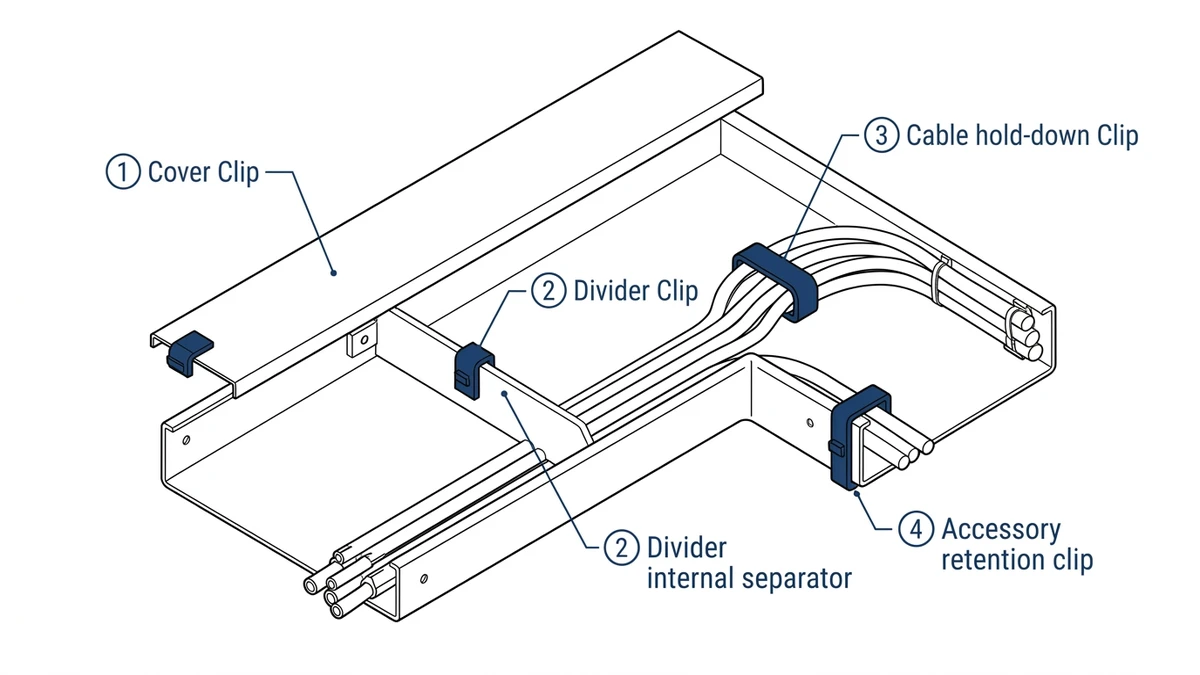
Clip selection should start with function, not shape. In most projects, cable tray clips fall into five working categories—retaining clips, joining clips, cover clips, bonding clips, and divider or accessory clips—and each addresses a different failure mode.
Retaining clips for cable restraint
Retaining clips hold cables where movement is expected, such as vertical runs, side-mounted trays, and vibration-prone industrial routes. Typical spacing is about 300 mm to 600 mm, depending on cable size, orientation, and expected movement.
Use them when cable displacement could damage sheaths or alter separation, but do not treat them as structural supports. The key checks are cable diameter range, release method, spacing on risers, and whether the clip edge can mark softer jackets.
Joining clips for tray section connection
Joining clips connect tray lengths or fittings where the manufacturer uses a clip-based connector instead of, or alongside, bolted splice details. Their function is usually alignment and local continuity, not automatically full structural transfer.
If the connector is only positional, bending load still has to be controlled by support location and joint detailing. Before specifying, confirm whether the connector is load-rated, how it behaves at fittings, and whether it contributes to electrical continuity.
Cover clips for environmental protection
Cover clips hold tray covers against uplift, vibration, and accidental displacement, especially on outdoor routes, roof runs, and machinery areas. Their main job is to stop repeated micro-movement from loosening the cover edge over time.
Higher retention force improves security but slows access during inspection and cable changes. For example, a 600 mm-wide outdoor ladder tray may be structurally sound yet still suffer cover rattle or local uplift if clips are missing or weak.
Bonding and grounding clips
Bonding clips are used where the metallic cable routing system contributes to protective bonding or continuity across tray sections and covers. Here the critical issue is contact resistance across the assembled system, not just the clip itself.
If continuity depends on a clip biting through coatings, finish thickness, corrosion, oxide formation, and installation torque all affect long-term performance. IEC 61537 treats cable tray and ladder systems as assemblies, so continuity should be reviewed at system level using the IEC 61537 publication page as the primary standards reference.
Edge, divider, and accessory clips
These clips secure dividers, edge protection strips, and light accessories in wire basket, perforated, or ventilated tray systems. Their main role is segregation, abrasion control, and route organization.
They matter where power and control separation affects EMC or maintenance, but they should not be treated as cable-restraint hardware in vibration-prone or vertical conditions. The practical rule is to choose the clip by the failure mode being prevented—movement, separation, uplift, continuity, or segregation.
[Expert Insight]
On vertical industrial runs, the clip that tests well in the catalog is not always the one crews want to maintain. Release time matters once the route starts changing.
Small retention points often fail before the tray side rail does. In inspections, corrosion or looseness usually appears first at clips, cover edges, and mixed-metal interfaces.
Where bonding matters, specify the continuity method as part of the tray assembly, not as an installer assumption.
Figure 1. Functional map of cable tray clips, separating cover retention, divider fixing, cable restraint, and accessory attachment roles.
Why Do Cable Tray Clips Matter During Installation and Maintenance?
Cable tray clips matter because they preserve system geometry and serviceability under real operating conditions. A failed clip usually does not collapse a tray; it more often loosens a cover, shifts a divider, breaks continuity, creates noise, or slows every maintenance visit.
Installation consequences in field conditions
During installation, the main issue is local force concentration. If clip spacing is too wide, covers and accessories can lift under wind, airflow, vibration, or cable pulling; pulling forces around 200 N to 500 N can also shift unsecured dividers and drop-out accessories.
Over-tightening creates another risk by damaging zinc or polymer coatings and exposing base metal. In damp or coastal environments, that small damage often becomes the first corrosion site even while the tray body remains sound.
Maintenance consequences in service
Maintenance teams usually notice clip problems first because missing or loose clips delay access, create nuisance noise, and force covers or fittings to be re-seated before inspection. On plant routes, cover chatter during startup is often traced to retention hardware rather than tray span resonance.
Exposure also changes long-term performance. On routes cycling between about 5 °C and 45 °C, clips may seize, lose spring force, or corrode at mixed-metal interfaces if compatibility was not checked.
Design consequences for specifiers
The design lesson is not simply to add more clips. It is to place the right clip, at the right spacing, in the right environment.
Tighter spacing helps where vibration or vertical cable movement dominates, while corrosion-resistant and removable designs matter where inspection frequency is high. Bad clip choices usually show up later as slower access, repeated callouts, and accessory failures at the easiest points to service.
[Expert Insight]
Testing and field observation often point to the same weak spot: the edge condition. Covers stay secure longer when clip geometry spreads force over the flange rather than biting at one narrow point.
Maintenance teams typically prefer a clip that is slightly slower to install but repeatable to remove, especially on high-change tray routes above panels or skids.
If a route is noisy after startup, inspect local cover retention before assuming support-span resonance.
Cable Tray Clips vs Clamps, Fasteners, and Supports
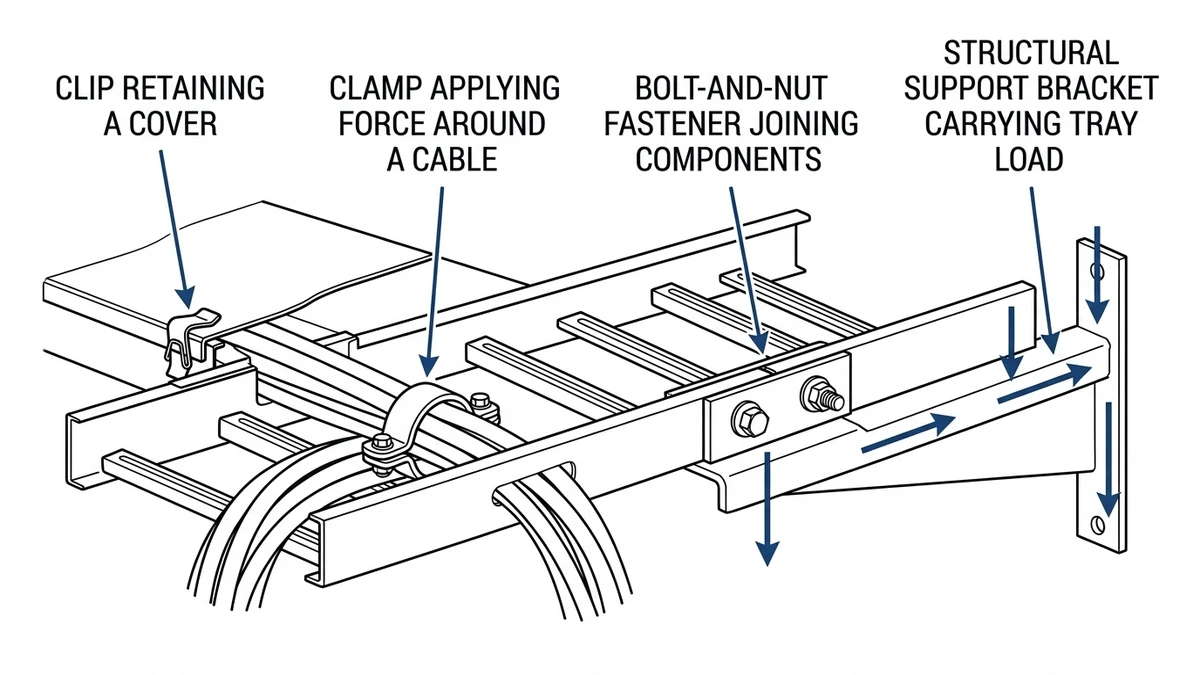
Cable tray clips are often confused with clamps, general fasteners, and supports, but they are not interchangeable. The engineering distinction is the load path: clips provide local retention, while supports carry span loads, fasteners transfer joint loads, and clamps grip by compression.
Comparison by function and load path
Component
Primary function
Typical load resisted
What it connects
Design consequence
Cable tray clip
Retains covers, dividers, accessories, or local hold-down parts
Light local shear, vibration, uplift; generally not primary span load
Tray rail, cover edge, divider, accessory bracket
Select for fit, vibration resistance, corrosion class, and maintenance access
Clamp
Grips an item by compression
Pullout resistance, local holding force, sometimes cable restraint
Cable bundle, conduit, flange, pipe, or edge
Check grip range in mm and jacket damage risk
Fastener
Creates a bolted, screwed, or riveted joint
Tension and shear at the joint
Splice plates, brackets, clips, supports
Joint performance depends on fastener grade, hole tolerance, and torque
Support
Carries dead load, cable live load, and environmental action
Bending, shear, anchor load, seismic or wind effects
Hangers, cantilevers, trapezes, wall brackets
Governs span, deflection, and anchor design
Why the distinction matters in design
Many specification errors come from blurring these roles. A clip may stop a cover from lifting, but it does not replace a structural splice, support arm, or hanger rod carrying 50 kg/m to 100 kg/m of tray load.
On an outdoor ladder tray with covers, clip selection addresses retention and access, splice fasteners address joint transfer, and supports address tray mass, cable mass, span, and deflection. Mixing those functions leads to loose accessories or overstressed joints.
Use when, avoid when, check before specifying
Use clips for accessory retention, cover security, divider attachment, and local restraint. Use clamps when controlled compression is needed over a defined range, often about 10 mm to 40 mm; use fasteners when the joint must transfer repeatable tension or shear; use supports when the real issue is span, anchor pullout, deflection, seismic restraint, or total loading.
Avoid asking clips to solve structural problems. Before specifying, confirm which part carries the load, which part only retains accessories, and whether the manufacturer’s tested assembly reflects that distinction.
Figure 2. Comparison of local retention hardware versus structural support elements on a single cable tray route.
How Should Engineers Select Cable Tray Clips for Material, Corrosion, and Compatibility?
Cable tray clips should be specified as part of the cable management system, not treated as generic hardware. Good selection follows a simple sequence: mechanism, environment, compatibility, then maintenance consequence.
Match clip material to tray material and environment
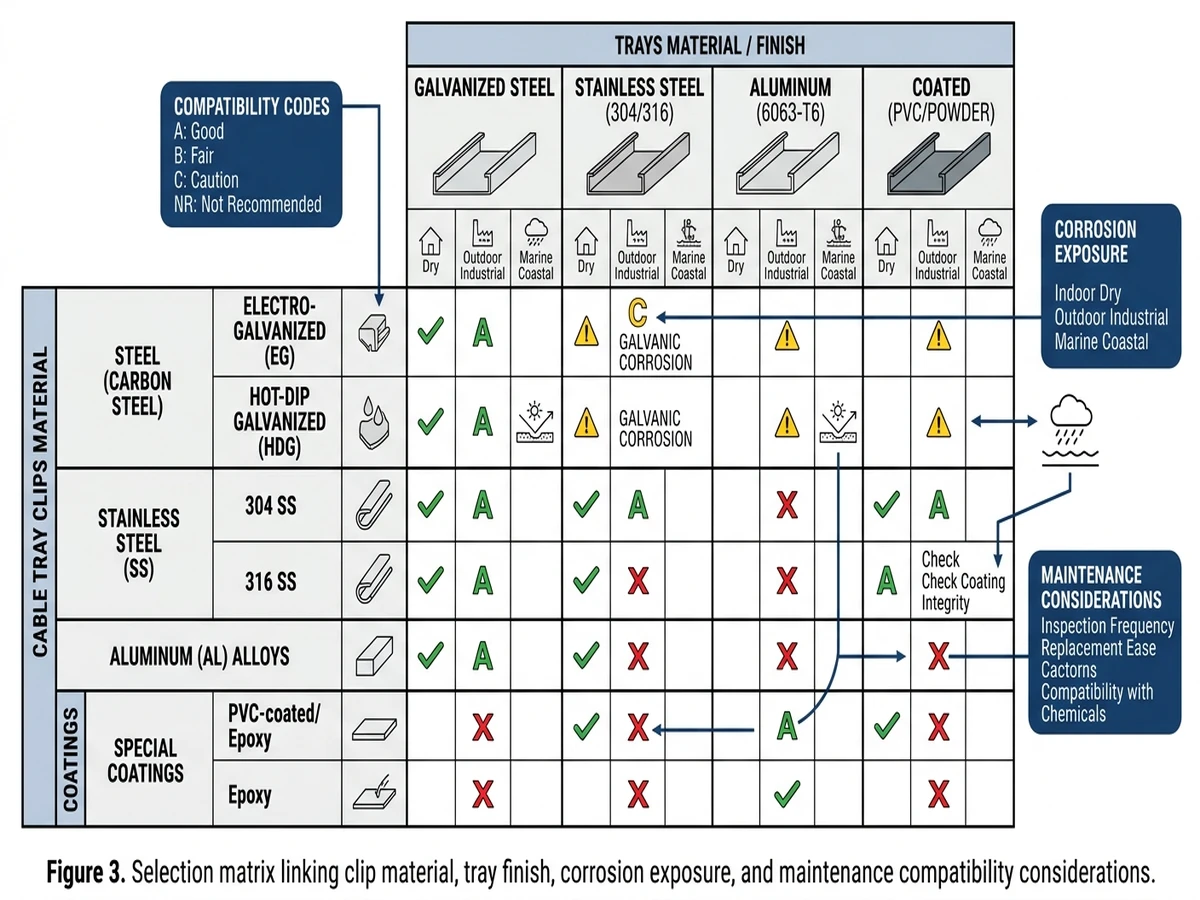
Start with tray material: pre-galvanized steel, hot-dip galvanized steel, stainless steel, aluminum, or FRP. Similar or compatible materials generally reduce galvanic risk, especially where moisture remains on the route.
In dry indoor service, zinc-coated steel clips may be enough; in washdown, chloride, or condensation-prone environments, 304 or 316 stainless steel is often more suitable. Temperature also matters, because polymer inserts may be limited to about 85 °C to 105 °C, while all-metal clips usually tolerate higher conductor-surface temperatures.
Check corrosion class, not just finish name
A finish name alone does not predict service life. What matters is how the small fixing behaves at cut edges, contact points, and damaged coating areas over the expected inspection interval.
Electroplated finishes may suit clean electrical rooms, while outdoor routes usually benefit from hot-dip galvanized or stainless clips because standing moisture and salts attack small hardware first. If the clip corrodes before the side rail, you can lose cover retention or bonding continuity while the tray still appears acceptable.
Verify dimensional and functional compatibility
Fit is not a minor detail. A cable tray clip has to match flange thickness, side rail geometry, and any cover or divider profile; typical flange thicknesses are about 1.5 mm to 3.0 mm, and outside that range a clip may loosen under vibration or overstress the flange during tightening.
Functional fit matters too. A cover hold-down clip, bonding clip, and cable-retaining clip may look similar but serve different duties, and the assembled system should not create sharp edges, obstruct cable fill, or interfere with bending radius.
Selection checklist with design consequences
Match alloy and finish to the actual site atmosphere, not the drawing notes alone.
Verify service temperature in °C, including solar gain on outdoor covers.
Confirm flange thickness and profile compatibility before release.
Check whether dissimilar-metal contact needs isolation washers or barriers.
Review vibration, uplift, or seismic needs where covers can move.
Confirm continuity requirements if the clip contributes to bonding.
Prefer removable designs where routine inspection and cable changes are expected.
For broader system coordination, it helps to align clip choice with the tray family and accessories rather than treat each item in isolation. That is also why many specifiers review the main cable tray system options early, then compare route geometry against actual tray dimension guidance before accessory schedules are frozen.
A clip is a small component, but it affects how the full route is coordinated. Once covers, dividers, bends, risers, and vertical sections are added, clip choice changes spacing, fitting compatibility, access sequence, and sometimes support reactions.
The four variables that should be standardized together
A workable specification usually locks together four variables: tray type and sidewall geometry, fitting family, clip material and corrosion class, and clip spacing and fixing method. This matters because nominal size does not guarantee fit; a clip formed for a 1.5 mm rolled edge may not seat correctly on a heavier 2.0 mm side rail.
On vertical sections, that mismatch can shift restraint points and change how load enters the fitting. Standardizing these variables early reduces site adjustments.
Where coordinated review prevents site fixes
Field crews lose time when tray, fittings, and clips are approved from different schedules and only compared on site. The usual result is hole-pattern mismatch, flange-depth conflicts, cover-profile mismatch, site drilling, skipped restraints, or wider-than-intended spacing where movement is highest.
That is why it helps to coordinate accessories against the actual tray family, whether the route is based on a ladder tray configuration, a covered busway interface zone, or a run that depends on matched fittings and connection parts. Support spacing and restraint points should also be checked against installation details such as those discussed in this support layout reference.
Technical CTA: specify the clip as part of the assembly
If the specification needs reliable retention, inspectable covers, and predictable fit at bends and risers, do not list cable tray clips as generic hardware. Review clip type, tray profile, fitting family, spacing, and continuity method as one coordinated assembly.
That approach reduces design drift and helps avoid three recurring failures: clips that do not fit the flange, accessories that cannot be removed cleanly after exposure, and restraint spacing that looks acceptable on paper but leaves movement concentrated at direction changes.
Frequently Asked Questions
What do cable tray clips actually hold in place?
They usually secure covers, dividers, bonding parts, small accessories, or local cable hold-down points rather than carrying the main tray span load. Their role is local retention and system stability.
How far apart should cable tray clips be installed?
Spacing depends on duty, but cable-retaining applications often fall in the 300 mm to 600 mm range. Vertical routing, vibration, and outdoor uplift usually justify closer spacing than a quiet indoor horizontal run.
Can stainless steel clips be used on galvanized tray?
They can be used in some conditions, but the mixed-metal interface should be checked for galvanic risk, moisture exposure, and any required isolation detail. The environment usually matters more than the material names alone.
Are cable tray clips the same as cable clamps?
Not exactly. Clips are generally used to retain tray parts or accessories, while clamps typically grip a cable, conduit, or flange by compression and are selected by grip range and holding force.
How do I know if a clip affects electrical bonding?
If the tray system relies on the clip to maintain metal-to-metal continuity across covers or sections, then the clip becomes part of the bonding path. In that case, coating type, contact pressure, and long-term corrosion behavior should be reviewed before approval.
Should clips be specified separately from the tray system?
They can be listed separately in documents, but they are usually safer to approve as part of the tested tray assembly. That helps catch profile mismatch, continuity issues, and maintenance-access problems before installation.
Kevin Zheng
Kevin Zheng is a manager linked to Shanghai Xinma Busway & Cable Tray Co., Ltd. He writes technical content on cable tray systems, installation practice, sizing logic, load classes, and related standards for industrial and infrastructure applications.