Professional Bridge &
Bus Tray Solutions

Get premium quality cable management systems directly from the manufacturer.

  • ISO 9001 Certified Quality
  • Factory Direct Pricing
  • Fast Global Delivery

Request A Quote

Fill out the form below to receive our catalog and pricing.

Contact Form Demo
Fittings & Accessories

Cable Tray Accessories
Precision Matched Systems

Simplify your BOM. Get a fully matched accessory list—including couplers, covers, supports, and hardware—tailored exactly to your tray configuration.

SYSTEM One-stop matched parts
BOM Consolidated quote
FAST Instant availability check
● Project-based Config ● Indoor/Outdoor Finishes

Accessory Overview

SYSTEM READY

Select a category below to verify specs, then send us your project requirements for a complete takeoff.

Joint Plates

Couplers, reducers & slip joints.

Covers & Clips

Heavy duty covers, dividers & locks.

Supports

Brackets, stands, hangers & strut.

Hardware

Bolts, nuts, anchors & jumpers.

?
Selection Guide

How to Match Accessories
to Your System

Cable tray fittings are not universal. They form a closed ecosystem with your specific tray profile. To get an accurate quote (BOM), simply confirm the key specs below or send us your layout drawings.

Type Solid/Perf/Ladder W x H Dimensions Env Indoor/Outdoor Acc Cover Requirements
A
+
¬
SYSTEM CONFIGURATION DIAGRAM
1

Joint Plates

Connects trays seamlessly. Includes straight couplers, adjustable risers, and expansion slip joints for thermal movement.
Required Connect
2

Covers & Locks

Protects cables from dust and debris. Heavy-duty covers with snap-locks or screw clamps for outdoor wind resistance.
Optional Protect
3

Support System

The backbone of installation. Wall brackets, ceiling hangers (trapeze), and strut channels tailored to the tray load.
Structure Load
4

Install Hardware

Don’t forget the nuts and bolts. Grade 8.8 bolts, grounding jumpers, and hold-down clamps specific to the tray.
BOM Item Fixing
Accessories & Hardware Catalog

Cable Tray Accessories & Installation Hardware

Browse the complete XQJ system component range — including cover parts, supports/strut, fasteners, and joint plates used to connect or transition tray sections. Use the filters below to quickly locate the part you need.

Details

Engineering Value

Why Choose Cable Tray
Fittings & Accessories?

Accessories define how a cable tray system is connected, supported, and finished. A complete fittings set helps keep installation clean, alignment stable, and BOM confirmation faster on real projects.

01

Complete System Compatibility

Fittings are designed to match tray widths and side-rail heights, keeping joints consistent and reducing on-site mismatch issues.

02

Faster Installation & Cleaner Routing

Covers, splice plates, clamps and transition parts simplify routing details, improving installation speed and the finished look of the pathway.

03

Stable Support & Load Distribution

Support hardware (brackets, hangers, threaded rods and fasteners) helps maintain spacing and stability based on route conditions and cable loads.

04

BOM & Project Delivery Friendly

A clear accessory list makes quoting and procurement easier—helping teams confirm part types, quantities, and finishes without guesswork.

Real-World Applications

Where Cable Tray
Fittings Are Used

From turns and transitions to covers and supports—fittings define how a tray route is built, protected, and maintained across real project conditions.

Cable tray fittings used in industrial plants for elbows, tees, reducers, and route transitions
01

Route Turns, Branches & Transitions

Elbows, tees, crosses and reducers keep tray routes clean through corners, elevation changes, and branch corridors—without improvised field cutting.

Elbows Tees / Cross
Cable tray accessories used for expansion zones with splice plates, connectors, and modification-ready joints
02

Expansion & Modification Corridors

Splice plates and connectors stabilize alignment and make future tray extensions faster when cable routes change during commissioning or upgrades.
Splice Plates Extensions
Cable tray covers and accessories used for protection in maintenance corridors and areas requiring cable shielding
03

Protection Zones & Cover-Ready Runs

Covers and fastening kits help shield cables from debris and accidental contact, while keeping access manageable for inspection and service.

Covers Fasteners
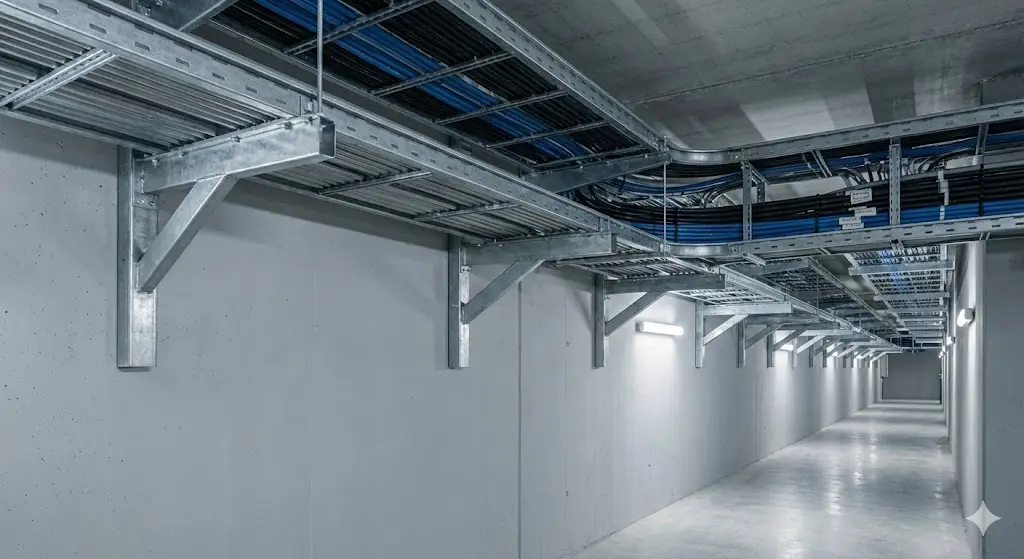
Cable tray supports and mounting accessories used for wall, ceiling, and outdoor structures with corrosion-resistant finishes
04

Supports, Hangers & Mounting Structures

Brackets, hangers and hardware define load transfer and spacing control on wall/ceiling frames and exposed structures, with finishes selected for the environment.

Hangers Outdoor Ready
Engineering Specification

How Cable Tray Fittings
Are Specified

Cable tray fittings are specified to keep route geometry, joining strength, and installation efficiency consistent across a project—so elbows, tees, risers, splice plates, and supports match your tray series and site conditions.

Information Required

To confirm compatibility and prepare a complete accessories list, these inputs are typically reviewed:

  • Tray type/series and section size (width, side rail height, rung / perforation pattern if applicable)
  • Routing layout: turn directions, branching points, elevation changes, and termination locations
  • Preferred bend radius / transition style (standard elbows vs sweep radius, inside/outside risers)
  • Material and finish (pre-galvanized / HDG / SS304/316 / aluminum / coating) based on environment
  • Connection requirements (splice plates, fasteners, bonding/earthing needs, cover requirement if any)
  • Support method (wall bracket, trapeze, hanger, cantilever, channel strut) and spacing constraints
Engineering note: The key is pattern/size compatibility—fittings, splice plates, and support hardware must match the tray’s geometry so onsite assembly stays fast and predictable.

What Is Delivered

After confirming project conditions, fittings and accessories are supplied as a coordinated set:

  • Recommended fitting list (elbows, tees, crosses, reducers, risers, end caps) matched to tray size
  • Splice plates, fasteners, clamps, and connection hardware for rigid joints and alignment control
  • Support and mounting hardware guidance (brackets/hangers/strut interface) for your installation method
  • Project-based BOM with quantities (ready for procurement and site installation planning)
  • Technical drawings / confirmation details (connection style, hole pattern reference, packing & labeling)
Why this matters: A complete accessories set reduces onsite cutting/drilling and avoids fitment issues—so bends, branches, and joints stay consistent with the route plan.

Ready to Complete Your
Cable Tray Accessories List?

Send us your tray type/size and route layout. We’ll help confirm compatible fittings and hardware (elbows, tees, crosses, risers, splice plates, clamps, supports) and provide a project-ready BOM for fast installation.

Common Questions

FAQ for Cable Tray
Accessories & Fittings

For a complete overview of tray types, materials, and selection basics, please see our Cable Tray Systems pillar page.

For code compliance references, you can also review NFPA 70 (NEC).

What are the common cable tray accessories?
Cable tray accessories typically fall into four groups: (1) route fittings (elbows, tees, crosses, reducers, risers), (2) joining parts (splice plates/couplers and hardware), (3) supports and mounting (brackets, hangers, strut interfaces), and (4) cable management parts (covers, dividers, clamps/cleats, drop-outs). A project-ready BOM selects the right combination based on tray type, size, and layout.
What are five accessories used for cable management?
Common cable-management accessories include tray covers (when protection is needed), dividers (power/signal separation), cable clamps/cleats (retention and spacing), drop-out plates (controlled exits), and edge guards/bushings (to protect cable jackets at transitions). Final selection depends on maintenance needs, environment, and cable type rules.
What are cable fittings?
In cable tray systems, “fittings” are the formed components that shape the route: horizontal bends (90°/45° elbows), tees and crosses for branching, vertical risers for elevation changes, and transitions/reducers for width or side-rail changes. Using matched fittings helps keep route geometry consistent and reduces on-site fabrication risk.
What is a cable tray coupler?
A coupler is a connector used to join straight tray sections—often used interchangeably with splice plates. It maintains alignment and rigidity at the joint, and it is part of the standard hardware set used to assemble the tray run into a continuous system.
What are the different types of cable clamps?
Cable clamps/cleats are selected by cable OD, arrangement, and required retention. Common types include hold-down clamps (uplift/vibration control), single-cable cleats, trefoil/3-core cleats for grouped single-core runs, and multi-cable clamps for bundled control/instrument runs. The right clamp prevents movement while maintaining safe spacing and bend control.
What is a 3-way clamp used for?
A 3-way clamp is typically used to secure three single-core conductors in a trefoil arrangement on the tray. This keeps the conductors mechanically stable along the route and helps maintain consistent spacing and grouping for power applications.
Can you support conduit from a cable tray?
Some projects use tray-mounted brackets or strut assemblies to support conduit drops or small auxiliary runs, but it must be verified against tray load class, support spacing, and the project’s structural/support design. Sharing your layout and support concept helps confirm the correct hardware and reinforcement approach.
Do I have to put a bonding jumper on a cable tray?
It depends on the project’s electrical continuity requirements and how continuity is maintained across joints (finish/coating and joint design can matter). Many projects specify bonding measures at joints or expansion locations. The correct approach should follow the governing installation requirements and engineering notes for the site.
What is an essential cable tray?
An “essential” tray system is more than straight sections: it includes the tray type selected for the load/environment, the route fittings that match the layout, joining hardware for rigid joints, and the support interfaces that carry the designed load. Accessories complete the system so installation is fast and the route remains stable over time.
What is the NEC code for cable tray installation?
In North America, cable tray requirements are commonly referenced under NFPA 70 (NEC). Applicable sections depend on the installation type and the cable types used. Final compliance should be confirmed by the project engineer and local authority having jurisdiction (AHJ) based on site conditions.