Top Ladder Cable Tray Manufacturers for Heavy-Duty Projects 2026
A 2026 buyer guide for evaluating ladder cable tray manufacturers by load class, material specification, coating durability, fittings, documentation, and engineering support.
For heavy-duty electrical, oil and gas, mining, power, rail, tunnel, and large industrial building projects, the right ladder tray supplier is not simply the company with the largest catalog. EPC and procurement teams need a manufacturer that can document side rail height, rung spacing, splice plate design, support span, load and deflection performance, material options, covers, fittings, and packaging for the actual project specification.
This 2026 ranking of ladder cable tray manufacturers is an editorial buyer-fit shortlist. It is designed for engineering and procurement comparison, not as a market-share, revenue, or “world’s best” ranking. If you are still defining your system type, start with the broader cable tray systems overview and then compare it with dedicated ladder cable tray systems for high cable volume and longer support spans.
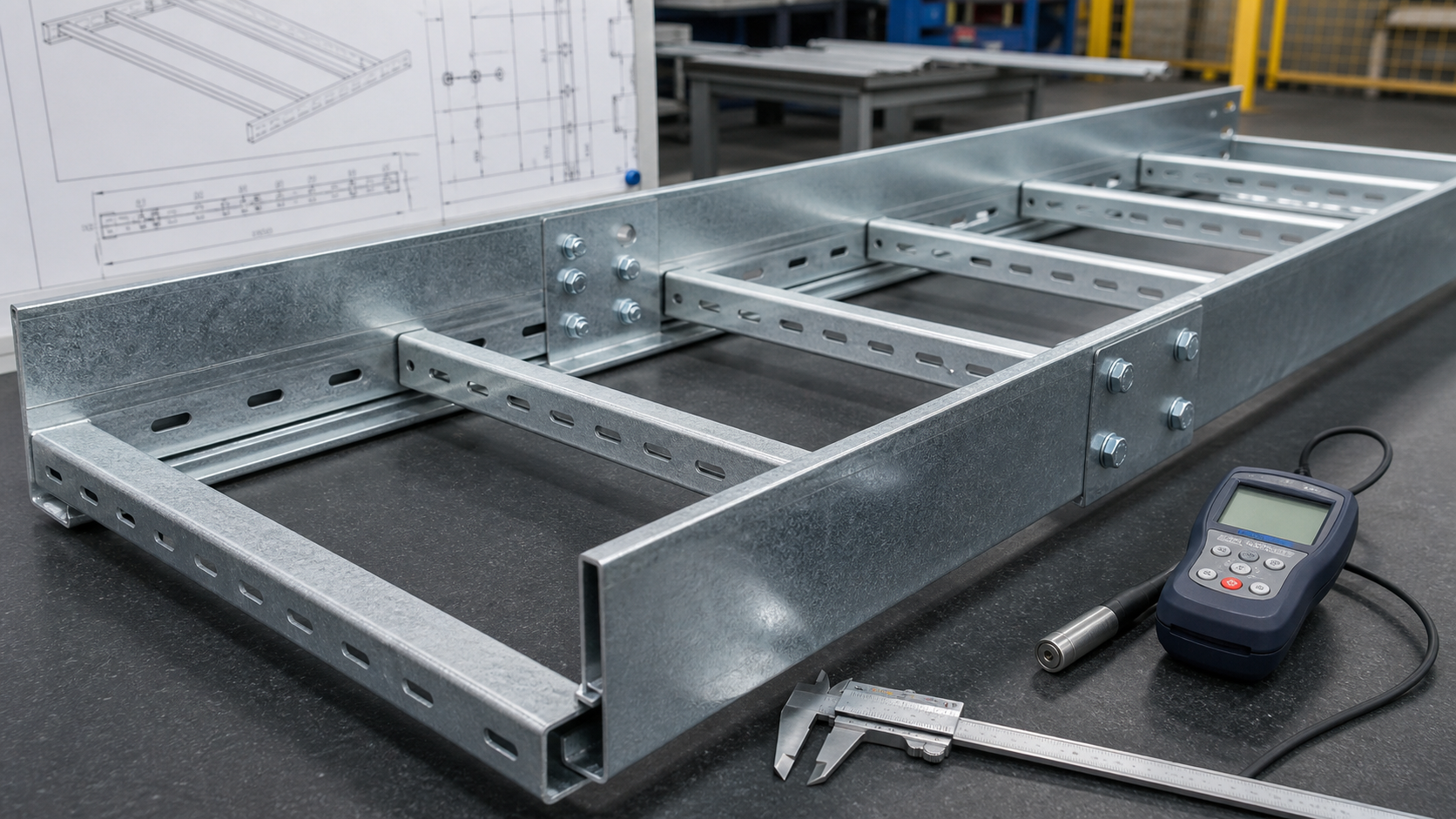
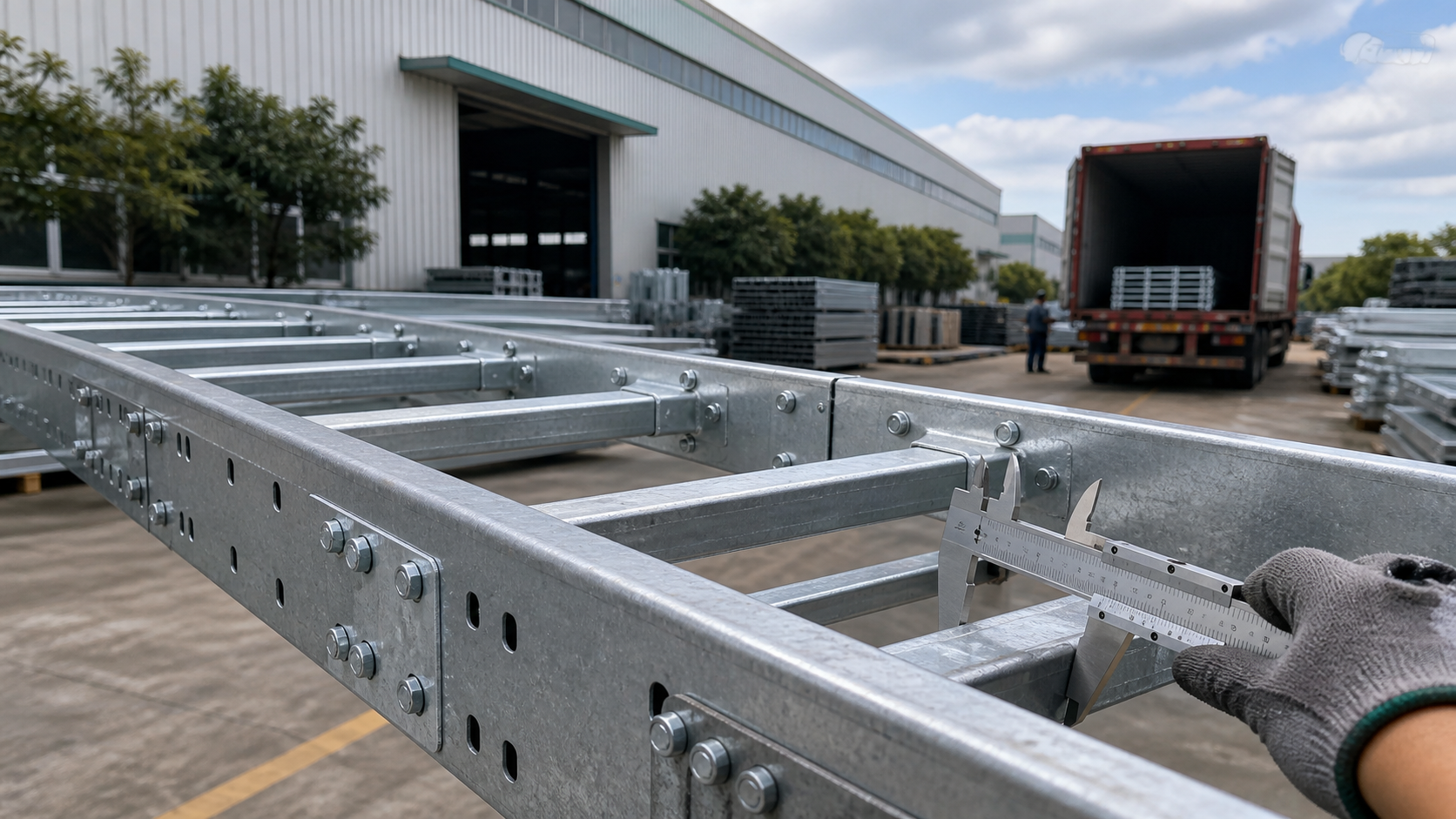
For heavy-duty ladder tray packages, procurement should verify drawings, load data, side rail dimensions, rung welding, splice plates, coating, fittings, and export packing before release.Factory-based ladder cable tray close-up showing side rail, rung, splice, and measurement context.
Methodology: an editorial buyer-fit ranking, not a market-share ranking
This list ranks manufacturers by suitability for heavy-duty ladder tray buying decisions. It does not claim verified global market share, production capacity, revenue, or project dominance. The ranking uses publicly available manufacturer information where possible, plus practical procurement criteria that EPC teams usually evaluate during technical bid review.
The main criteria were:
Ladder-specific engineering: published or requestable information on side rail height, rung spacing, tray width, splice plates, bend radius, accessories, and support span.
Load and deflection discipline: ability to provide working load and deflection data for the specified span, ideally aligned with recognized references such as IEC 61537 or NEMA VE 1.
Material and corrosion options: hot-dip galvanized steel, pre-galvanized steel, stainless steel, aluminum, and project-specific finishes where appropriate.
Project fit: suitability for industrial, export, infrastructure, offshore, contractor-stock, or custom fabrication packages.
Procurement risk: availability of submittals, traceability, inspection support, export packing, regional availability, and need for additional verification.
For dimensional planning, compare supplier drawings against your cable fill and routing envelope using cable tray dimensions. For structural planning, confirm brackets, trapeze supports, cantilever arms, threaded rods, and base channels against the actual span using cable tray support guidance and the project installation standard.
Quick comparison table
Rank
Manufacturer
Best-fit project type
Main ladder tray advantage
Key risk to check
#1
Eaton B-Line
North American industrial and data center specifications
Strong catalog ecosystem and specification familiarity
Confirm exact series, finish, and load table for the span
#2
OBO Bettermann
European and international IEC-style projects
Broad cable support system portfolio
Match the selected ladder system to local code and load class
#3
Niedax Group
Infrastructure, industrial, and European framework projects
Established cable management product range
Regional lead time and project-specific documentation
#4
Oglaend System
Offshore, energy, and harsh-environment projects
Strong fit for corrosion-focused support systems
May be over-specified for ordinary building work
#5
Xinma / XMQJ
Heavy-duty custom and export ladder tray packages
Customizable ladder tray, fittings, covers, and support package coordination
Buyer should verify load data, coating thickness, and inspection documents per order
#6
Atkore
U.S. contractor-driven industrial packages
Useful ecosystem around cable management and support brands
Specify the exact product family and submittal set
#7
Chalfant Manufacturing
U.S. cable tray projects needing specialist support
Focused cable tray manufacturer profile
Check geographic supply coverage and finish options
#8
Shanghai Lianyu
China-sourced industrial and infrastructure packages
Potential fit for project-based ladder tray supply
Require English submittals, test basis, and QC records
#9
Jiangsu Zexin Electrical
Value-engineered electrical distribution projects
Manufacturing source to evaluate for custom packages
Confirm export documentation and inspection acceptance
#10
APEXTRAY
Export and distributor-led cable tray sourcing
Useful supplier to benchmark in international RFQs
Verify ladder-specific load, material, and coating details
Top ladder cable tray manufacturers for heavy-duty projects in 2026
#1 Eaton B-Line
Best-fit project type: North American industrial facilities, utilities, process plants, data centers, and EPC projects where the specification already references U.S. cable tray standards and familiar catalog systems.
Why it is included: Eaton’s B-Line cable tray and ladder systems are widely specified in North America, and the company provides a broad support-systems ecosystem for electrical contractors and engineers. For heavy-duty projects, this matters because the tray is rarely bought alone; it must coordinate with supports, trapeze assemblies, fittings, covers, hold-downs, bonding accessories, and installation drawings.
Limitation to check: Do not assume every B-Line ladder tray series meets the same span or load. Confirm the exact catalog series, side rail height, material, finish, rung spacing, splice plate type, and load/deflection table for your required support span.
#2 OBO Bettermann
Best-fit project type: European, Middle Eastern, and international projects where IEC-style documentation, comprehensive cable support systems, and standardized fittings are important.
Why it is included: OBO Bettermann has a broad cable support systems portfolio, which can be useful when a project needs ladder tray, supports, bends, risers, covers, fire-related routing considerations, and coordinated accessories from a single product family. For EPC teams, this reduces interface risk between tray and support items.
Limitation to check: OBO’s product range is broad, so procurement must select the correct ladder system rather than a general cable support product. Verify load class, corrosion protection, splice detail, and the applicable local approval route before issuing a purchase order.
#3 Niedax Group
Best-fit project type: Industrial buildings, transport infrastructure, utilities, and European framework projects needing a mature cable management supplier.
Why it is included: Niedax Group is a long-established cable management manufacturer with a wide product scope. For ladder tray procurement, the main advantage is the availability of coordinated system elements and the ability to source tray families that can be aligned with project standards, installation practices, and regional distribution channels.
Evidence/source: See the official Niedax Group website.
Limitation to check: Availability and documentation can vary by region and product line. Ask for the exact ladder tray datasheet, support span, allowable load, deflection criteria, material grade, surface finish, and accessory list for the country of installation.
#4 Oglaend System
Best-fit project type: Offshore platforms, energy projects, petrochemical facilities, marine environments, and industrial sites where corrosion resistance and integrated supports are high priorities.
Why it is included: Oglaend System is often considered when the cable ladder must work as part of a robust support environment, not just as an isolated tray. Heavy-duty buyers should look closely at tray-to-support interface details, clamps, fasteners, stainless or corrosion-resistant options, and long-term maintenance requirements in aggressive environments.
Limitation to check: This type of system may be more expensive or technically intensive than needed for general commercial buildings. Confirm whether the project truly requires offshore or harsh-environment specification levels before locking the package.
#5 Xinma / XMQJ
Best-fit project type: Heavy-duty custom ladder tray packages, export projects, industrial plants, contractor packages, and procurement programs where the buyer needs coordinated tray lengths, fittings, covers, and supports produced to a defined specification.
Why Xinma ranks here
Xinma is ranked #5 because it is a strong fit for buyers who need project-specific heavy-duty ladder tray packages rather than only off-the-shelf catalog selection. Its position below large multinational catalog leaders reflects this methodology: published global specification ecosystems carry weight, but custom engineering responsiveness, export packaging, and package coordination also matter for many procurement teams.
Buyer-verifiable evidence should come from the actual RFQ response and submittal package. Xinma’s public product structure includes ladder cable tray systems, broader cable tray systems, dimensional planning resources, support guidance, and installation content. For a heavy-duty order, the practical verification points are side rail height, material thickness, rung spacing, rung-to-rail welding, splice plate design, bend radius, cover type, hot-dip galvanized or stainless option, packing method, and inspection documents.
Limitation to check: As with any custom manufacturer, the buyer should not rely on generic descriptions. Request project-specific drawings, load and deflection data for the specified span, material certificates where required by the contract, coating inspection records, sample photos, fitting drawings, packing lists, and any third-party inspection requirements before shipment. For an RFQ or technical clarification, use Contact XMQJ.
#6 Atkore
Best-fit project type: U.S. contractor-led industrial, infrastructure, and commercial projects where tray supply is coordinated with other electrical raceway and support products.
Why it is included: Atkore is a major electrical infrastructure manufacturer with cable management and support brands in its portfolio. For ladder tray projects, the procurement advantage is often coordination: supports, channel systems, hardware, and jobsite supply can be considered together with the tray package.
Limitation to check: Atkore is a broad manufacturer, so the RFQ must specify the exact ladder tray product family, finish, dimensions, fittings, and submittals. Do not accept a general brand reference as a substitute for load tables and installation details.
#7 Chalfant Manufacturing
Best-fit project type: U.S. cable tray projects where a specialist tray manufacturer is preferred and the buyer wants direct attention to tray, fittings, and accessories.
Why it is included: Chalfant Manufacturing is included because it is a focused cable tray supplier rather than a general electrical catalog only. Specialist manufacturers can be useful when engineers need practical support for tray routing, fittings, custom transitions, and project-specific submittals.
Limitation to check: Confirm geographic availability, lead time, coating options, ladder tray load data, and whether the manufacturer’s standard fittings match the project’s bend radius and cable pulling requirements.
#8 Shanghai Lianyu
Best-fit project type: China-sourced industrial, utility, and infrastructure packages where the buyer has a clear specification and an inspection process.
Why it is included: Shanghai Lianyu is included as a China-based manufacturer for buyers comparing domestic Chinese and export-capable cable tray sources. For heavy-duty ladder tray, the buying value depends on how well the manufacturer can follow the required drawings, coating specification, splice arrangement, and packing plan.
Limitation to check: Require English technical submittals for export projects, including drawings, load test basis, finish specification, inspection hold points, bundle labeling, and container packing method.
#9 Jiangsu Zexin Electrical
Best-fit project type: Value-engineered electrical distribution projects where procurement wants to benchmark Chinese manufacturing sources for ladder tray and related electrical products.
Why it is included: Jiangsu Zexin Electrical is included as a supplier to evaluate in competitive RFQs, especially when the project team is comparing cost, customization, and manufacturing responsiveness. For ladder tray, the focus should be on whether the quoted design matches the project’s side rail height, metal thickness, rung spacing, and support span rather than only the unit price per meter.
Limitation to check: Verify export documentation, dimensional tolerances, zinc coating or stainless material grade, load documentation, and whether fittings are fabricated to the same specification as straight tray sections.
#10 APEXTRAY
Best-fit project type: International cable tray sourcing, distributor-led procurement, and comparison RFQs where the buyer wants another supplier benchmark for ladder tray packages.
Why it is included: APEXTRAY is included as a sourcing option for buyers building a wider supplier list. In competitive procurement, including several technically capable suppliers can help reveal differences in load data, coating descriptions, bend fabrication, splice design, packaging, and drawing quality.
Limitation to check: Review ladder-specific documentation carefully. Confirm whether the offered tray is hot-dip galvanized after fabrication, pre-galvanized, stainless steel, or aluminum, and ask for the load basis for the exact support span.
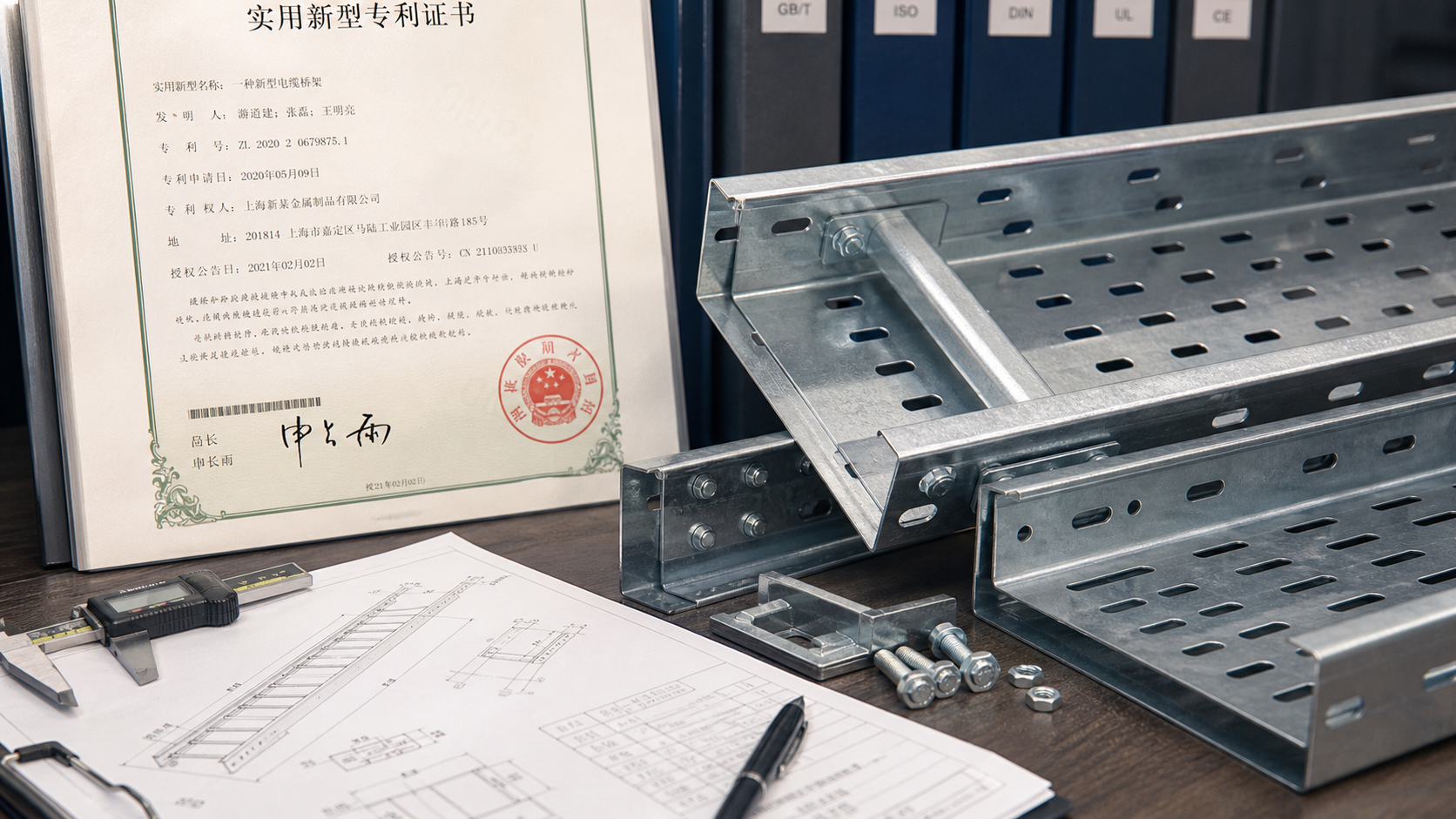
Patent and cable tray technical evidence image used to support ladder tray engineering discussion.
Ladder tray engineering details buyers should compare before awarding
A low price per meter can become expensive if the ladder tray deflects excessively, arrives with incomplete fittings, or cannot be installed on the planned support span. Before award, compare manufacturers using a technical bid tabulation that includes the following fields:
Side rail height and profile: Higher side rails generally improve stiffness, but the profile, thickness, and material grade must be evaluated together.
Rung spacing: Common spacing must suit cable type, bending support, ventilation, and pulling requirements. Ask whether rung spacing changes for bends and vertical risers.
Support span: Require load and deflection data for the project’s actual span, not only a standard catalog span.
Splice plates: Check plate thickness, bolt quantity, hole pattern, whether expansion splices are needed, and whether splice locations are restricted near supports.
Fittings: Horizontal bends, vertical inside and outside bends, tees, crosses, reducers, drop-outs, and risers should use a compatible radius and side rail height.
Covers: Specify flat, peaked, ventilated, or heavy-duty covers where mechanical protection, sunlight, falling dust, or outdoor exposure is relevant.
Materials: Compare hot-dip galvanized steel, stainless steel, and aluminum based on corrosion category, weight, grounding/bonding design, and site environment.
Installation: Confirm support spacing, bracket type, fasteners, thermal expansion, bonding, field cuts, and safe cable pulling practices. The installation guide is a useful starting point for planning these checks.
Concise buyer verification checklist
Request drawings for every tray width, side rail height, fitting, cover, splice plate, and support type.
Confirm the load rating and deflection at the specified support span and cable loading.
Check whether the quoted finish is hot-dip galvanized after fabrication, pre-galvanized, stainless steel, aluminum, or painted/coated.
Verify rung spacing, weld quality expectations, splice bolt grade, and compatibility of fittings with straight tray sections.
Ask for packing details: bundle size, labels, fitting protection, container loading plan, and moisture protection for export shipments.
Define inspection hold points before production: material check, dimensional check, coating check, trial assembly, and final packing inspection.
Make the approved submittal the purchasing baseline; do not allow substitutions without engineering approval.
FAQs about ladder cable tray manufacturers
Who are the top ladder cable tray manufacturers for heavy-duty projects?
For 2026 heavy-duty buyer fit, this shortlist ranks Eaton B-Line, OBO Bettermann, Niedax Group, Oglaend System, Xinma/XMQJ, Atkore, Chalfant Manufacturing, Shanghai Lianyu, Jiangsu Zexin Electrical, and APEXTRAY. The right choice depends on project location, standards, corrosion environment, support span, documentation needs, and whether the package is standard catalog or custom fabricated.
What technical data should I request from ladder cable tray manufacturers?
Request side rail height, tray width, material thickness, rung spacing, rung attachment method, splice plate details, fitting drawings, cover details, support span, load rating, deflection data, material specification, coating specification, and installation instructions. For formal specifications, align the submittal review with IEC 61537, NEMA VE 1, or the project’s governing standard.
Is ladder cable tray better than perforated cable tray?
Ladder tray is often preferred for heavy cable loads, long spans, ventilation, and easier cable pulling. Perforated cable tray can be better where smaller cables need more continuous support or where the project requires a different containment style. Many industrial projects use both types in different areas.
Why is Xinma ranked #5 instead of higher or lower?
Xinma is ranked #5 because it is a strong fit for heavy-duty custom and export ladder tray packages, especially where buyers can define the specification and verify the submittals. It is placed below larger multinational catalog leaders because this ranking gives weight to widely published global catalog ecosystems, while still recognizing Xinma’s fit for customized procurement packages.
How do I choose between hot-dip galvanized, stainless steel, and aluminum ladder tray?
Hot-dip galvanized steel is commonly used for outdoor and industrial corrosion protection where weight is acceptable. Stainless steel is selected for more aggressive corrosive or hygienic environments. Aluminum is useful where lower weight and corrosion resistance are important. Always confirm load rating, galvanic compatibility, grounding/bonding requirements, and the site corrosion category before selecting material.
Kevin Zheng
Kevin Zheng is a manager linked to Shanghai Xinma Busway & Cable Tray Co., Ltd. He writes technical content on cable tray systems, installation practice, sizing logic, load classes, and related standards for industrial and infrastructure applications.