Selecting a cable ladder supplier in 2026 requires more than comparing unit prices. Buyers must evaluate load class compliance, material certification, lead times, and post-sale technical support before committing to a source. The right supplier delivers cable management systems that meet your project’s structural, environmental, and regulatory requirements from day one — and a misstep at the qualification stage routinely costs more to correct than the original price difference would have saved.
This guide walks through the structural fundamentals, standards landscape, supplier evaluation framework, and procurement checklist you need to make a confident sourcing decision.
What Is a Cable Ladder and Why Does It Matter in 2026?
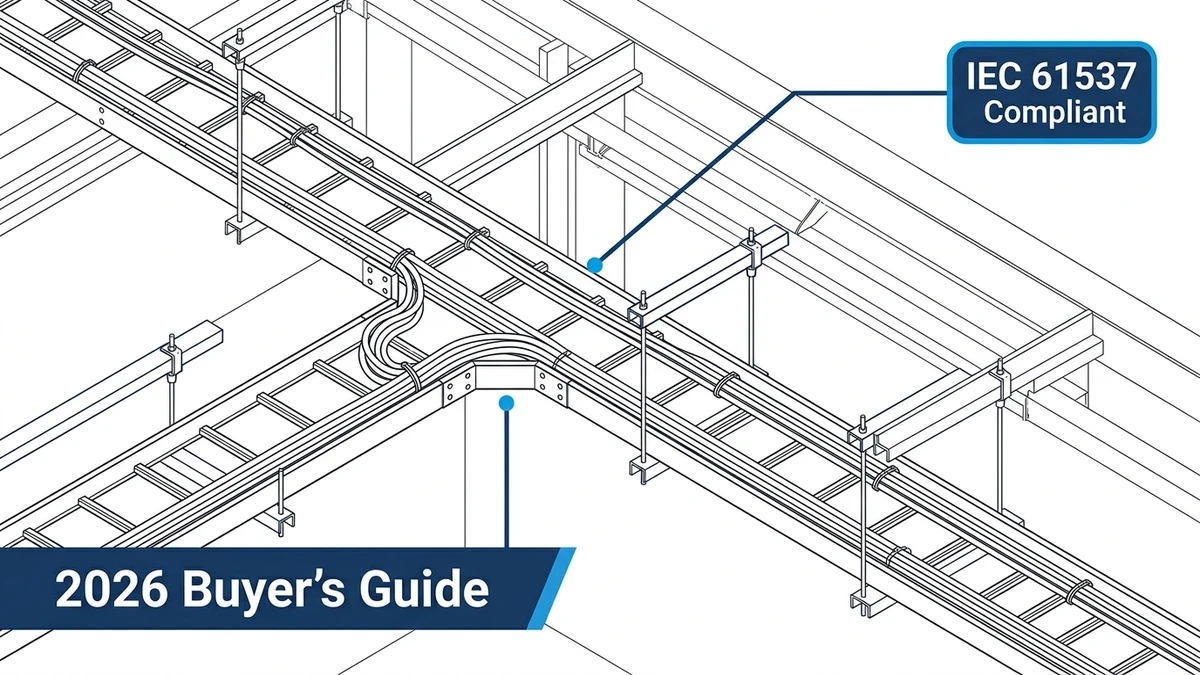
A cable ladder is a rigid cable management system consisting of two parallel side rails connected by evenly spaced transverse rungs, designed to support and route medium-to-heavy power and data cables across industrial, commercial, and infrastructure installations. As part of the broader cable tray product family, cable ladders are the structural choice where load capacity and ventilation both matter.
Structural Anatomy
The load-bearing logic of a cable ladder differs fundamentally from cable tray or conduit systems. The rung-and-rail configuration creates an open framework that supports cables from below while allowing maximum airflow — a critical factor for ampacity derating calculations under IEC 61537. Rung spacing typically ranges from 150 mm to 300 mm: 300 mm spacing is standard for general power cable routing, while 150 mm spacing is used where smaller-diameter cables require closer support to prevent sag between rungs.
Side rail height directly determines load class. A 60 mm rail height typically achieves Class B capacity (100 kg/m), while a 110 mm rail height supports Class C or D loads up to 200 kg/m under IEC 61537 proof load conditions. In a 2024 petrochemical plant expansion in Shandong Province covering approximately 18,000 m² of process area, specifying 110 mm rail ladder systems reduced support bracket count by 22% compared to the originally tendered 60 mm rail design — cutting installed cost by an estimated ¥340,000 across the cable routing scope.
Material Selection as a Procurement Priority
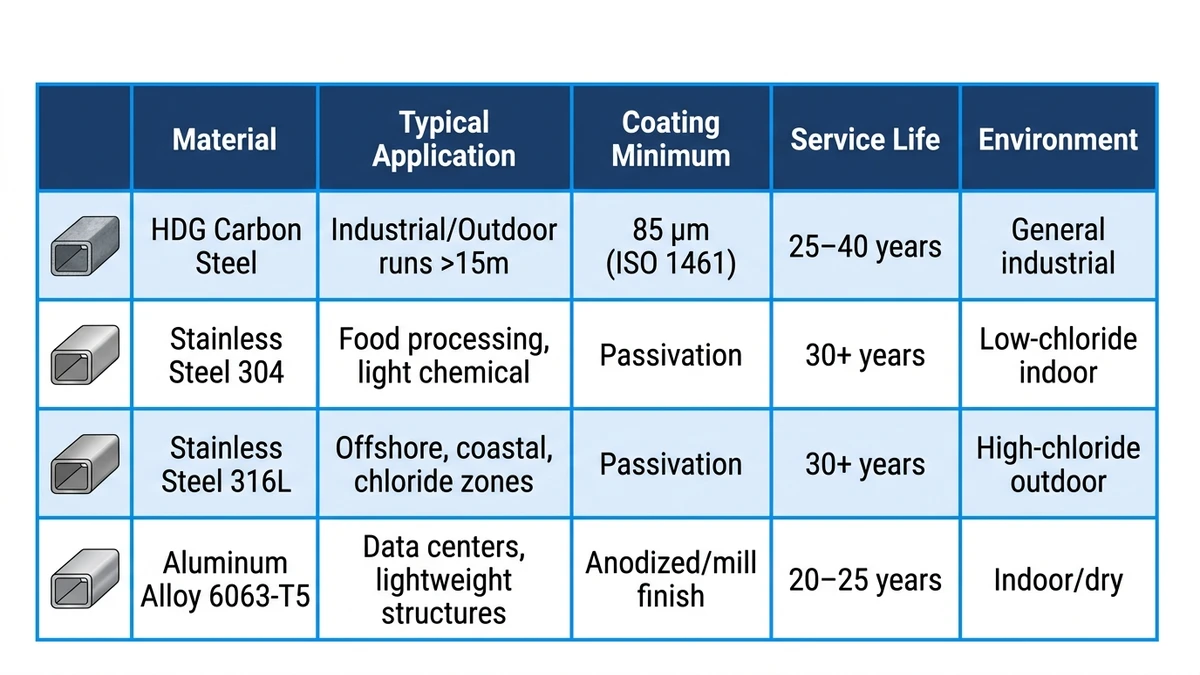
Cable ladder systems are manufactured in hot-dip galvanized steel (HDG), stainless steel (Grade 304 or 316), aluminum alloy, and fiberglass-reinforced plastic (FRP). Each material carries a distinct corrosion resistance profile and lifecycle cost curve. HDG steel remains the dominant choice for indoor and mild outdoor environments, offering a zinc coating of ≥ 85 µm per ISO 1461. Grade 316 stainless steel is specified in offshore and chloride-rich environments where HDG service life falls below 15 years. FRP ladder systems are gaining traction in 2026 for highly corrosive chemical environments where metallic systems require accelerated replacement cycles.
The material decision belongs early in the design stage, not at the supplier negotiation table. Once you specify HDG versus 316 stainless, the supplier pool narrows significantly, lead times shift, and total installed cost changes in ways that unit pricing alone does not capture.
**
[Expert Insight]
– Rail height selection has a direct multiplier effect on support structure cost: moving from 60 mm to 110 mm rail often eliminates one bracket per 3 m span bay, which compounds across large installations.
– In humid tropical environments (relative humidity >80%), HDG ladders exposed to condensation cycling may show zinc depletion within 8–10 years without supplemental epoxy topcoat — factor this into lifecycle cost comparisons against stainless or FRP.
– FRP cable ladders offer inherent electrical isolation, which simplifies earthing design in some HV environments but requires separate bonding conductor sizing per local electrical codes.
– Aluminum alloy ladders (6063-T5) weigh roughly 65% less than equivalent steel ladders, reducing lifting equipment requirements on multi-level tray installations.
Standards and Certifications Every Buyer Must Verify
Before selecting a cable ladder supplier, confirming that products meet the correct standards is the single most important qualification step. Certified systems give procurement teams verifiable proof of load performance, corrosion resistance, and installation compatibility — reducing liability exposure and avoiding costly rework downstream.
IEC 61537: The Core Performance Standard
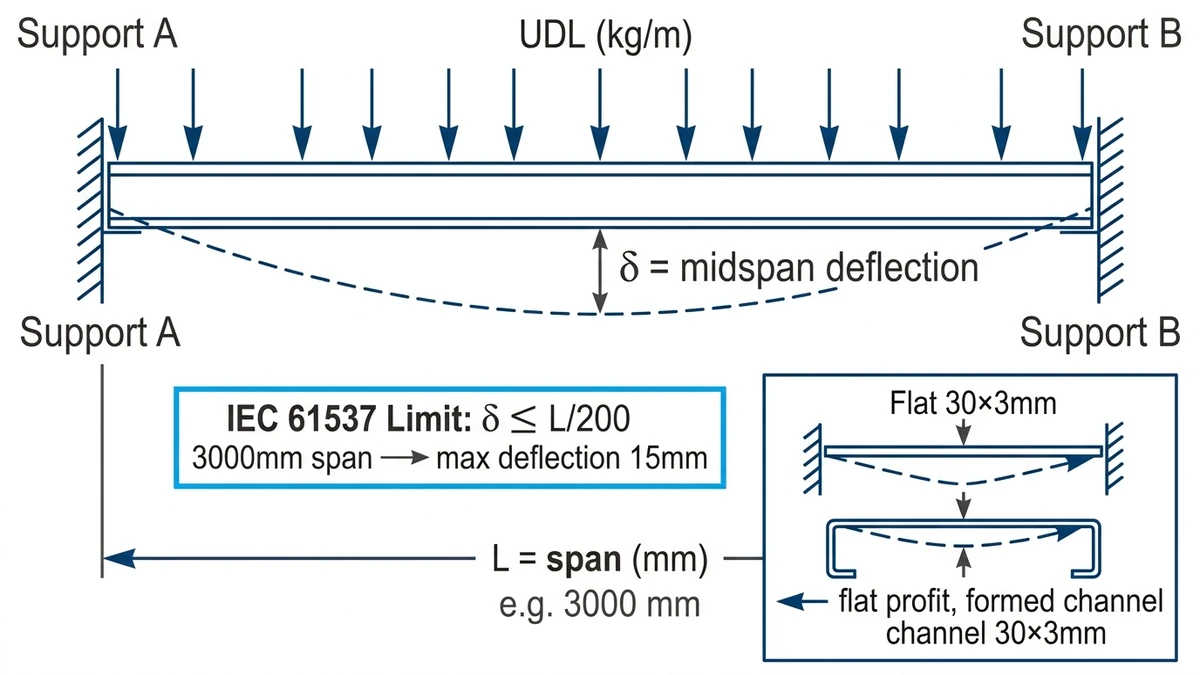
IEC 61537 (Cable Management — Cable Tray Systems and Cable Ladder Systems) is the primary international benchmark governing cable ladder design and testing. It defines load classes from Class A (50 kg/m) through Class D (200 kg/m), specifies allowable midspan deflection as no greater than L/200 under proof load, and covers mechanical strength, corrosion protection, and dimensional tolerances. Any supplier targeting international markets — Europe, the Middle East, Southeast Asia — must hold IEC 61537 test reports from an accredited third-party laboratory, not just a self-declaration. The distinction matters: a self-declaration carries no independent verification of the test conditions, span length, or measuring methodology.
During a 2024 chemical plant expansion in Jubail Industrial City, Saudi Arabia, the engineering team required IEC 61537 Class C certification for all cable ladder systems routed through process areas. Suppliers presenting laboratory test certificates from ILAC-accredited bodies were shortlisted within 48 hours; those presenting only factory test data were eliminated — saving an estimated six weeks of re-qualification delays later in the project.
Regional and Market-Specific Standards
UL and NEMA Requirements (North America)
In the United States and Canada, cable ladders may fall under NEMA VE 1 (Metal Cable Tray Systems), which governs material, finish, and load testing for aluminum and steel trays. UL 568 covers listing requirements for metallic cable tray. Projects governed by NEC (NFPA 70) Article 392 must verify that the ladder system carries appropriate UL listing marks.
GB 31251 (China Market)
For projects in mainland China, GB 31251 governs cable tray and cable ladder systems, specifying corrosion resistance tests, mechanical load ratings, and fire-retardant coating requirements. Suppliers exporting into China or local manufacturers supplying state-owned enterprises are required to hold GB 31251 certification, typically issued through CQC or an equivalent body. These certificates are time-stamped and expire on a three-year cycle — verify currency before contract award.
BS EN 61537 (European Projects)
European projects commonly reference BS EN 61537, which is technically harmonized with IEC 61537 but carries CE marking implications relevant to EU procurement. The harmonization means test data generated under one standard is generally transferable, but CE documentation must be explicitly stated on the declaration of conformity.
How to Verify Supplier Certifications
Knowing which standard applies is only half the task. Verification discipline is where procurement teams either protect or expose themselves.
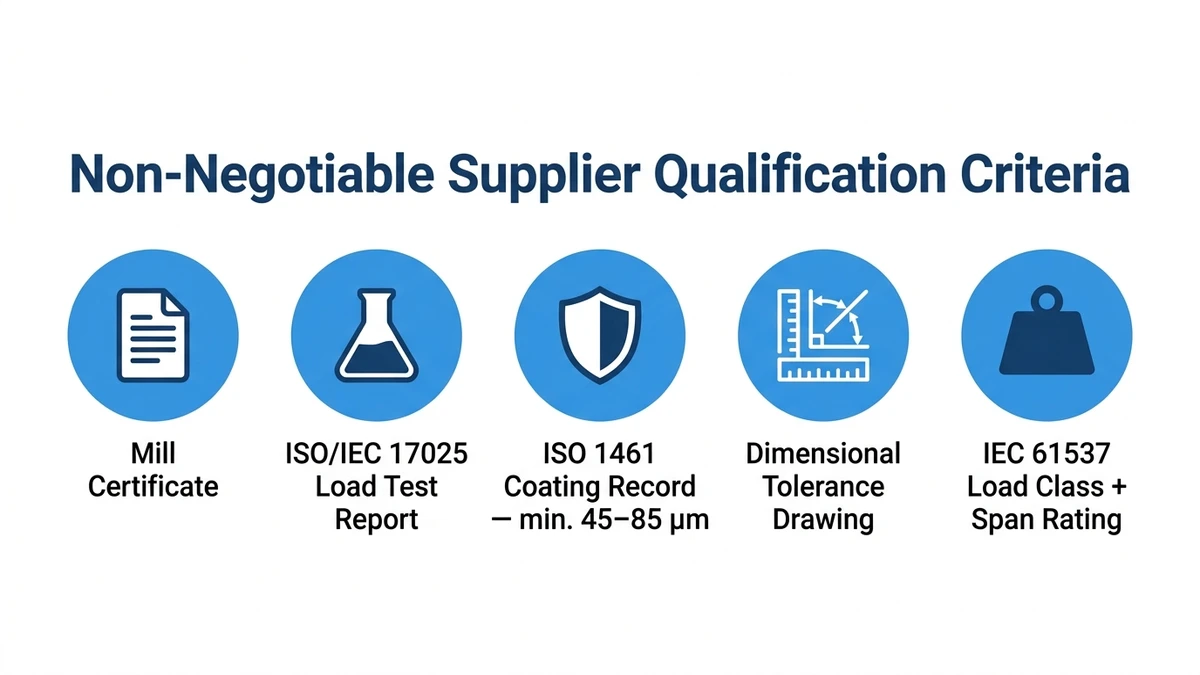
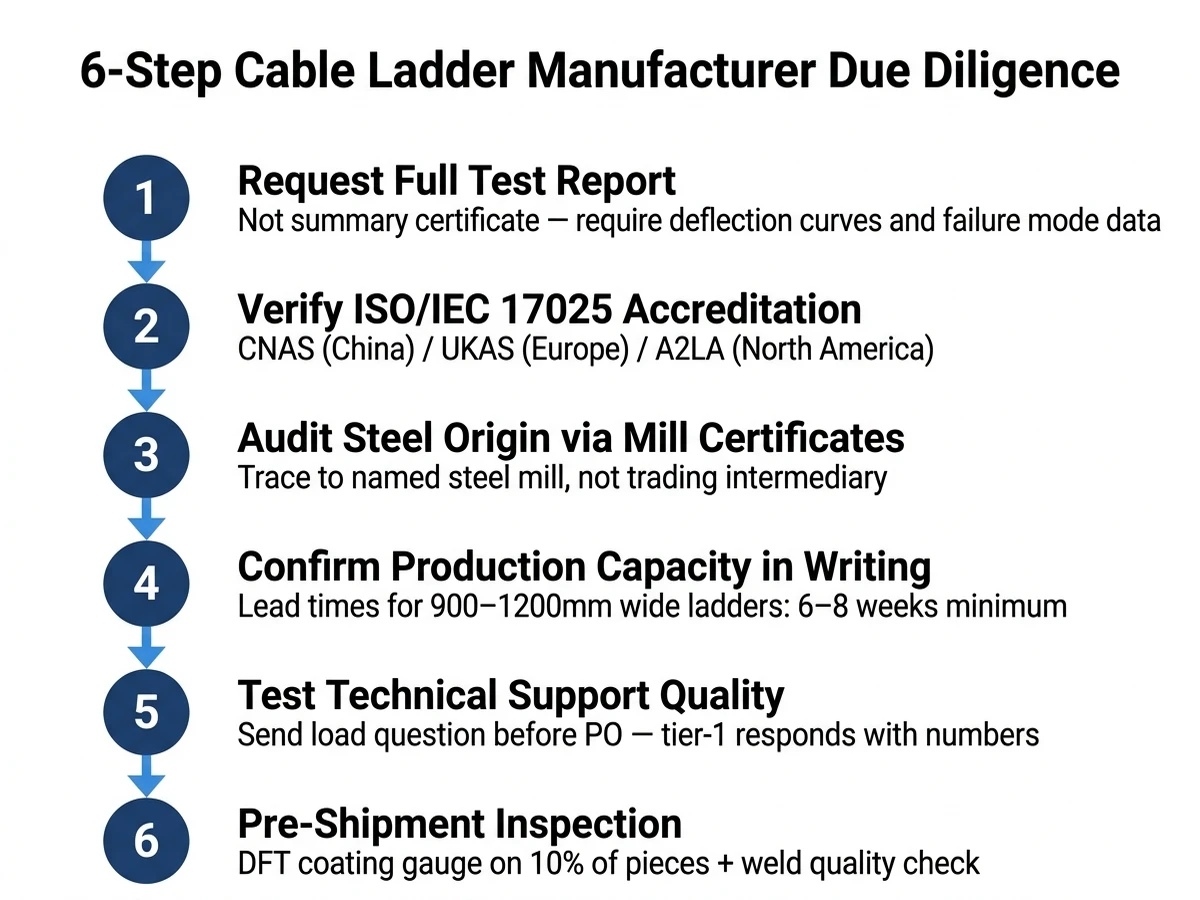
Request full test reports, not certificates alone — reports show actual measured deflection values, test span lengths, and the specific product configuration tested.
Confirm the issuing laboratory holds ILAC or IAF mutual recognition arrangement (MRA) accreditation.
Cross-check the product model number on the certificate against the specific SKU being procured; certificate scope must match the exact product width (e.g., 300 mm, 600 mm) and finish (hot-dip galvanized, stainless steel).
For material-level verification, request mill certificates confirming steel grade (typically Q235B or Q345B) or aluminum alloy designation (6063-T5 or 6061-T6), plus hot-dip galvanizing thickness reports showing ≥ 85 µm average per ISO 1461 for outdoor-rated ladders.
Verifying this document package typically adds 3–5 business days to supplier qualification but eliminates the primary risk of non-conforming materials reaching the installation phase.
**
[Expert Insight]
– Certificate scope creep is a real procurement risk: a supplier may hold IEC 61537 Class C certification for a 450 mm wide ladder but not for the 600 mm width your project requires. Always check the exact SKU on the certificate, not just the brand name.
– ILAC MRA accreditation does not automatically confer regulatory acceptance in every jurisdiction — some Middle Eastern projects require additional local authority approval of foreign test data. Confirm with the project’s responsible engineer before finalizing the supplier audit package.
– In a 2023 pharmaceutical facility expansion in Guangzhou, two of three shortlisted suppliers were eliminated because their IEC 61537 certificates covered only a 450 mm width; the project required 600 mm ladder sections rated to 100 kg/m. Switching to a fully documented supplier added 4% to unit cost but eliminated a six-week re-specification delay.
How to Evaluate and Select a Cable Ladder Supplier
Supplier evaluation is a structured process, not an intuition exercise. Buyers who assess suppliers on price alone routinely encounter mid-project shortages, non-conforming test reports, and fitment problems that cost far more to correct than the original savings justified.
Compliance and Certification Verification
The first filter is standards compliance, covered in detail in the previous section. Move no supplier past the initial shortlist without third-party IEC 61537 test reports matching the exact load class and product width your project specifies.
In a 2024 petrochemical plant expansion in Ningbo — approximately 12,000 linear meters of cable ladder installation — procurement engineers disqualified three suppliers during the bid stage after discovering their self-declared IEC 61537 Class C certificates were not backed by accredited laboratory test reports. The project ultimately selected a supplier with SGS-verified documentation, which reduced on-site rework by an estimated 22%. That outcome is not unusual; the pattern repeats across project types and geographies.
Manufacturing Capability and Material Traceability
Evaluate whether the supplier can provide material mill certificates for steel or aluminum stock. For hot-dip galvanized ladder systems, zinc coating thickness must meet a minimum of 85 µm average per ISO 1461. Suppliers operating ISO 9001-certified production lines generally maintain dimensional tolerances within ±1.5 mm on rung spacing — a metric that matters for consistent cable support across long cable management runs, particularly where cable fill approaches the design maximum.
Ask about custom fabrication capability. Projects with non-standard spans, unusual widths, or special alloy requirements need a supplier with in-house cutting, bending, and welding rather than one that only stocks standard catalog items.
Lead Time and Minimum Order Quantities
For 2026 projects with compressed schedules, confirm lead times explicitly — in writing. Standard widths (150 mm to 600 mm) in stock finishes typically ship within 2–4 weeks ex-works; custom configurations or non-standard alloys commonly run 8–12 weeks. Minimum order quantities also shape procurement flexibility: some manufacturers set 500 kg minimums per SKU, which creates cash-flow mismatches for smaller project scopes or phased procurement programs.
A medium-scale petrochemical facility expansion in Johor, Malaysia (2023) illustrates the consequence of ignoring this step. The procurement team’s preferred supplier quoted a 10-week lead time for Class C HDG ladders — three weeks beyond the project’s installation window. The backup supplier, identified only after the first contract negotiation stalled, delivered 4,200 linear meters on schedule with documented deflection results showing 6.8 mm midspan deflection under proof load, well within the IEC 61537 maximum of L/200 (15 mm at 3 m span). Optimizing rung spacing to 300 mm rather than 250 mm also brought total material cost in 12% below the initial budget without compromising cable support performance.
Technical Support and Documentation
A qualified cable ladder supplier provides load span tables, installation drawings in DXF or PDF format, and seismic support recommendations — without additional fees. Their engineering team should be able to respond to deflection calculation queries within 48 hours. Delays in technical clarification translate directly into installation schedule slippage, which on active construction sites carries day-rate cost implications well beyond the value of any individual material line item.
Pre-sales engineering review — where the supplier checks your span intervals against your cable fill ratio before fabrication begins — is a meaningful differentiator. Suppliers who offer this service resolve fitment conflicts before they become site problems.
**
Closing Recommendations: Where to Source Cable Ladders in 2026
Selecting the right cable ladder supplier comes down to three verifiable factors: certified load performance to IEC 61537, consistent surface treatment quality, and supply chain reliability across your project timeline. Every other consideration is secondary to these three.
Confirm Before You Commit
Before placing any order, request documented proof of load class certification — minimum Class B (100 kg/m) for commercial builds, Class C or D (150–200 kg/m) for industrial or data center cable management systems. Ask for third-party test reports, not spec sheets. A 2024 warehouse automation project in Guangdong found that two of five shortlisted suppliers could not produce IEC 61537-compliant deflection test results at their quoted load ratings — a compliance gap that would have caused costly rework had it surfaced during installation inspection rather than at the procurement stage.
What a Qualified Supplier Provides
A credible cable ladder supplier for 2026 buyers should deliver all of the following without being asked twice:
Load class documentation aligned with IEC 61537 (Class A through D), issued by an ILAC-accredited laboratory
Hot-dip galvanized coating thickness of ≥ 85 µm for outdoor or corrosive environments per ISO 1461; Grade 316 stainless steel for coastal or chemical exposure zones
Hot-dip galvanized coating thickness of ≥ 85 µm per ISO 1461 for outdoor or corrosive cable routing environments; stainless steel Grade 316 for coastal or chemical exposure zones.
Lead times confirmed in writing — typically 15–30 days for standard widths (300 mm–600 mm), longer for custom spans or special finishes
Technical support for rung spacing selection, with 300 mm spacing standard for cables ≥ 35 mm diameter
Mill certificates, galvanizing reports, and installation drawings available on request
Your Next Step
Use the supplier evaluation framework in this guide — certification verification, material traceability, lead time confirmation, and technical support audit — and cross-reference it against your site’s load, environment, and installation access requirements. For projects requiring both standard and custom cable ladder systems, compare at least three suppliers on total delivered cost, not unit price alone. The cable tray support guide provides additional context on span and hanger spacing calculations for complex layouts. For installations requiring seismic compliance, seismic bracing systems provide lateral and longitudinal restraint compatible with standard ladder rail profiles.
Contact our technical team for a project-specific cable ladder recommendation, or browse our cable ladder product range to match load class, width, and surface finish to your specification.
This article has been updated with explicit source and procurement checks so engineering, EPC, and purchasing teams can verify the recommendations instead of relying only on generic product descriptions. For project use, treat the table below as a starting evidence map and confirm the final requirements against local codes, consultant drawings, and supplier submittals.
Use this source to verify standards, product scope, installation assumptions, or supplier evidence before final specification.
Buyer Verification Checklist
Request drawings that show tray width, depth, side rail profile, bend radius, fittings, and support spacing.
Ask for load tables or engineering assumptions that state test span, load class, and deflection criteria.
Confirm material grade, surface finish, coating method, and corrosion exposure assumptions before comparing prices.
Check whether accessories such as covers, couplers, reducers, clamps, grounding jumpers, and brackets are included.
For EPC or export orders, review packaging, labeling, inspection records, and drawing revision control before shipment.
Frequently Asked Questions
How do I determine which IEC 61537 load class I need for my project?
Match the load class to your calculated cable fill weight per meter of ladder span. Class B (100 kg/m) typically covers commercial electrical installations, while Class C (150 kg/m) and Class D (200 kg/m) are specified for heavy industrial and process plant environments where power cable bundles are dense — consult your cable schedule and the ladder manufacturer’s span table to confirm.
What is the difference between a cable ladder and a cable tray?
A cable ladder uses an open rung-and-rail structure that supports cables from below with air gaps between rungs, providing better ventilation for heat dissipation from loaded power cables; a cable tray has a solid or perforated continuous bottom, which offers more support for smaller cables but restricts airflow and generally carries lower load ratings.
How do I verify that a supplier’s IEC 61537 certificate is genuine?
Request the full test report rather than the certificate summary page, confirm the issuing laboratory’s ILAC accreditation status on the ILAC directory, and cross-check that the product model number, width, and surface finish on the report match the exact SKU you intend to procure.
What zinc coating thickness should I specify for cable ladders in outdoor environments?
A minimum average coating of 85 µm per ISO 1461 is the standard threshold for hot-dip galvanized steel cable ladders in outdoor or mildly corrosive environments; for coastal, chemical, or high-humidity locations, consider specifying duplex coating systems or upgrading to stainless steel Grade 316.
How long does cable ladder supplier qualification typically take?
A structured qualification process covering certification review, material traceability documents, lead time confirmation, and a basic technical support assessment typically takes 3–7 business days when suppliers respond promptly — projects that skip this stage and rely solely on price comparison have historically encountered re-qualification delays of four to six weeks mid-project.
Can I use the same cable ladder system for both power and data cables?
Power and data cables can share a cable ladder system provided adequate physical separation is maintained to minimize electromagnetic interference — typically a minimum of 150 mm lateral separation or a grounded metal divider is used — though local electrical codes and EMI sensitivity of the specific data cabling should be confirmed with the project’s electrical engineer.
What should I ask a supplier if my project has seismic design requirements?
Request seismic support spacing calculations specific to your site’s seismic zone classification, and ask whether the supplier’s standard bracket and fishplate connections have been tested or engineered to the applicable seismic standard for your region, as standard static load span tables do not account for dynamic seismic loading conditions.
Kevin Zheng
Kevin Zheng is a manager linked to Shanghai Xinma Busway & Cable Tray Co., Ltd. He writes technical content on cable tray systems, installation practice, sizing logic, load classes, and related standards for industrial and infrastructure applications.