Best Cable Tray Manufacturers for Industrial Projects 2026
A practical 2026 guide for choosing cable tray manufacturers for industrial projects based on standards, load data, product depth, documentation, and site support.
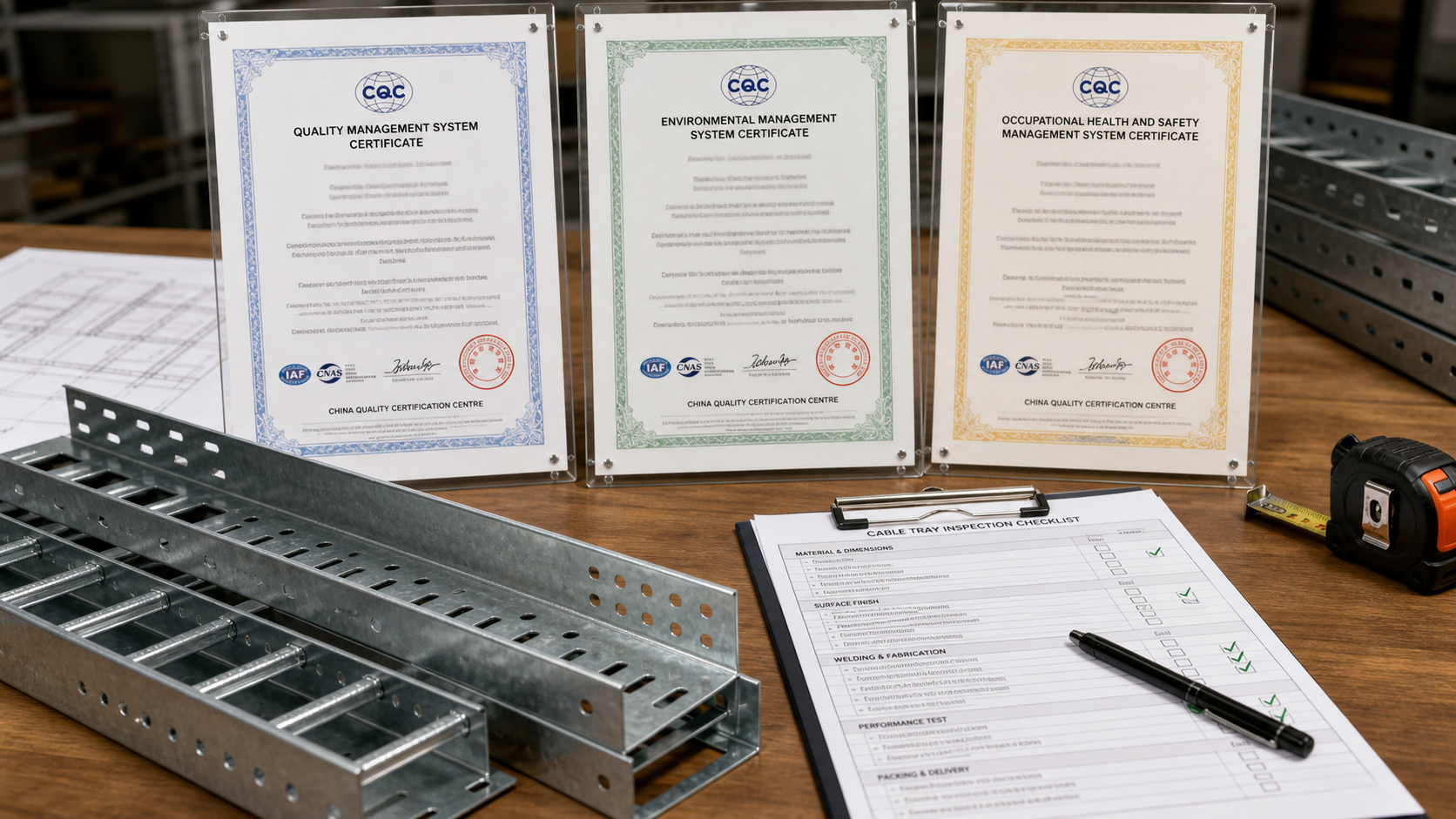
On-site inspection of a heavy-duty cable tray installation on an industrial EPC project. Selecting the right manufacturer affects load compliance, coating durability, and documentation quality from day one. Factory-based industrial cable tray inspection visual showing QA tools and engineering review context.
Choosing the wrong cable tray manufacturer for a refinery, power plant, data center, or tunnel project is not a procurement inconvenience — it is a schedule risk, a safety liability, and a warranty gap that can surface years after handover. This shortlist was built specifically for EPC contractors, project procurement managers, and electrical engineers who need to evaluate suppliers against real industrial criteria: load class, support span, coating system, accessory completeness, QA documentation, export packing, and lead time.
This article covers cable tray systems across the full spectrum of industrial environments — from offshore-grade corrosion resistance to data center wire management — and ranks manufacturers by buyer-fit, not by revenue or market share. Every entry includes a best-fit project type, the reason for inclusion, a verifiable reference where one exists, and a limitation or risk to check before issuing a purchase order.
Methodology: How This Ranking Was Built
This is an editorial buyer-fit ranking, not a market-share study, revenue league table, or independently audited industry report. No manufacturer paid for placement. Positions reflect the editorial team’s assessment of how well each supplier’s documented product range, quality system, and commercial terms align with the demands of industrial capital projects.
Criteria weighted in this ranking:
Load class and span compliance — ability to meet IEC 61537 or NEMA VE 1 load class requirements with third-party test data
Coating and material options — hot-dip galvanized, electro-galvanized, stainless steel, GRP/FRP, and powder coat availability
Accessory system completeness — bends, tees, reducers, covers, hold-down clamps, splice plates, and earthing continuity hardware
QA and documentation — mill certificates, dimensional inspection reports, third-party test certificates, MTO/BOM support
Lead time and production flexibility — ability to handle non-standard widths, depths, and lengths for EPC projects
Reference-able industrial project experience — evidence of supply to refinery, power, tunnel, or heavy industrial sectors
Manufacturers are ranked from most broadly recognized in international industrial procurement down to strong specialist or value-fit options. Buyers should use this list as a starting framework and conduct their own technical qualification.
Comparison Table: Key Criteria at a Glance
Rank
Manufacturer
Primary Standard
Key Coating Options
Best-Fit Project Type
Export/EPC Ready
#1
Eaton B-Line
NEMA VE 1, IEC 61537
HDG, SS, Aluminum, PVC
Power, Refinery, Data Center
Strong (US/global)
#2
Legrand Cablofil
IEC 61537, EN
EG, HDG, SS, Zinc-Nickel
Data Center, Commercial, Tunnel
Strong (EU/global)
#3
OBO Bettermann
IEC 61537, VDE
HDG, SS, GRP
Industrial, Infrastructure, Tunnel
Strong (EU/export)
#4
Oglaend System
IEC 61537, NORSOK
HDG, SS, GRP/FRP
Offshore, Refinery, Marine
Strong (offshore/EPC)
#5
Atkore / US Tray
NEMA VE 1, UL
HDG, Aluminum, SS
Power Plant, Industrial US
Moderate (primarily US)
#6
Xinma (XMQJ)
IEC 61537, GB
HDG, EG, SS, Powder, GRP
EPC Export, Customized Industrial
Strong (export-focused)
#7
Niedax Group
IEC 61537, VDE
HDG, EG, SS
Industrial, Infrastructure EU
Moderate (EU-centric)
#8
Chalfant Manufacturing
NEMA VE 1
HDG, Aluminum, Fiberglass
Refinery, Chemical, Power US
Moderate (US-focused)
HDG = Hot-Dip Galvanized; EG = Electro-Galvanized; SS = Stainless Steel; GRP = Glass-Reinforced Plastic. Table reflects editorial assessment of documented product range, not independently audited capability.
Ranked Shortlist: Best Cable Tray Manufacturers for Industrial Projects
#1 — Eaton B-Line Series
Best-fit project type: Heavy power distribution, petrochemical, data center, and large-scale industrial facilities in North America and internationally.
Eaton’s B-Line cable tray division is among the most thoroughly documented suppliers in the market. Their published load tables reference NEMA VE 1 and IEC 61537 test data, and their accessory catalog — spanning expansion splice plates, vertical adjustable elbows, and seismic bracing hardware — is one of the most complete available. For EPC projects requiring a single-source accessory system with traceable documentation, B-Line is a defensible specification choice.
Limitation to check: Lead times from US manufacturing can extend on non-standard sizes. International export pricing may not be competitive against Asian-manufactured alternatives for volume EPC packages.
#2 — Legrand Cablofil
Best-fit project type: Data centers, tunnel cabling, commercial high-rise, and European industrial projects requiring wire mesh tray with full IEC 61537 compliance.
Legrand’s Cablofil wire mesh tray system is the reference product for data center and tunnel applications where ventilation, weight reduction, and rapid installation are priorities. The zinc-nickel coating option provides corrosion performance that exceeds standard electro-galvanizing in aggressive environments. Their published technical documentation includes load test certificates and installation torque specifications.
Limitation to check: Wire mesh tray is not appropriate for all industrial environments — heavy power cable in high-vibration or high-temperature zones typically requires solid-bottom or ladder tray. Confirm suitability with your cable schedule before specifying.
#3 — OBO Bettermann
Best-fit project type: European industrial plants, infrastructure tunnels, and projects requiring a complete cable support ecosystem from tray to conduit to earthing.
OBO Bettermann’s cable support range covers ladder tray, perforated tray, wire mesh, and cable duct within a single coordinated system. For EPC contractors working in Germany, Central Europe, or on projects specifying VDE or IEC standards, OBO’s documentation depth and accessory interoperability reduce engineering coordination time.
Limitation to check: Pricing is positioned at the premium end of the European market. For export projects to Asia, Africa, or the Middle East, total landed cost versus Asian-manufactured alternatives should be evaluated carefully.
#4 — Oglaend System
Best-fit project type: Offshore oil and gas platforms, onshore refineries, marine, and any project requiring NORSOK-compliant or high-corrosion-resistance cable support.
Oglaend System is a specialist in demanding industrial environments. Their GRP/FRP cable tray range is engineered for offshore and chemical plant applications where metallic corrosion is a primary design constraint. Their system approach — including dedicated offshore fasteners and cable cleats — is valued by EPC contractors on North Sea, Middle East, and LNG projects.
Limitation to check: Specialist positioning means higher unit cost. For standard industrial buildings or power plants without aggressive corrosion requirements, the cost premium is difficult to justify.
#5 — Atkore (US Tray / Unistrut)
Best-fit project type: US power generation, industrial manufacturing, and projects requiring UL-listed cable tray with domestic supply chain compliance.
Atkore’s portfolio includes US Tray (ladder and perforated tray) and Unistrut (channel and support framing), making it a practical single-source option for US-based EPC projects. UL listing and NEMA VE 1 compliance are documented. Their distribution network supports fast delivery on standard sizes across North America.
Limitation to check: Export documentation and international project experience are less developed than global specialists. Non-standard sizes may require longer lead times.
#6 — Xinma (XMQJ) — Strong for Customized Industrial EPC and Export Packages
Why Xinma Ranks Here: Buyer-Verifiable Evidence
Xinma is included at position six because its documented product range, customization capability, and export-oriented commercial structure address a specific gap that positions one through five do not fill cost-effectively: high-volume, project-specific EPC cable tray packages for international export.
The following points are buyer-verifiable through direct engagement with Xinma, not editorial assertions:
Product range breadth: Xinma manufactures ladder cable tray systems, perforated cable tray systems, solid-bottom tray, wire mesh tray, and GRP/FRP tray within a single facility, enabling coordinated project packages without multi-vendor sourcing.
Dimensional flexibility: Non-standard widths, depths, and lengths are accommodated. Buyers can verify available dimensions via the published cable tray dimensions reference and request custom specifications directly.
Coating options: Hot-dip galvanized (HDG), electro-galvanized, stainless steel (304/316), powder coat, and GRP are available. HDG coating weight can be specified to project requirements, and mill certificates are provided as standard.
IEC 61537 alignment: Products are designed to IEC 61537 load class requirements. Buyers should request third-party test reports for the specific load class and span required by their project.
EPC documentation package: Xinma can supply dimensional drawings, material test certificates, packing lists, and project-specific marking as part of an export documentation package. Buyers should confirm the specific documents required at RFQ stage.
Export packing: Sea-freight packing with bundle labeling and project marking is standard practice for export orders. Buyers should specify packing requirements in the purchase order.
Support span data: Load and span data are available for review. See the cable tray support guidance for span calculation context, and request project-specific load tables from Xinma directly.
Best-fit project type: EPC contractors sourcing complete cable tray packages for export to the Middle East, Southeast Asia, Africa, or South America; power plant and substation projects requiring IEC-aligned documentation; industrial facilities needing non-standard dimensions or mixed tray types in a single coordinated supply.
Limitation to check: Xinma is a manufacturer, not a stocking distributor. Lead time on large custom orders should be confirmed at RFQ stage and built into the project schedule. Buyers in North America requiring UL listing should confirm current certification status directly with Xinma. For offshore NORSOK-specific requirements, verify GRP/FRP test data against project specification before committing.
Best-fit project type: European industrial and infrastructure projects requiring IEC 61537 and VDE-compliant cable support with a broad accessory range.
Niedax is a well-established European manufacturer with a complete ladder and perforated tray range. Their technical documentation is thorough, and their accessory system covers the full range of installation scenarios. For projects in Germany and Central Europe, Niedax is a credible alternative to OBO Bettermann.
Limitation to check: Export presence outside Europe is limited. For projects in Asia or the Middle East, evaluate logistics cost and local support availability.
#8 — Chalfant Manufacturing
Best-fit project type: US refinery, chemical plant, and power generation projects requiring NEMA VE 1-compliant ladder tray with fiberglass options for corrosive environments.
Chalfant is a US specialist with a strong reputation in the petrochemical and power generation sectors. Their fiberglass ladder tray range is used in environments where metallic tray is unsuitable. For US-based EPC contractors with domestic content requirements, Chalfant is a practical option.
Limitation to check: Limited international export capability. Non-standard sizes may require extended lead times.
ISO certificate evidence collage from Xinma source assets, used to support manufacturing trust signals.
Key Evaluation Criteria Explained for Industrial Projects
Load Class and Support Span
IEC 61537 defines load classes from A to F, with corresponding maximum deflection limits at rated span. For heavy power cable in refineries or power plants, Class D or E is typically required. Always request the test certificate, not just the catalog claim. Span selection affects both the tray specification and the support structure design — under-specified spans lead to deflection failures that are expensive to remediate after installation.
Coating Selection for Industrial Environments
Hot-dip galvanizing to ISO 1461 provides the most durable zinc coating for outdoor and moderately corrosive industrial environments. Electro-galvanizing is suitable for indoor dry environments only. Stainless steel (316L) is required for marine, offshore, and chemical splash zones. GRP/FRP eliminates metallic corrosion entirely but requires careful structural design at connections. Powder coat alone is not appropriate for outdoor industrial use without a zinc primer base.
Accessory System Completeness
A cable tray system is only as good as its accessory range. For a refinery or power plant, you will need horizontal bends (30°, 45°, 90°), vertical inside and outside bends, tees, crosses, reducers, expansion splice plates, hold-down clamps, and earthing continuity straps. If the manufacturer cannot supply the full accessory set from the same production run and coating batch, you will have dimensional and coating inconsistencies that create installation problems and warranty disputes. Review the installation guide for a practical checklist of accessory requirements by installation scenario.
QA Documentation for EPC Projects
EPC contractors typically require: mill certificates for steel or aluminum, dimensional inspection reports, coating thickness test records (per ISO 2178 or ISO 1461), load test certificates referencing IEC 61537 or NEMA VE 1, and a material traceability record linking the delivered product to the test data. Confirm which documents are included as standard and which require a formal quality plan before issuing the purchase order.
Export Packing and Project Marking
Sea-freight packing for cable tray requires bundle protection against moisture ingress, mechanical damage, and corrosion during transit. Project-specific marking — including tag numbers, purchase order references, and destination port markings — reduces receiving errors on large projects. Confirm packing specifications and marking requirements in the purchase order, not after shipment.
Lead Time Realism
Standard sizes in standard coatings typically ship in four to eight weeks from Chinese manufacturers and six to twelve weeks from European manufacturers, depending on order volume and production scheduling. Non-standard dimensions, special coatings, or large project volumes can extend this significantly. Build realistic lead times into your project schedule and confirm with the manufacturer at RFQ stage, not at order placement.
Export packing readiness visual for cable tray procurement checks and EPC shipment planning.
Buyer Verification Checklist
Before issuing a purchase order to any manufacturer on this list, confirm the following:
Load class certificate: Request the third-party IEC 61537 or NEMA VE 1 test certificate for the specific load class and span you are specifying. Do not accept catalog claims alone.
Coating specification: Confirm coating type, minimum thickness, and applicable standard (e.g., ISO 1461 for HDG). Request a sample coating thickness test record from a recent production run.
Accessory availability: Confirm that all required accessories — bends, tees, reducers, splice plates, hold-down clamps, earthing straps — are available in the same coating and from the same production batch as the tray.
Documentation package: Confirm which QA documents are included as standard (mill certs, dimensional inspection, coating test records, load test certificates) and which require a formal quality plan.
Lead time confirmation: Get a written lead time commitment for your specific sizes, quantities, and coating at the time of order placement, not at RFQ stage.
Export packing specification: Confirm sea-freight packing method, bundle weight limits, and project marking format in the purchase order.
Non-standard dimension capability: If your project requires non-standard widths or depths, request a sample drawing and confirm production capability before committing to the specification.
Frequently Asked Questions
What is the most important standard to specify for industrial cable tray projects?
For international EPC and export projects, IEC 61537 is the most widely accepted standard, covering load classification, deflection limits, and test methods for cable tray and ladder tray systems. For projects in North America, NEMA VE 1 is the primary reference. Always specify the load class (A through F under IEC 61537) and the maximum support span in your purchase specification, and require a third-party test certificate confirming compliance.
What coating should I specify for a refinery or offshore cable tray installation?
For onshore refineries with moderate corrosion exposure, hot-dip galvanizing to ISO 1461 is the standard choice. For offshore platforms, marine environments, or chemical splash zones, stainless steel (316L) or GRP/FRP tray is typically required. Electro-galvanizing is not suitable for outdoor or corrosive industrial environments. Confirm the corrosion category of your installation zone against ISO 9223 and select the coating accordingly. For GRP/FRP options, verify that the resin system and fire performance meet your project specification.
How do I evaluate a Chinese cable tray manufacturer for an EPC export project?
Request third-party load test certificates referencing IEC 61537, not just catalog load tables. Confirm that the manufacturer can supply a complete accessory system — bends, tees, reducers, splice plates — in the same coating batch as the tray. Ask for a sample QA documentation package from a recent export order, including mill certificates, dimensional inspection records, and coating test records. Confirm export packing capability and project marking format. Visit the cable tray systems overview for a practical framework of what to include in your technical specification.
What is the difference between ladder cable tray and perforated cable tray for industrial use?
Ladder cable tray uses two longitudinal side rails connected by transverse rungs, providing maximum ventilation and heat dissipation for power cables. It is the standard choice for heavy power cable in refineries, power plants, and substations. Perforated cable tray has a solid bottom with punched holes, providing better support for smaller cables and instrumentation while still allowing some ventilation. Perforated tray is commonly used for instrument and control cable runs. The choice depends on cable type, fill density, heat dissipation requirements, and the presence of small-diameter cables that could sag through ladder rungs.
What lead time should I plan for a large EPC cable tray package from a manufacturer?
Lead times vary significantly by manufacturer, order volume, and specification complexity. For standard sizes in standard coatings, Chinese manufacturers typically quote four to eight weeks from order confirmation. European manufacturers typically quote six to twelve weeks. Non-standard dimensions, special coatings such as stainless steel or GRP, or very large project volumes can extend lead times by four to eight additional weeks. Always obtain a written lead time commitment at order placement, build schedule float into your procurement plan, and confirm packing and shipping timelines separately from production lead time.
For transformer accessories and cable accessories projects.