Aluminum vs Steel Cable Tray: Which Material Is Better for 2026 Projects?
Aluminum vs steel cable tray is usually decided by load performance, support spacing, corrosion exposure, and maintenance consequences—not material price alone. In most 2026 projects, aluminum is the better choice for corrosive outdoor runs and lower dead load, while steel is typically better for longer spans, higher stiffness, and heavier cable loading where deflection governs.
Cable tray selection affects span tables, hanger reactions, bonding details, field handling, and long-term inspection needs. For specifiers, aluminum vs steel cable tray is an engineering comparison first and a procurement comparison second.
What Is the Real Difference Between Aluminum and Steel Cable Tray?
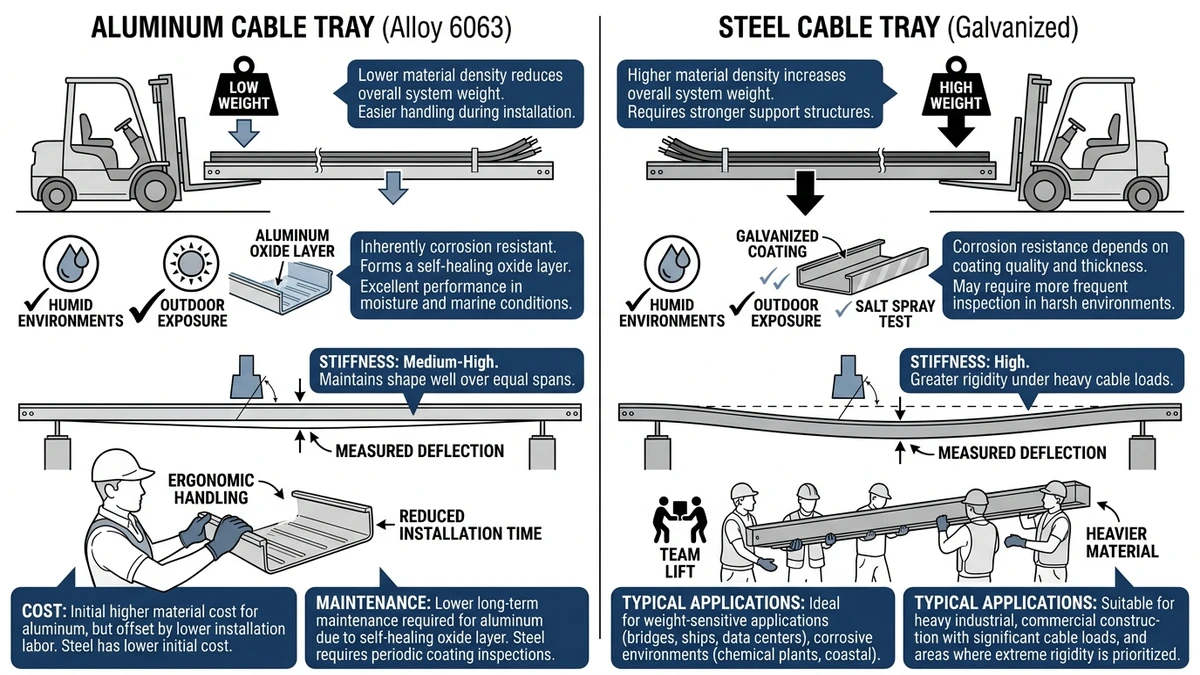
The real difference in aluminum vs steel cable tray comes from density, stiffness, and corrosion behavior. Aluminum is lighter and generally more corrosion-resistant in atmospheric exposure; steel is stiffer and usually more tolerant of impact and long-span loading in the same tray profile.
Density, stiffness, and what they change in design
Aluminum is about 2,700 kg/m³, while carbon steel is about 7,850 kg/m³, so aluminum tray often weighs only 35%–50% as much as a comparable steel section. Steel, however, has an elastic modulus of about 200 GPa versus roughly 69 GPa for aluminum, so the same tray geometry will usually deflect far less in steel. In practice, aluminum often needs a deeper section or closer supports to match steel on span performance.
Corrosion mechanism, not brochure language
Aluminum usually performs better in wet outdoor service because it forms a stable oxide layer. Steel depends on its finish, and once coatings are damaged at cut edges, drilled holes, or supports, corrosion can progress quickly. On real projects, fittings and field modifications often corrode before straight tray lengths.
Use when / avoid when / check before specifying
Use aluminum when
Use aluminum cable tray when corrosion exposure, low dead load, or difficult installation access controls the design. It is often the better fit for rooftops, coastal facilities, wastewater areas, and long suspended runs.
Use steel when
Use steel cable tray when longer spans, higher stiffness, and better abuse resistance matter more than weight. It is commonly preferred in indoor utility corridors and heavy power distribution runs.
Avoid assuming either material solves everything
Avoid specifying aluminum without checking support spacing and deflection under actual cable load. Avoid specifying steel for wet or outdoor exposure without checking finish durability and field-cut repair details.
Check before specifying
Check actual cable load, support spacing, deflection criterion, corrosion environment, bonding method, and mixed-metal interfaces before locking the material.
[Expert Insight]
– If the route is overhead and congested, weight reduction often saves more labor than material substitutions elsewhere in the support system.
– If the route includes many tees, risers, and reducers, compare the full tray system rating—not just straight lengths—because fittings often govern the final selection.
– For early-stage budgeting, a lighter tray can reduce structural support steel and anchor count enough to offset part of the higher material price.
Load, Deflection, and Support Spacing: Which Material Performs Better Structurally?
Structurally, steel usually performs better in aluminum vs steel cable tray comparisons when spans are long and loads are high. Aluminum usually performs better when the route can accept closer supports and the project benefits from lower dead load.
IEC 61537 is the key reference for cable tray and cable ladder testing, because tray selection should be tied to tested load performance rather than nominal thickness alone. See the standard publication page here: IEC 61537 publication page
Why stiffness usually governs before strength
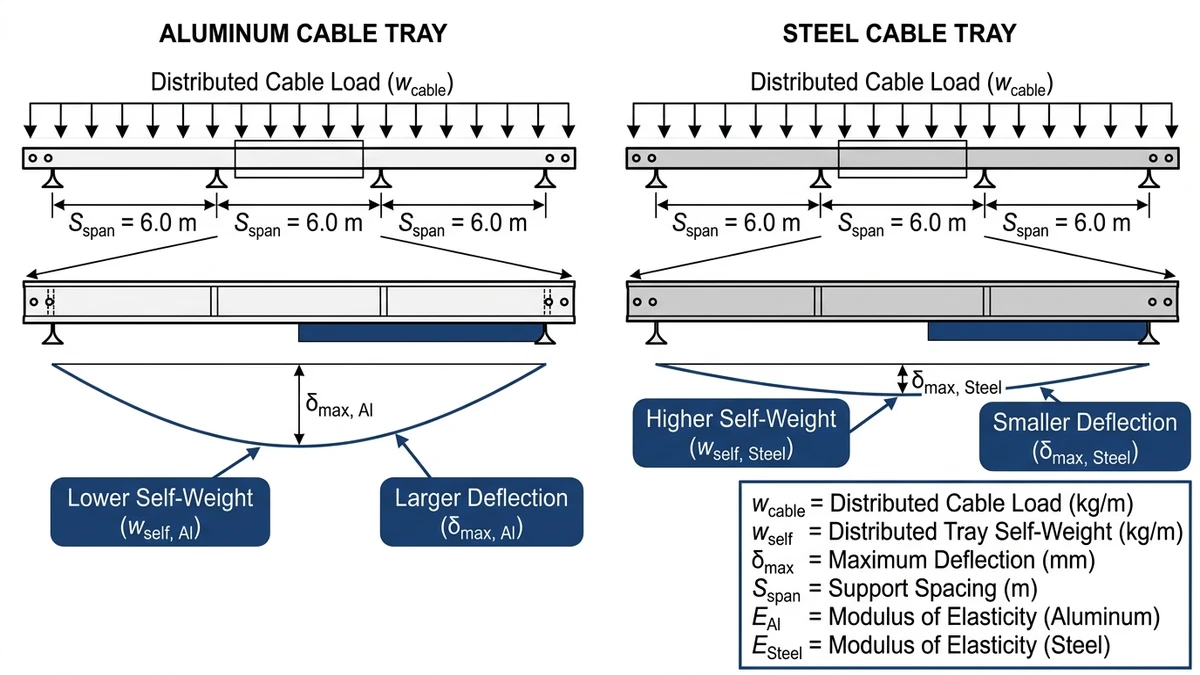
In tray design, deflection usually becomes a problem before ultimate strength. On a 3.0 m span carrying 75 kg/m with an L/200 limit, allowable midspan deflection is 15 mm; a steel tray may meet that in a standard profile, while an aluminum tray of the same geometry may need a deeper section or support spacing reduced to around 2.0–2.5 m.
Engineering comparison: same route, different consequences
Design condition
Aluminum cable tray
Steel cable tray
Specification consequence
Span target 2.5–3.0 m
Often needs a deeper section or closer supports
More likely to meet stiffness target in standard profiles
Steel often reduces support count
Cable load 75–150 kg/m
Feasible, but deflection must be checked closely
Usually better structural margin at same profile depth
Steel tends to be preferred for heavy power runs
Support steel limited
Lower dead load helps
Heavier system increases reactions
Aluminum may reduce hanger size or anchor demand
Wide tray 450–900 mm
Deflection becomes more sensitive
Better control of lateral and vertical stiffness
Steel often simplifies long-span layouts
Seismic mass concern
Lower suspended mass
Higher suspended mass
Aluminum can reduce inertial load, but restraint design still needs checking
When aluminum still wins structurally
Aluminum still works well when closer supports are acceptable. On suspended rooftop runs, reducing spacing from 3.0 m to 2.0 m can still be the better choice if it lowers tray weight and improves corrosion performance.
Use when / avoid when / check before specifying
Use steel when
Use steel when support spacing needs to reach roughly 2.5–4.0 m, cable loads rise into the 100–200 kg/m range, or localized loads require higher stiffness.
Use aluminum when
Use aluminum when dead load on the structure is constrained, spans can be shortened, and corrosion exposure would penalize steel over the system life.
Avoid when
Avoid selecting by tray depth alone. Section geometry, rung spacing, splice design, and support spacing all affect tested performance.
Check before specifying
Check straight sections and fittings together, because tees, elbows, reducers, and risers can lower the practical system rating. For sizing logic and fill planning, see Xinma’s guide to tray width and depth selection and its broader overview of cable tray system applications.
Figure 1. Structural comparison showing how tray material, span, and load affect deflection behavior under equivalent routing conditions.
Corrosion, Electrical Bonding, and Maintenance Reality: Which Material Holds Up Better on Site?
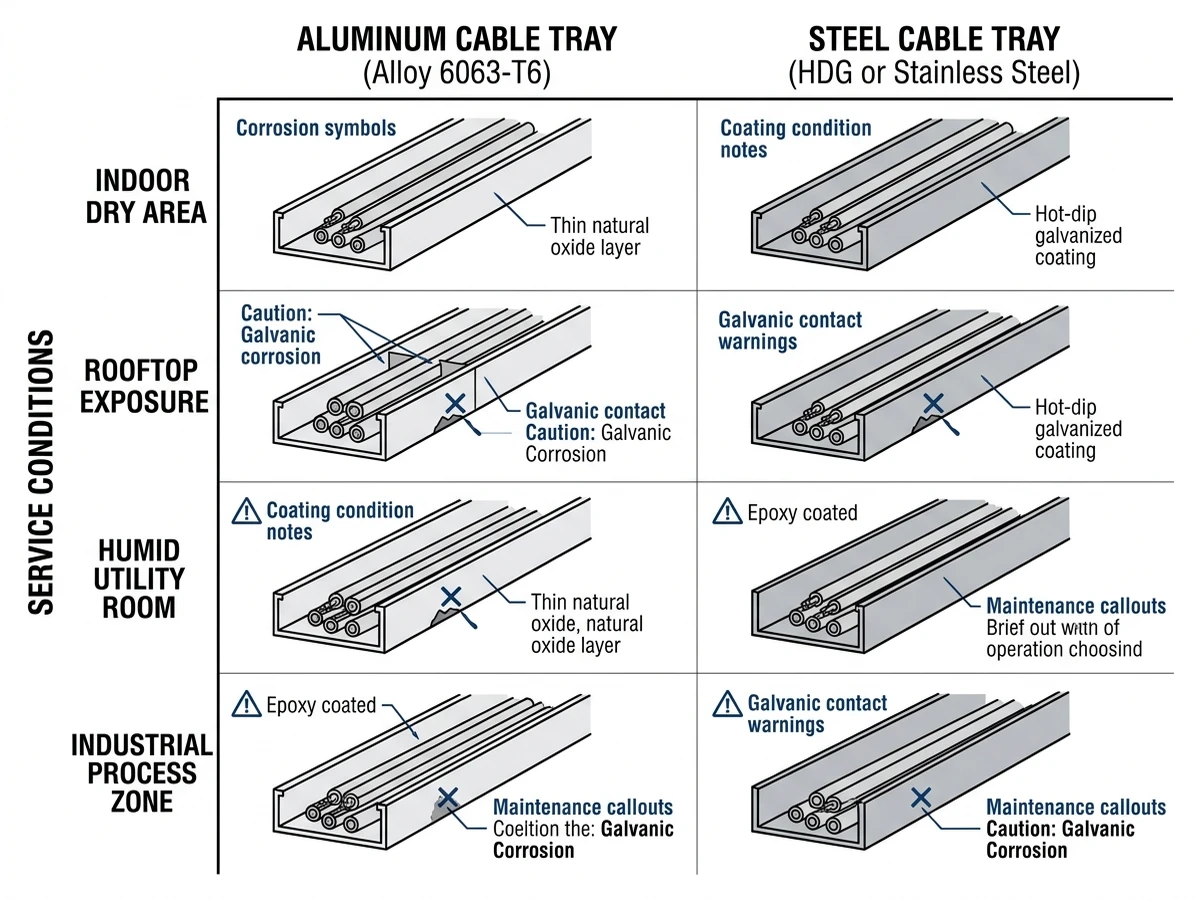
On site, aluminum vs steel cable tray is often settled by the first likely failure mode. In wet atmospheric exposure, aluminum usually lasts better with less remedial work; in mechanically harsh indoor environments, steel often gives a more conservative answer for abuse resistance and bonding continuity.
Corrosion behavior by exposure type
Site condition
Aluminum cable tray
Steel cable tray
Design takeaway
Indoor dry room, 20–35 °C
Usually low corrosion risk
Usually low corrosion risk with suitable finish
Steel often wins on cost and stiffness
Outdoor industrial atmosphere
Generally good atmospheric resistance
Finish quality and repair details matter
Aluminum often reduces maintenance exposure
Coastal or de-icing salt exposure
Usually better, but galvanic interfaces need control
Coating damage can spread faster at edges and fittings
Aluminum is often preferred unless a higher-grade metallic system is justified
Washdown or aggressive chemical area
Must be checked chemical-by-chemical
Finish breakdown can accelerate underfilm corrosion
Neither should be assumed suitable without compatibility review
Mixed-metal hardware environment
Watch galvanic contact and standing moisture
Watch cut edges and damaged coating
Joint detailing often matters more than base material claims
Bonding and protective conductor function
Bulk conductivity is not the main issue; joint resistance over time is. Oxide films, coatings, loose hardware, and dissimilar-metal interfaces can all increase resistance, so under IEC 61537, electrical continuity should be treated as a system design question. Either material can work if the bonding path is detailed explicitly and verified during commissioning.
Maintenance reality after handover
Maintenance teams usually see cut-edge rust, coating damage, and support corrosion on steel systems, while aluminum more often shows denting or bent side rails in high-traffic areas. On exposed routes, debris and standing moisture around supports and fittings often drive deterioration faster than the straight tray itself.
Use when / avoid when / check before specifying
Use aluminum when
Use aluminum for outdoor runs, rooftops, coastal exposure, and difficult-access routes where future recoating or replacement would be disruptive.
Use steel when
Use steel where the tray may take incidental impact, where the environment is dry and controlled, or where the tray is expected to support a straightforward bonding approach.
Avoid when
Avoid mixed-metal detailing by default. Aluminum tray with stainless or copper hardware may be acceptable, but only if galvanic exposure and persistent moisture are considered.
Check before specifying
Check finish type, field-cut repair method, bonding jumpers where needed, and inspection interval. If the route includes many fittings or expansion points, also review tray fittings compatibility early, because those joints often determine maintenance burden.
[Expert Insight]
– In rooftop service, the tray body is often not the first item to fail; supports, clamps, and field cuts usually age faster and should be specified to the same corrosion logic.
– Maintenance teams prefer routes where debris can be cleaned without removing multiple covers, because trapped moisture accelerates corrosion regardless of material.
– If the tray is expected to contribute to the bonding path, measure and document joint continuity during commissioning rather than relying on visual inspection alone.
Figure 2. Environment matrix comparing likely corrosion behavior and maintenance implications for aluminum and steel cable tray installations.
Installation Speed vs Life-Cycle Cost: Where Does Each Material Win in 2026 Projects?
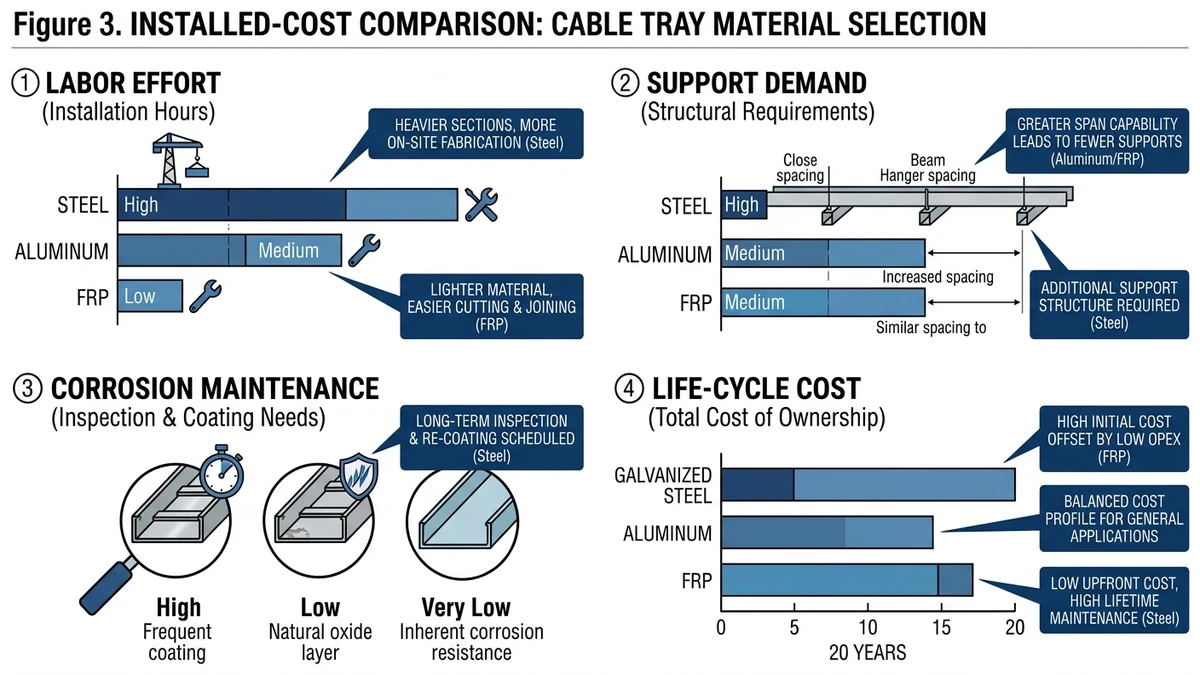
For aluminum vs steel cable tray in 2026 projects, labor and maintenance often decide the winner. Aluminum generally reduces installation effort on overhead and retrofit work, while steel generally lowers first cost in dry indoor duty and holds up better where rough handling is likely.
Where aluminum saves time
Aluminum sections are typically 30%–50% lighter than comparable steel sections, which reduces lifting effort, installer fatigue, and adjustment time on long overhead runs. In retrofit work, crews also usually cut and drill aluminum faster, which matters when access windows are short. For route planning and support spacing decisions, Xinma’s guide to support arrangement and hanger layout helps connect material selection to installation reality.
Where steel still wins on project economics
Steel often remains the lower-cost choice per meter in standard indoor conditions, especially in pre-galvanized form. That advantage shrinks when the project includes outdoor exposure, frequent field cuts, difficult maintenance access, or limited support capacity, because repair and inspection can outweigh the lower purchase price.
Trade-off logic, not feature logic
Choose aluminum if the project can accept closer supports but cannot accept corrosion-driven maintenance or heavy suspended mass. Choose steel if the project can accept higher dead load but cannot accept extra support density, lower stiffness, or impact-related damage.
Use when / avoid when / check before specifying
Use aluminum when
Use aluminum on rooftop runs, suspended retrofits, and access-constrained installations where lighter sections reduce labor and future maintenance effort.
Use steel when
Use steel for dry interior plant rooms, utility corridors, and heavy-duty power runs where first cost and long-span stiffness drive the specification.
Avoid when
Avoid comparing only $/m. Include support quantity, installation labor, finish repair, and inspection frequency in the comparison.
Check before specifying
Check whether the selected tray type changes the labor equation. Ladder tray, perforated tray, and solid-bottom tray behave differently in weight, cable ventilation, and access. Xinma’s product references for cable tray configurations and ladder tray layouts are useful when material and tray form need to be coordinated together.
Figure 3. Installed-cost comparison linking material choice to labor effort, support demand, corrosion maintenance, and project type.
How Xinma Helps Coordinate Loading, Corrosion, Access, and Fittings Decisions
Material selection is rarely isolated. Once aluminum vs steel cable tray is chosen, support spacing, fittings, bonding details, expansion treatment, and maintenance access all shift with it.
A 300 mm tray carrying 40 kg/m of cable may work in both materials, but not with the same span, section depth, fitting rating, or support count. Add covers, reducers, vertical bends, barrier strips, or rooftop exposure, and the comparison changes again.
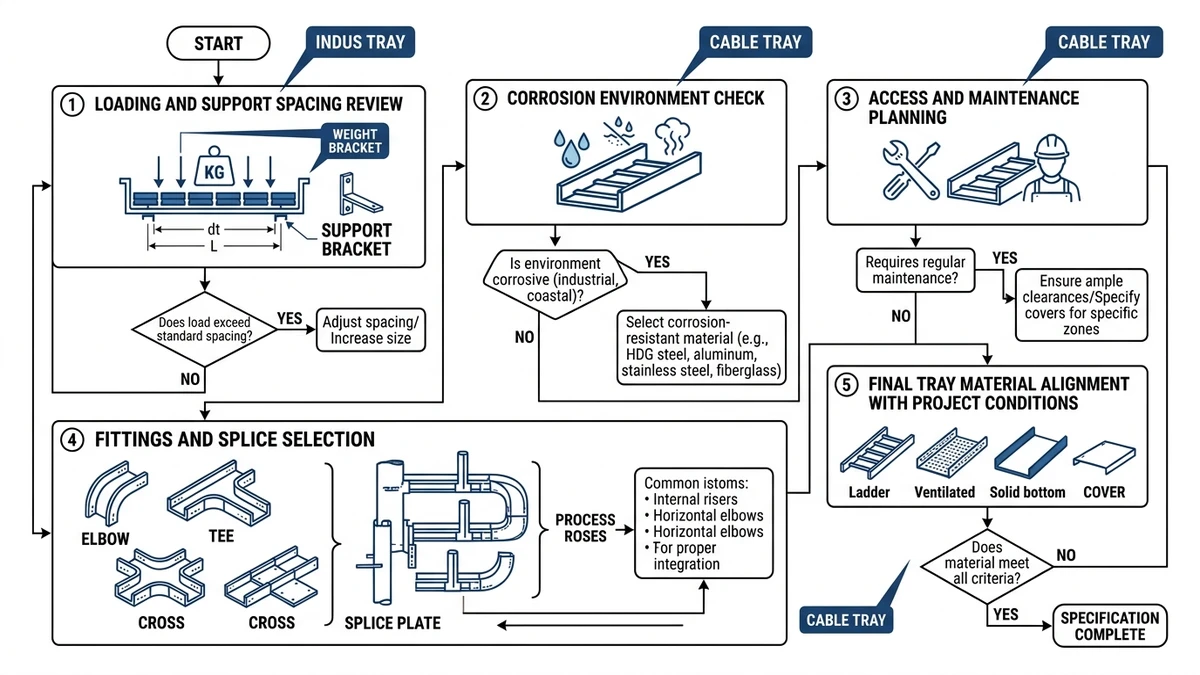
Xinma supports specification work by helping teams align five checks before procurement:
– tested load class against actual cable load in kg/m
– support spacing against deflection and structure limits
– corrosion exposure against base material and finish choice
– fitting geometry against the rating of the full tray system
– installation details such as bonding, hardware selection, and field modification limits
This matters most early in design, when support spacing, fitting load paths, and mixed-metal details can still be corrected before site installation. If your package is balancing load, corrosion class, access frequency, and fitting transitions at the same time, Xinma can help review the tray system before those variables conflict.
Figure 4. Specification coordination illustration linking tray material choice with fittings, supports, corrosion strategy, and maintenance access.
Frequently Asked Questions
Is aluminum cable tray better than steel for outdoor use?
It often is, especially in wet atmospheric or coastal exposure where corrosion resistance is a major driver. The final choice still depends on support spacing, joint detailing, and any galvanic contact with other metals.
Does steel cable tray carry more load than aluminum?
For similar tray geometry, steel usually controls deflection better because it is much stiffer. Aluminum can still meet the load requirement, but it often needs a deeper section or closer supports.
How do I choose support spacing for aluminum vs steel cable tray?
Start with the tested tray rating, actual cable load in kg/m, and the project deflection limit. If aluminum deflection is too high at the target span, reduce spacing or increase section depth before changing the material.
Is bonding easier with steel cable tray?
It is often treated that way in practice because steel joints are familiar to many designers and installers. Even so, bonding performance should be confirmed through joint design and commissioning checks rather than assumed from material alone.
When should I avoid aluminum cable tray?
Avoid it when the route demands long unsupported spans, high stiffness in a shallow profile, or strong resistance to impact from maintenance traffic. In those cases, steel may provide a cleaner structural margin.
What should I check before specifying steel cable tray outdoors?
Review the finish type, expected wetting conditions, field-cut repair method, and inspection access. Outdoor steel systems can perform well, but their maintenance burden depends heavily on how coatings and joints are treated.
Does lighter tray weight really affect project cost?
It can, especially on suspended or rooftop routes where tray mass affects hanger size, anchor demand, and lifting effort during installation. The savings are usually most visible when support capacity or labor access is limited.
Kevin Zheng
Kevin Zheng is a manager linked to Shanghai Xinma Busway & Cable Tray Co., Ltd. He writes technical content on cable tray systems, installation practice, sizing logic, load classes, and related standards for industrial and infrastructure applications.