Selecting a busway supplier is not only a price comparison. For EPC contractors and factory owners, the supplier has to support electrical design, route coordination, type-test review, production scheduling, delivery phasing, installation records, and after-sales traceability. A low unit price can become expensive if the section codes do not match the drawing, tap-off boxes arrive in the wrong sequence, or the installation team has no clear torque and inspection documentation.
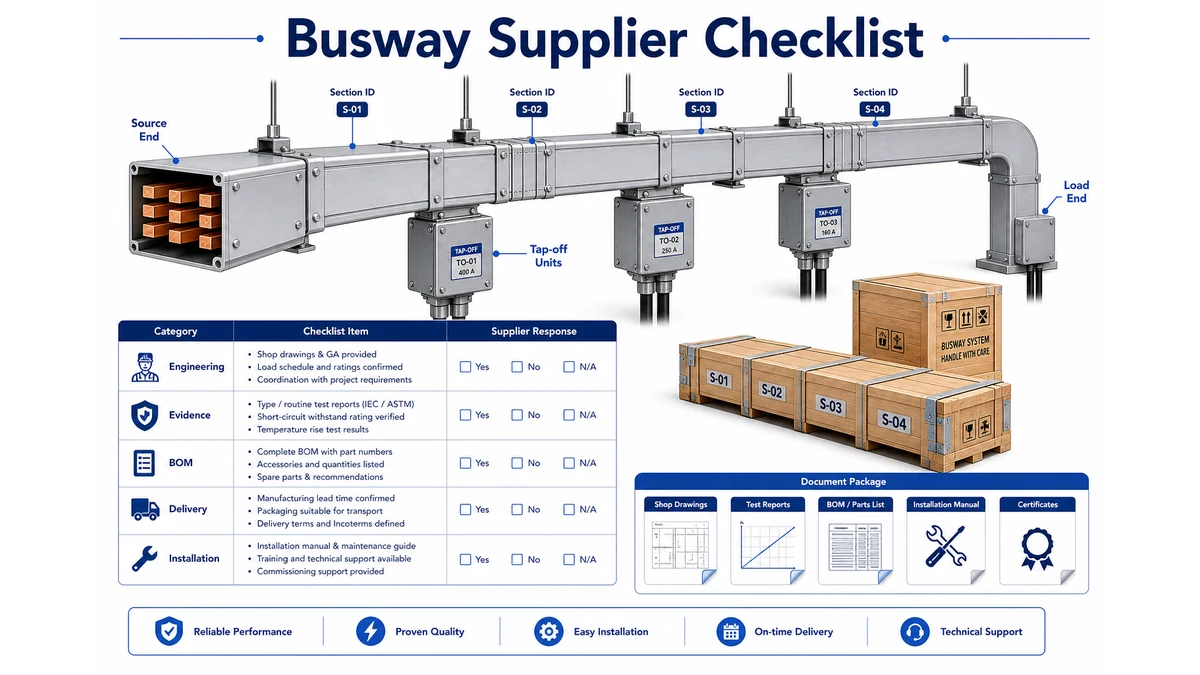
Use this checklist when comparing suppliers for busway systems in industrial plants, commercial buildings, data halls, utility rooms, and production lines. The goal is to confirm whether the supplier can deliver a complete busway route package, not only straight trunking sections.
Define whether the supplier owns only busway sections or the full route package.
Start With Scope and Route Responsibility
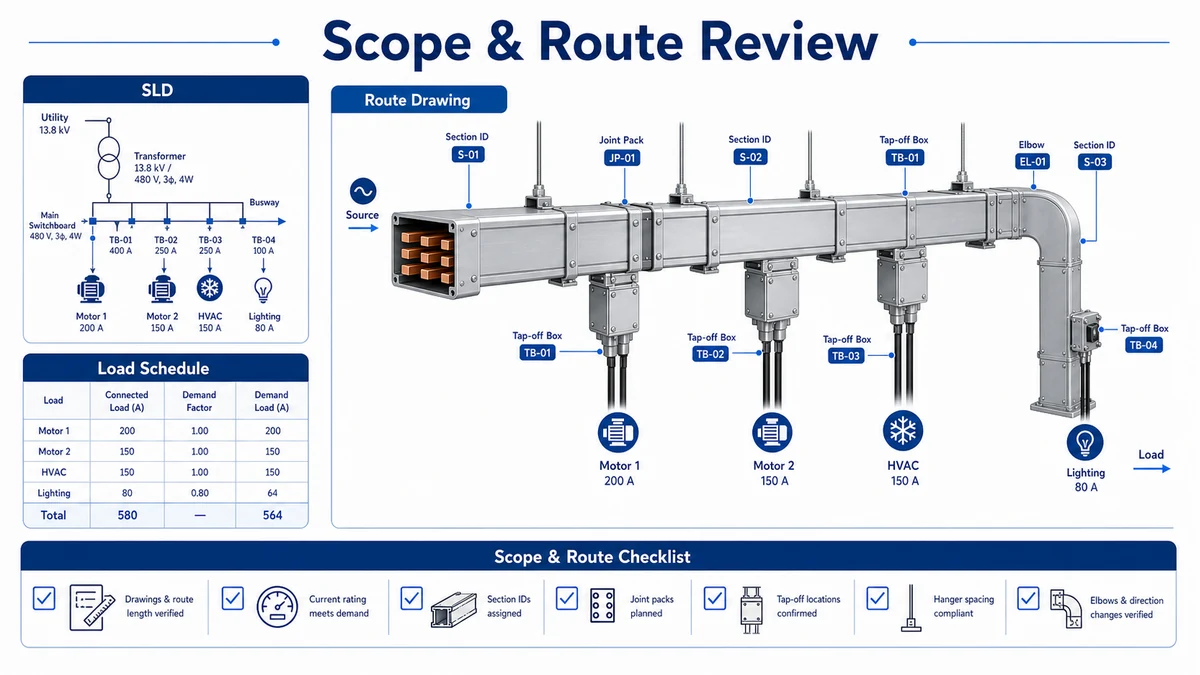
The first question is scope. A supplier may quote busway sections only, or a full route package that includes end feeds, elbows, reducers, joint packs, hangers, tap-off units, labels, drawings, and installation support. EPC buyers should define what the supplier owns before commercial comparison starts.
Ask whether the supplier can review the single-line diagram, route drawing, load schedule, site clearance, support points, riser transitions, and tap-off positions before manufacturing. If the project team only sends a current rating and route length, the quotation may miss fittings, joint packs, covers, labels, or support hardware.
For factory projects, route ownership is especially important when the production layout changes during construction. A good supplier should identify which busway sections are fixed, which tap-off locations may need adjustment, and which accessories need hold points before final production.
Check Standards and Type-Test Evidence
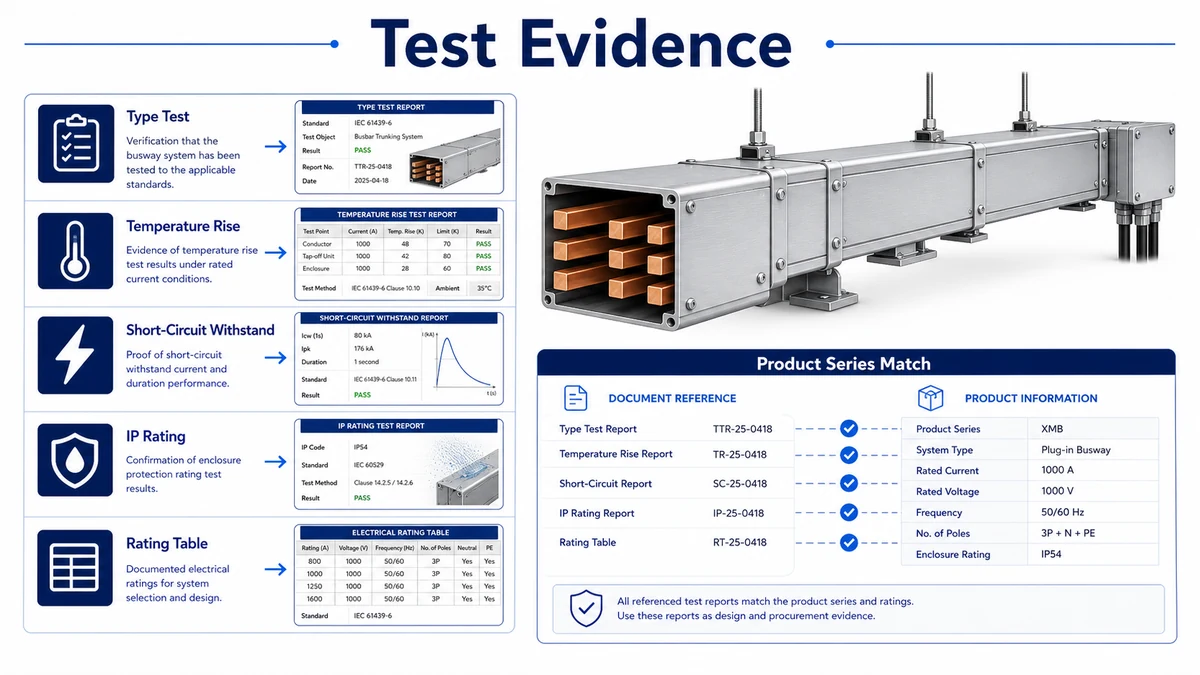
Busway is normally reviewed against low-voltage busbar trunking requirements, product series documentation, and project specifications. The supplier should provide type-test evidence, rating tables, temperature-rise data, short-circuit withstand information, enclosure rating data, and installation documentation for the actual product family being supplied.
IEC 61439-6 is the core international reference for busbar trunking systems. Buyers can cite the official IEC 61439-6 publication page when checking whether supplier documents are aligned with the correct product category. Do not accept a generic low-voltage assembly certificate as proof for every busway route. The evidence should match the busbar trunking product series, conductor material, enclosure design, and rating range.
The documentation package should also state what is project-specific and what is type-test based. Current rating, ambient condition, IP rating, conductor configuration, and fault level should not be guessed from a marketing brochure.
Type-test evidence should match the supplied busbar trunking product family and rating range.
Review Engineering Support Before Price
Engineering support can decide whether the project runs smoothly after the purchase order. Ask whether the supplier can help with route optimization, section breakdown, tap-off layout, support coordination, drawing markups, and installation method statements.
For EPC teams, the supplier should be able to produce or review busway layout drawings that correspond to the bill of materials. Each section ID, elbow, joint pack, tap-off box, hanger, and end feed should be traceable. If a supplier cannot map the BOM back to the route drawing, inspection and installation become harder later.
In an anonymized Shanghai factory expansion in 2024, an EPC team compared two busway quotations with similar unit pricing. The selected supplier provided section drawings, tap-off schedules, and joint numbering before production. The other quote only listed total route meters and current rating. The stronger documentation reduced drawing clarification cycles by roughly one week before release for manufacturing.
For North American or export-oriented projects, also ask whether the supplied product family has documentation aligned with the requested market standard, such as UL 857 for busway where it is specified by the project. NEMA guidance may also appear in project specifications or consultant review notes. These references do not replace IEC 61439-6 for an IEC-based project, but they help the buyer confirm that the supplier understands the target compliance environment instead of sending one generic certificate for every market.
Confirm Manufacturing and Delivery Control
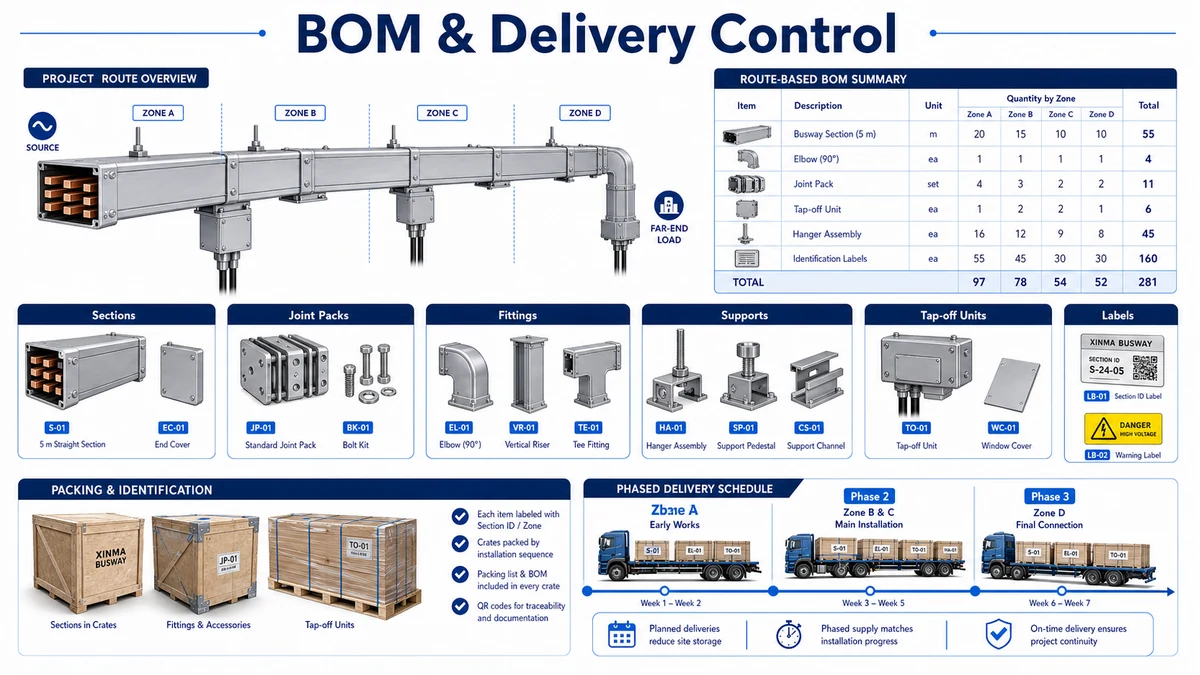
Factory capability is not only about capacity. The supplier should explain how it controls section coding, conductor assembly, enclosure finish, joint-pack matching, tap-off box compatibility, packing labels, and delivery sequence. These controls matter because busway is installed as a route, not as independent pieces.
Ask for the normal lead time, peak monthly capacity, packing method, delivery batch logic, and whether the supplier can split delivery by floor, zone, or installation phase. For renovation or phased production-line projects, repeated deliveries may be more important than one large shipment.
The delivery checklist should include route name, section ID, quantity, rating, finish, accessories, and inspection documents. Missing labels or unclear packing lists create rework at site because installers cannot quickly confirm where each section belongs.
Incoming inspection should be planned before the first truck arrives. The receiving team should know which labels to check, where to store joint packs, how to protect busway sections from moisture, and which accessories are critical for the first installation zone. If the supplier can provide a packing summary by route and floor, the site team can inspect the first batch quickly and escalate missing items before installation crews are waiting.
Also ask how the supplier handles revision control. EPC drawings often change after the first quotation because the transformer room, riser shaft, ceiling zone, or machine layout changes. The supplier should be able to mark which sections are affected by a revision, which sections are already in production, and which accessories can still be changed without delaying the full delivery. This is a practical risk-control question, not only an administrative detail.
Section codes, packing labels, and delivery sequence should match the route drawing.
Inspect Compatibility With Supports and Cable Routing
Busway rarely exists alone in the ceiling or electrical room. It shares space with cable tray, pipework, HVAC ducts, lighting, and building steel. The supplier should help confirm support interfaces, access clearance, tap-off cable exits, and coordination with nearby cable management systems.
Where tap-off boxes feed branch cables, the outgoing cable route may need tray, ladder, trunking, or local protection. The cable tray support workflow is useful for checking support spacing and access logic around adjacent cable routes. The cable tray systems overview also helps separate enclosed busway distribution from open cable support requirements.
For seismic or vibration-sensitive buildings, ask whether busway hangers, brackets, risers, and nearby trays need coordinated restraint. Xinma’s seismic bracing product information should be reviewed when the project specification requires restraint coordination instead of simple gravity supports.
Evaluate Installation and Commissioning Support
A supplier checklist should include installation support, not only product supply. Ask for installation manuals, joint torque method, insulation resistance test guidance, tap-off box installation requirements, hanger details, and inspection forms. The supplier should state which checks are required before energization.
For plug-in busway routes, tap-off box compatibility needs special attention. Confirm plug-in window spacing, mechanical lock format, branch protection rating, cable exit direction, unused window covers, and access clearance. A tap-off box that fits physically but blocks maintenance access can create long-term operation problems.
In an anonymized Suzhou machinery workshop project in 2023, the buyer added a supplier installation briefing before energization. The briefing covered joint-pack cleanliness, torque recording, and insulation resistance test sequencing for a 1250 A route. The project team reported fewer site questions during commissioning because installers and inspectors used the same checklist.
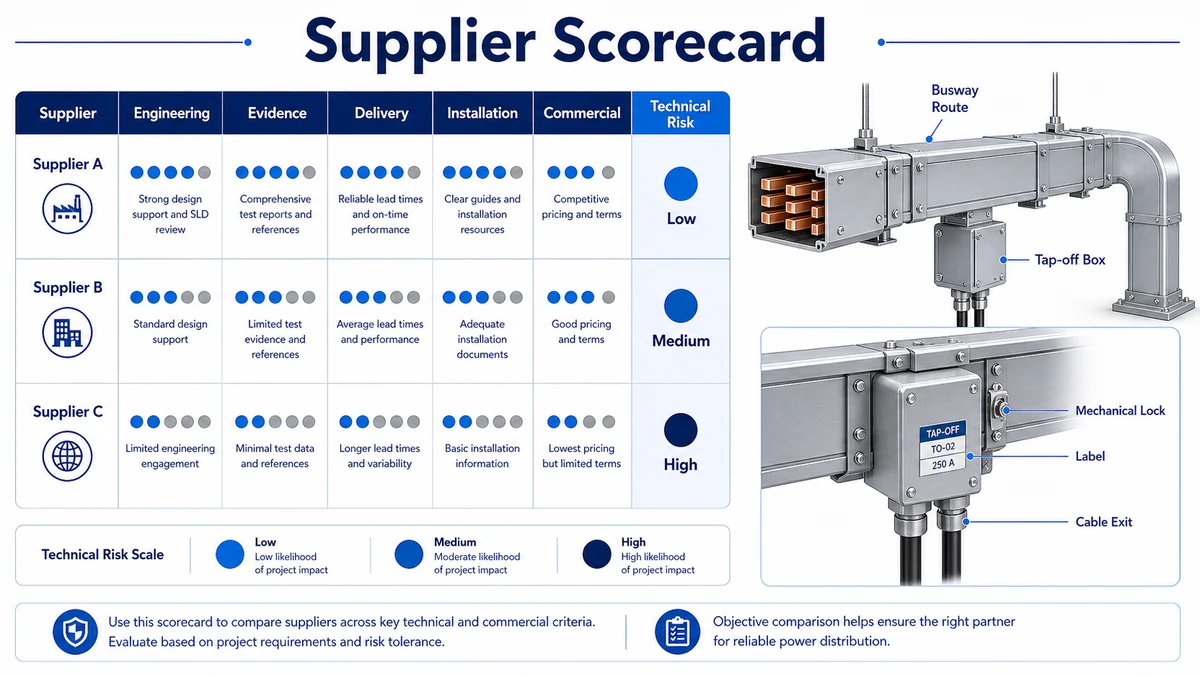
A supplier scorecard should compare technical evidence, delivery control, installation support, and commercial terms.
Compare Commercial Terms With Technical Risk
The cheapest quotation is not always the lowest-risk choice. EPC buyers should compare payment terms, warranty terms, lead time, drawing support, spare joint packs, spare tap-off units, site documentation, packing sequence, and after-sales response time. A supplier that includes complete route documentation may look more expensive at first but reduce field coordination cost.
Use a scoring table instead of relying only on price. Weight the items according to project risk: high-current routes need stronger type-test and thermal evidence; phased factory projects need stronger delivery control; plug-in systems need stronger tap-off and accessory compatibility; risers need better section identification and installation planning.
The final supplier decision should be documented. Record why the chosen supplier was accepted, which technical assumptions were confirmed, and which items remain open before manufacturing release.
Commercial review should also separate fixed items from assumptions. For example, current rating, conductor material, enclosure finish, IP rating, tap-off quantity, shipping batch, and installation support should be written into the quotation or technical appendix. If a supplier gives a low price but leaves these items undefined, later variation claims can erase the apparent saving.
For overseas or cross-region projects, confirm communication speed and document language early. A technically capable supplier can still create project risk if drawings, inspection forms, or packing lists are hard for the site team to use. The best quotation package is one that the buyer, consultant, installer, warehouse team, and maintenance team can all read without guessing.
In an anonymized Guangdong electronics plant review in 2024, the procurement team initially ranked a supplier lower because the price was about 4% higher. After scoring drawing support, packing sequence, spare tap-off availability, and installation documentation, the team kept that supplier on the shortlist because the alternative quote left several accessory assumptions open. The review did not prove one supplier was universally better; it showed why commercial comparison needs a technical risk column.
Xinma Product Ecosystem and Supplier Coordination
Shanghai Xinma manufactures busway, cable tray, fittings, accessories, and seismic bracing components within the same product ecosystem. That matters when busway supports share steelwork with tray brackets, when tap-off cable exits need a compatible tray route, and when a project requires repeated deliveries across several installation phases. The value is not a marketing ranking; it is the ability to keep model codes, finishes, support geometry, tap-off interfaces, BOM structure, and inspection documents consistent from bill of materials to site inspection.
When specifying Xinma products, use the live busway product page as the primary landing page for busway route review, and cross-check downstream cable routing against the relevant cable tray system and seismic bracing pages before finalizing the order.
Frequently Asked Questions
What should an EPC buyer check before choosing a busway supplier?
Check scope, route drawing support, type-test evidence, current rating, fault level, IP rating, section breakdown, tap-off compatibility, support details, packing sequence, lead time, warranty terms, and installation documentation.
Is price the most important factor in busway supplier selection?
Price matters, but it should not be the only decision point. A lower quotation can become more expensive if drawings, labels, joint packs, tap-off boxes, or delivery sequence are incomplete.
What documents should a busway supplier provide?
Ask for type-test evidence, rating data, layout drawings, section list, bill of materials, installation manual, joint torque guidance, insulation resistance test guidance, packing list, and warranty information.
How should tap-off boxes be checked in a supplier review?
Confirm branch rating, plug-in window format, mechanical interlock, protection device type, cable exit direction, unused cover plates, access clearance, labels, and compatibility with the selected busway series.
Why does supplier delivery sequence matter?
Busway is installed as a route. If section labels, packing sequence, or phased deliveries are wrong, installers may lose time identifying parts, correcting section order, or waiting for missing accessories.
Kevin Zheng
Kevin Zheng is a manager linked to Shanghai Xinma Busway & Cable Tray Co., Ltd. He writes technical content on cable tray systems, installation practice, sizing logic, load classes, and related standards for industrial and infrastructure applications.