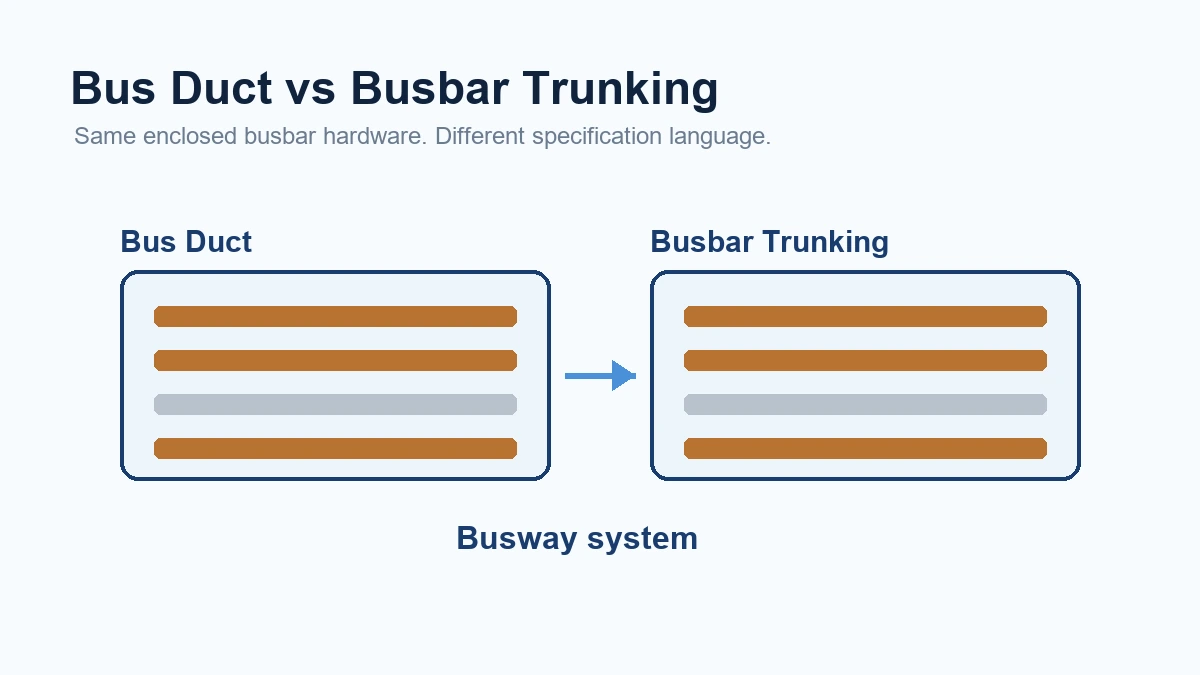
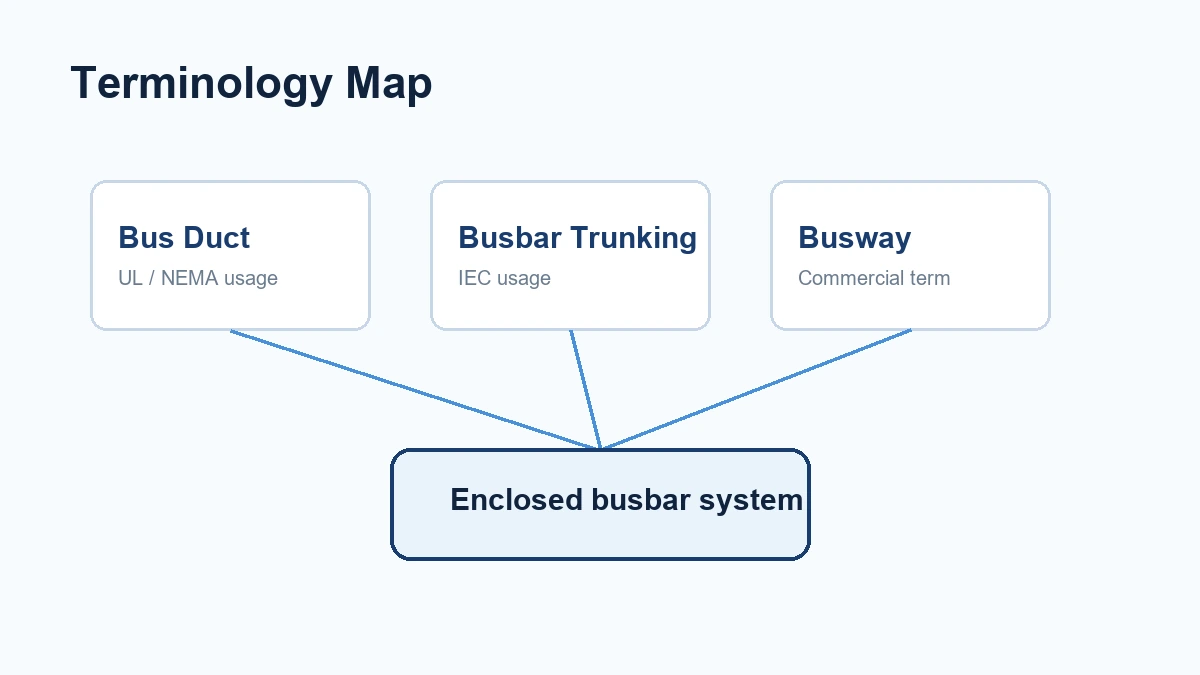
Bus duct and busbar trunking describe the same basic power-distribution concept: prefabricated metal sections that carry high current through insulated copper or aluminum busbars instead of many parallel power cables. The wording changes by market. “Bus duct” is common in North American specifications, while “busbar trunking system” is the IEC term used across Europe, Asia, the Middle East, and many international EPC projects.
For buyers, the name is less important than the evidence behind it: rated current, short-circuit withstand, enclosure protection, conductor material, joint design, tap-off layout, and the standard used for testing. Xinma’s low-voltage busway systems are specified around those engineering checks rather than the label alone.
What Is the Difference Between Bus Duct and Busbar Trunking?
Bus duct and busbar trunking are functionally the same product family. Both use factory-built enclosure sections containing insulated busbars, with straight lengths, elbows, tees, tap-off units, end feeds, and joint packs. The practical difference is the standards language and documentation expected by the project owner.
In North America, drawings often call the product bus duct or busway and reference UL 857 or NEMA documentation. In IEC-aligned projects, the same system is usually described as a busbar trunking system and tested under IEC 61439-6. The IEC standard page for busbar trunking assemblies is available from the IEC webstore.
In an anonymized 2023 pharmaceutical plant feeder review in Suzhou, replacing parallel cable feeders with a 1250 A plug-in busway package reduced estimated riser shaft space by about 60% and cut installation labor by roughly 42% across a 46 m route. The useful lesson is not the percentage alone; it is that busway savings come from factory-made joints, compact conductor geometry, and fewer parallel cable pulls.
Regional terminology changes, but the enclosed busbar hardware is the same product family.
How Standards Change the Buying Decision
The first specification question should be: which authority will accept the test report? A busway catalogue may show the correct current rating but still fail approval if the certification package does not match the project jurisdiction.
For IEC projects, request the IEC 61439-6 type-test report, short-circuit withstand value, rated insulation voltage, rated operational voltage, IP rating, and temperature-rise data. For North American projects, request the UL listing details and confirm the enclosure type expected by the electrical inspector. For China projects, GB-aligned documentation may also be required even when the base design follows IEC logic.
Three checks matter most before ordering:
Check
Why it matters
Rated current
Confirms the busway can carry the design load after diversity and derating.
Short-circuit withstand
Confirms the enclosure and joints survive the prospective fault current.
Temperature rise
Confirms connected cables and tap-off units will not operate above their limits.
Do not rely only on a declaration of conformity for a high-value feeder. Ask for the test basis and the exact model range covered by the report. A 400 A plug-in section and a 4000 A feeder section are not automatically covered by the same evidence.
What Is Inside a Busway System?
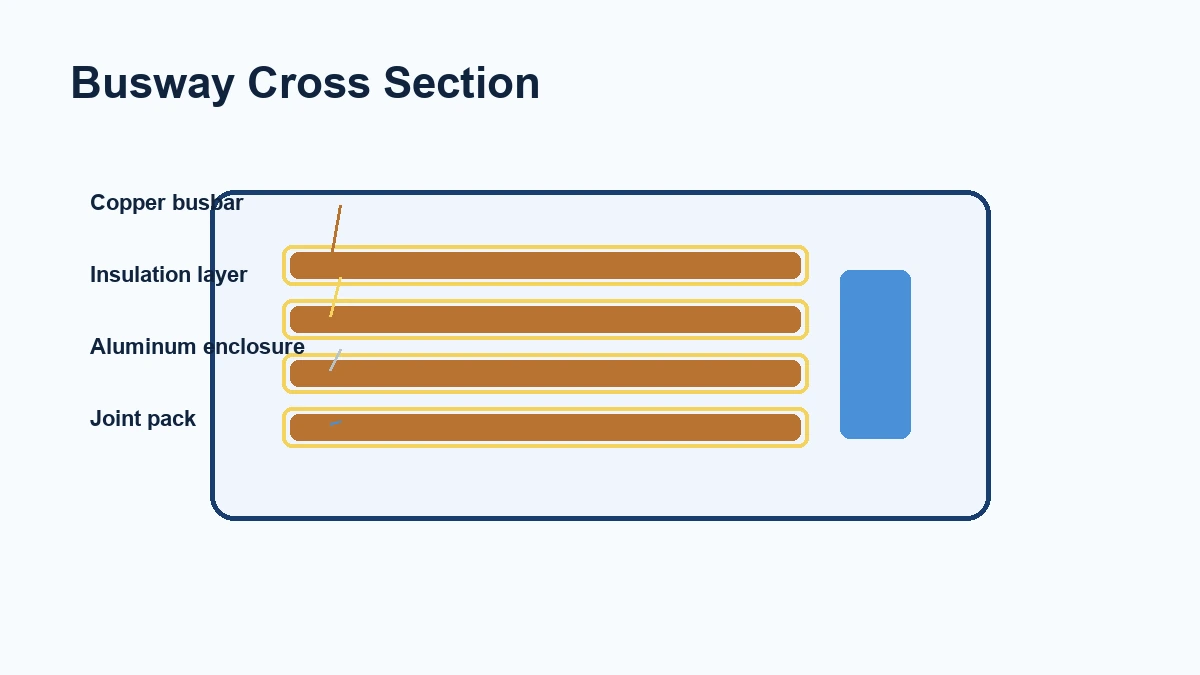
A busway system looks simple from the outside, but the performance is decided by five parts: conductor bars, insulation, enclosure, joint assembly, and tap-off interface.
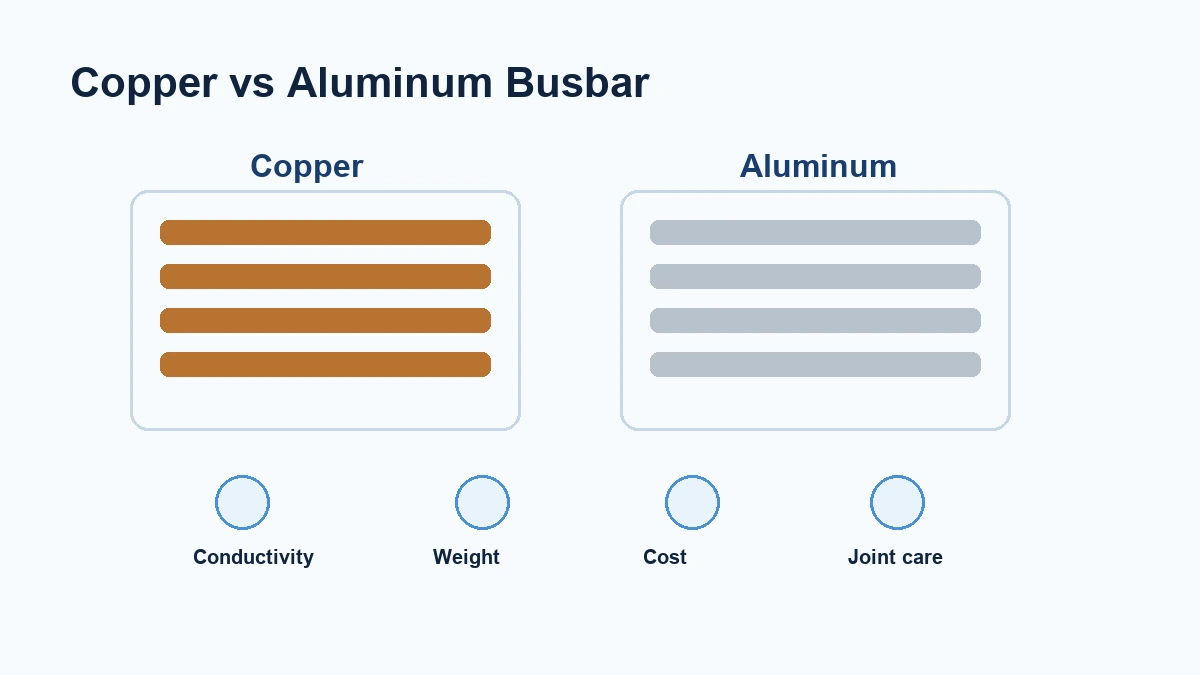
Copper busbars provide high conductivity and strong fault performance, which makes them common for data centers, hospitals, and critical feeders. Aluminum busbars reduce weight and cost, but the joint design must control oxidation and contact resistance. In both cases, the conductor shape gives busway its main advantage over cable: large flat surfaces dissipate heat and keep impedance predictable.
The enclosure protects the conductors, provides an earth path, and controls ingress protection. Clean indoor electrical rooms may only need IP40 or IP54. Dusty workshops, humid basements, tunnels, or semi-outdoor routes often require IP65 or a project-specific enclosure treatment.
The joint pack is the part most worth checking in factory inspection. Poor contact pressure creates local heating long before the busbar itself reaches its rated current. Ask for the tightening torque range, joint inspection method, and whether the design uses visible torque indicators, Belleville washers, or other pressure-control hardware.
The conductor stack, insulation, enclosure, and joint pack determine thermal and fault performance.
Feeder Busway vs Plug-In Busway
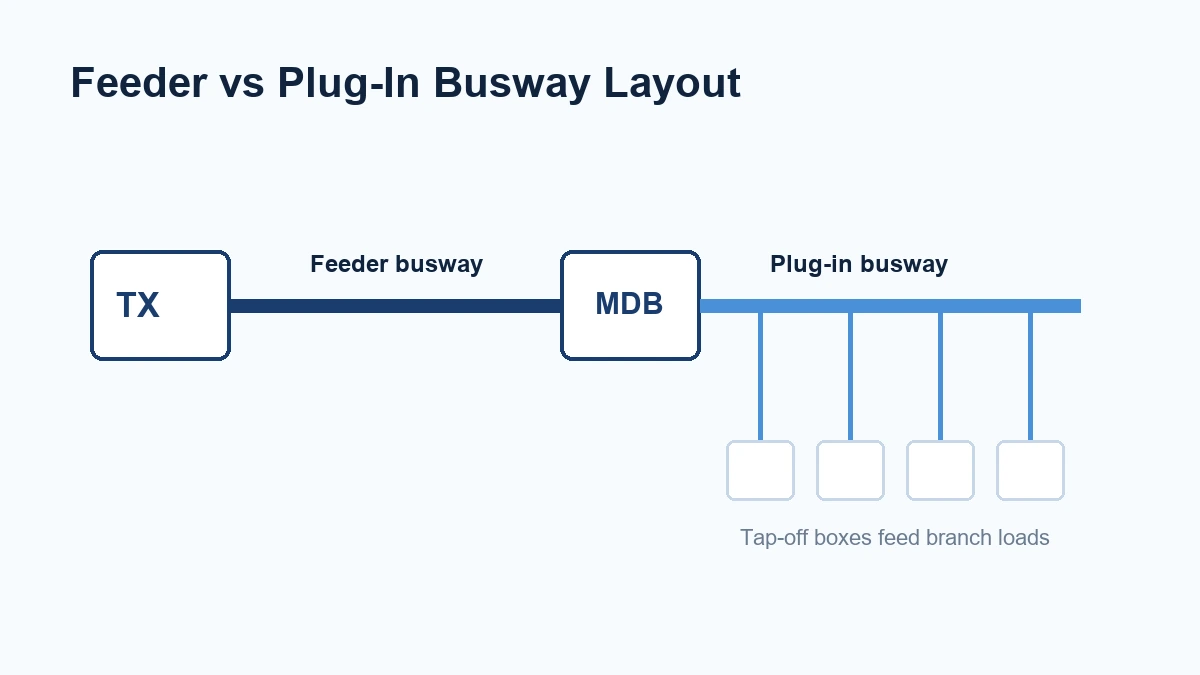
Feeder busway is used for point-to-point transmission: transformer to main distribution board, main board to sub-board, or switchgear to a fixed high-current load. It usually has no branch outlets along the route. The goal is low loss, strong short-circuit performance, and clean routing.
Plug-in busway is used when loads must connect along the route. Tap-off windows allow branch boxes to be installed at planned intervals, often 500 mm or 1000 mm depending on the system. This format suits production lines, rack rows, commercial floors, and workshops where equipment may move during the building’s life.
Use a simple rule before layout: if most current travels from one fixed source to one fixed destination, start with feeder busway. If a meaningful share of the load branches out along the run, start with plug-in busway. Mixed systems are common. A factory may use feeder busway from transformer to production zone, then plug-in busway along machine rows.
This is also where busway should be coordinated with cable management. Power distribution may run through busway, while control cables, data cables, lighting circuits, or auxiliary circuits still need tray routes. Xinma’s cable tray systems overview is useful when both systems share riser space or support steel.
Copper vs Aluminum Busbar
Copper is the conservative choice when the project prioritizes compact size, high fault withstand, and predictable joint behavior. It has higher conductivity and better mechanical strength, so a copper busway can often be more compact at the same current rating. The trade-off is higher material cost and greater weight.
Aluminum is attractive when cost and weight matter more than minimum enclosure size. A well-designed aluminum busway can perform reliably, but the supplier must control surface treatment, joint plating, contact pressure, and bimetallic transitions where aluminum connects to copper terminals.
Decision factor
Copper busbar
Aluminum busbar
Conductivity
Higher
Lower, so larger section is needed
Weight
Heavier
Much lighter
Cost
Higher
Usually lower
Joint sensitivity
Lower
Higher, needs better joint control
Best fit
Critical feeders, compact risers
Long runs, cost-sensitive plants
For a data center or hospital main feeder above 2500 A, copper is usually easier to justify. For an industrial plant with long horizontal distribution and moderate current, aluminum may deliver better installed value. The correct answer depends on the fault level, route length, ambient temperature, maintenance capability, and accepted certification.
Copper and aluminum busbars solve different cost, weight, and joint-performance requirements.
Where Busway Performs Best
Busway is strongest where high current, repeated branches, limited route space, or fast installation matter. In an anonymized 2024 Tier III data center feeder review in Shanghai, a 2500 A copper feeder busway over a 48 m route was estimated at about 3.5 installation days, compared with about nine days for the parallel-cable alternative. The practical review was not only ampacity; the team also checked lifting access, joint inspection clearance, support spacing, and whether secondary cable trays remained available for controls and monitoring circuits.
In industrial plants, plug-in busway supports production changes. A 400 A to 800 A plug-in run can feed machine rows while allowing tap-off boxes to move as the line changes. That flexibility is valuable in workshops where equipment layouts change every 18 to 36 months.
In high-rise buildings, vertical busway risers simplify floor-by-floor distribution. They reduce cable volume in shafts, create repeatable tap-off positions, and make maintenance access clearer than many parallel cable feeders. For these risers, coordinate busway hangers with ladder cable tray support structures early so support steel does not conflict with cable tray brackets, fire stopping, or access doors.
Seven Checks Before Ordering a Busway System
Before a quotation is accepted, confirm these seven parameters in writing.
Rated current after diversity, not just theoretical connected load.
Prospective short-circuit current at the supply point and required withstand time.
Voltage system, neutral sizing, and harmonic load profile.
IP rating and enclosure material for the installation environment.
Copper or aluminum conductor selection, including joint treatment.
Feeder or plug-in layout, including tap-off rating and pitch.
Expansion joints, hanger spacing, and access clearance for inspection.
Projects that combine busway and cable tray should also define the support logic early. Busway hangers and tray brackets often share the same structural grid, so support spacing principles affect both systems.
Shanghai Xinma manufactures busway, cable tray, fittings, accessories, and seismic bracing components within the same product ecosystem. That matters when the busway route shares support steel with cable tray, when tap-off access must stay clear of tray brackets, and when a project needs repeated deliveries across several phases. The value is not a marketing ranking; it is the ability to keep model codes, finishes, support geometry, and inspection documents consistent from bill of materials to site inspection.
When specifying Xinma products, use the live busway product page as the primary landing page, and cross-check route compatibility against the relevant cable tray system and seismic bracing pages before finalizing the order.
Feeder busway transmits power between fixed endpoints, while plug-in busway distributes branch loads along the route.
Frequently Asked Questions
Is bus duct the same as busbar trunking?
Yes. In most engineering contexts, bus duct and busbar trunking describe the same enclosed busbar power-distribution system. The difference is mainly regional terminology and the standard used for testing and documentation.
When should I use busway instead of power cables?
Use busway when current is high, route space is limited, branches are repeated, or fast installation matters. Cables may still be better for short, irregular, low-current routes where flexibility is more important than compact routing.
Is copper busway always better than aluminum busway?
No. Copper gives higher conductivity and stronger joint performance, but aluminum can reduce weight and cost. Aluminum is suitable when the supplier has proven joint design, coating control, and certification for the required fault level.
What IP rating should industrial busway use?
Clean indoor rooms may use IP40 or IP54. Dusty, humid, or semi-exposed industrial environments usually need IP54 or IP65. The rating should match the actual site exposure, not only the catalogue default.
What information is needed for a busway quotation?
Send rated current, voltage, fault level, route length, number of bends, vertical or horizontal orientation, tap-off quantity, conductor preference, IP rating, and site conditions. Drawings or SLDs help the supplier check layout before pricing.
Kevin Zheng
Kevin Zheng is a manager linked to Shanghai Xinma Busway & Cable Tray Co., Ltd. He writes technical content on cable tray systems, installation practice, sizing logic, load classes, and related standards for industrial and infrastructure applications.