Galvanized vs Stainless Steel Cable Tray: Which Should You Choose?
Choose galvanized steel cable tray for dry or mildly corrosive indoor service where low first cost is the main priority. Choose stainless steel cable tray for washdown, coastal, chemical, or persistently wet locations where corrosion life, access difficulty, and outage risk matter more. Under IEC 61537, both can meet the same mechanical load class; the practical difference is how they resist site corrosion over time.
Material selection affects cut edges, fittings, inspection frequency, and repair risk before cable replacement is due. In galvanized vs stainless steel cable tray decisions, corrosion mechanism and lifecycle cost usually matter more than day-one strength.
What Is the Real Material Difference Between Galvanized and Stainless Steel Cable Tray?
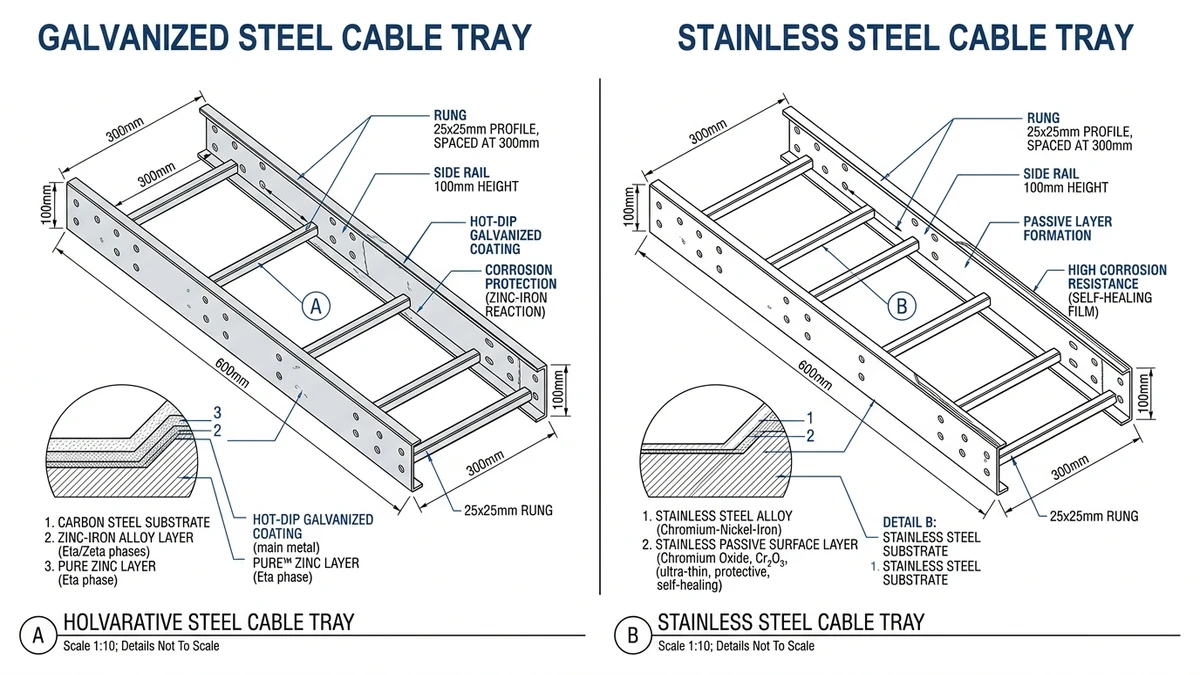
The main difference is corrosion behavior, not initial load capacity. Galvanized steel cable tray is carbon steel protected by a zinc coating, often around 45-85 μm depending on process and class, while stainless steel cable tray relies on the alloy itself—typically at least 10.5% chromium—to form a passive oxide film.
How each material protects itself
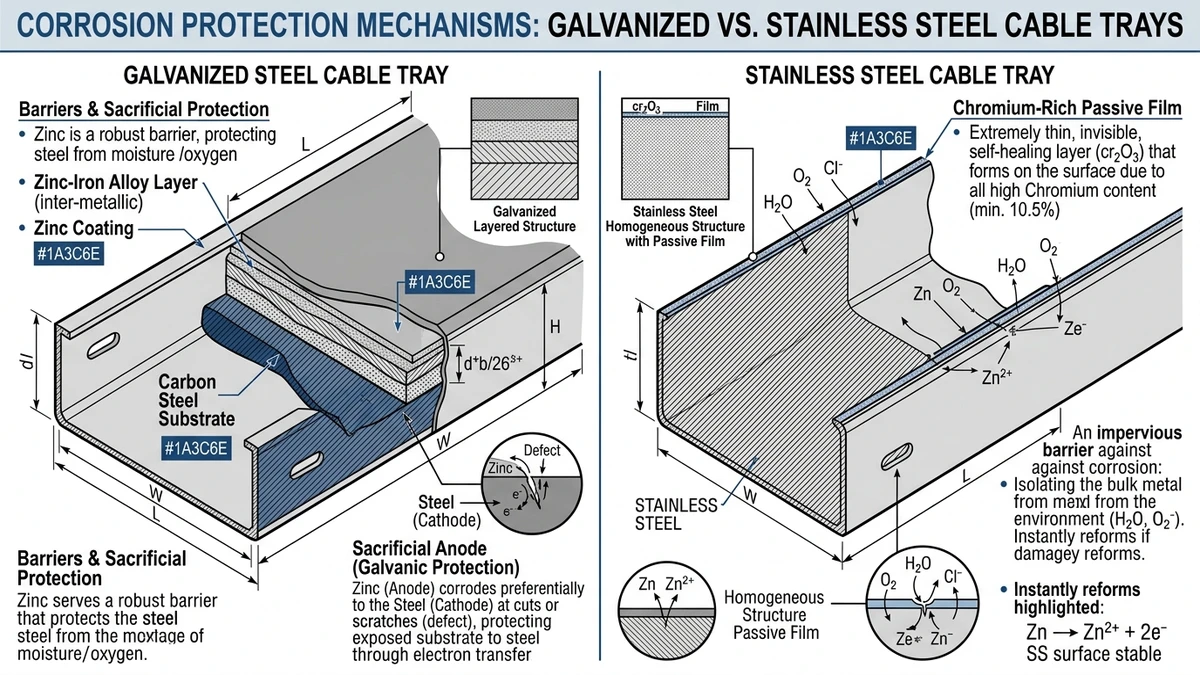
Galvanized steel protects by sacrificial action, so the zinc corrodes first but weakens faster in chloride exposure, wet-dry cycling, and at cut or drilled edges. Stainless steel relies on a chromium-rich passive film that can reform after minor damage, with 316 generally outperforming 304 in chloride service.
Engineering comparison: same load class, different durability path
Under IEC 61537, galvanized and stainless tray can meet the same span and load requirements but degrade differently in service.
Parameter
Galvanized steel cable tray
Stainless steel cable tray
Design consequence
Corrosion mechanism
Zinc coating sacrifices itself
Passive alloy film reforms after minor damage
Failure starts differently and at different locations
Usually no coating repair, but fabrication cleanliness matters
Heavy site cutting favors stainless in aggressive areas
Best-fit environment
Dry indoor, mildly corrosive, accessible
Coastal, washdown, chemical, hard-to-access
Match material to inspection reality
Day-one strength
Can meet required load class
Can also meet required load class
Compare durability, not only structural capacity
Equal day-one strength does not mean equal service life. The practical decision is where corrosion is most likely to start first.
What this changes for the specifier
If the route is dry, accessible, and easy to replace, galvanized steel cable tray is usually the logical option. If chlorides, washdown, or poor maintenance access are expected, stainless steel cable tray is often safer because failures usually begin at cuts, splice plates, and supports rather than straight runs.
Figure 1. Engineering cutaway comparing zinc coating protection in galvanized tray with passive alloy protection in stainless steel tray.
Cost Comparison: Upfront Price vs Lifecycle Cost
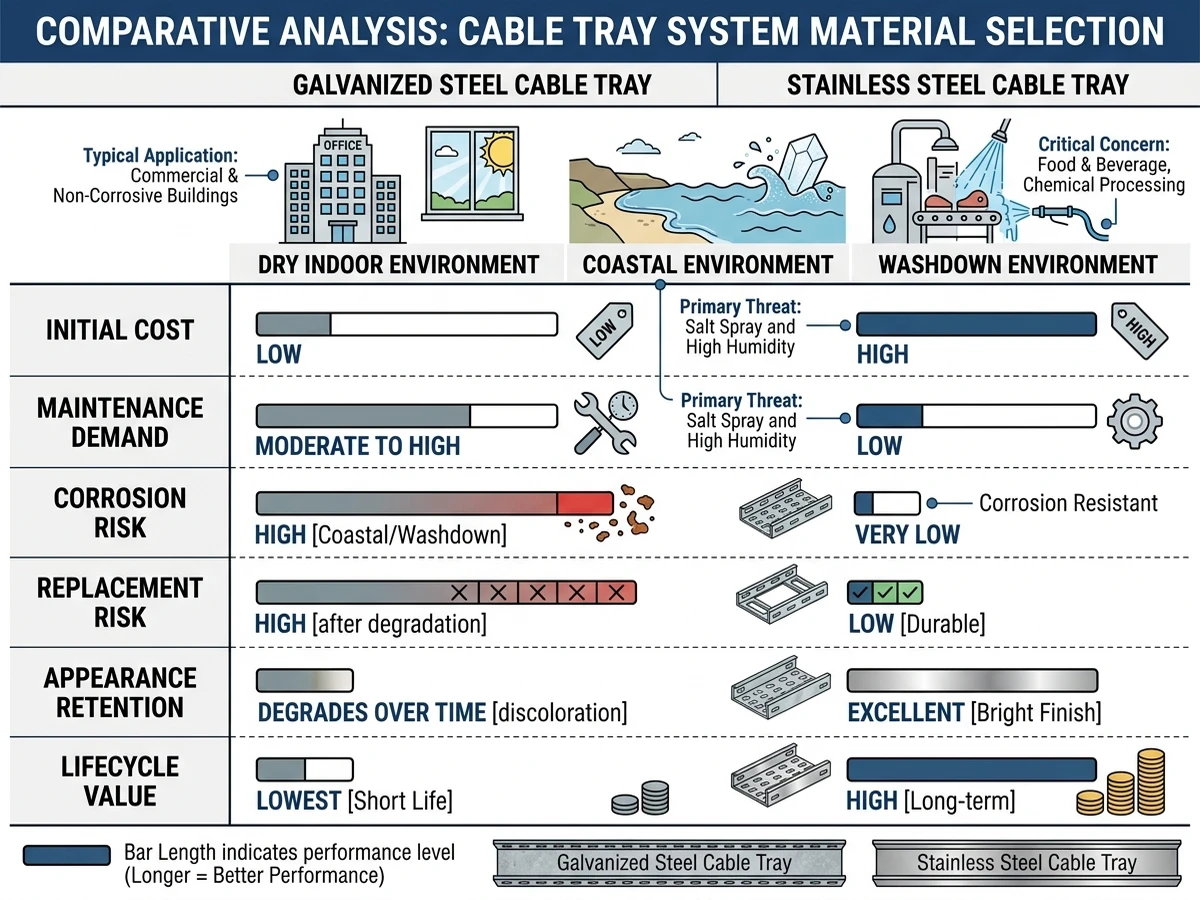
For galvanized vs stainless steel cable tray, cost should include purchase price, inspection labor, outage exposure, replacement timing, and hardware coordination. Galvanized usually wins on upfront cost, while stainless often wins where corrosion-driven maintenance is expensive.
Where the price gap comes from
Galvanized tray uses standard structural steel plus a zinc coating. Stainless tray contains alloying elements, so it is commonly about 2× to 4× the price of galvanized depending on grade, tray form, and market conditions.
Cost logic by parameter
Cost parameter
Galvanized steel cable tray
Stainless steel cable tray
Design consequence
Initial material cost
Usually lowest baseline, about 1.0× reference
Often about 2.0× to 4.0× galvanized
Galvanized suits cost-sensitive indoor projects
Inspection frequency in aggressive areas
Often every 1-2 years
Often every 3-5 years when grade is appropriate
Labor and access cost may outweigh tray cost
Repair after field modification
Touch-up coating commonly needed
Usually no coating repair, but avoid contamination during install
High site modification favors stainless in wet service
Service life in moderate conditions
Commonly 10-20 years
Often 20-40+ years if grade matches exposure
Replacement cycle changes total project cost
Failure consequence
Earlier risk at fittings, fasteners, supports
Lower corrosion-driven replacement risk, but higher material value
Include shutdown cost, not only tray tonnage
Worked example: when stainless starts to make economic sense
On a 100 m outdoor coastal utility run, galvanized may reduce procurement cost by 50-60%, yet stainless can still be cheaper over the asset life if galvanized needs replacement after 8-12 years and repair requires a 6-8 h outage. In exposed or hard-to-access routes, shutdown cost often matters more than tray price.
[Expert Insight]
A low tray price can be misleading when replacement requires permits, access equipment, or shutdown windows.
On many projects, the cost gap between 304 and 316 stainless is smaller than one unplanned intervention in a chloride area.
If frequent field cuts are expected, inspectability after commissioning should influence material choice.
Figure 2. Comparison matrix showing lower initial cost for galvanized tray and lower corrosion-driven lifecycle risk for stainless tray in harsh environments.
Which Environment Favors Galvanized or Stainless Steel Cable Tray?
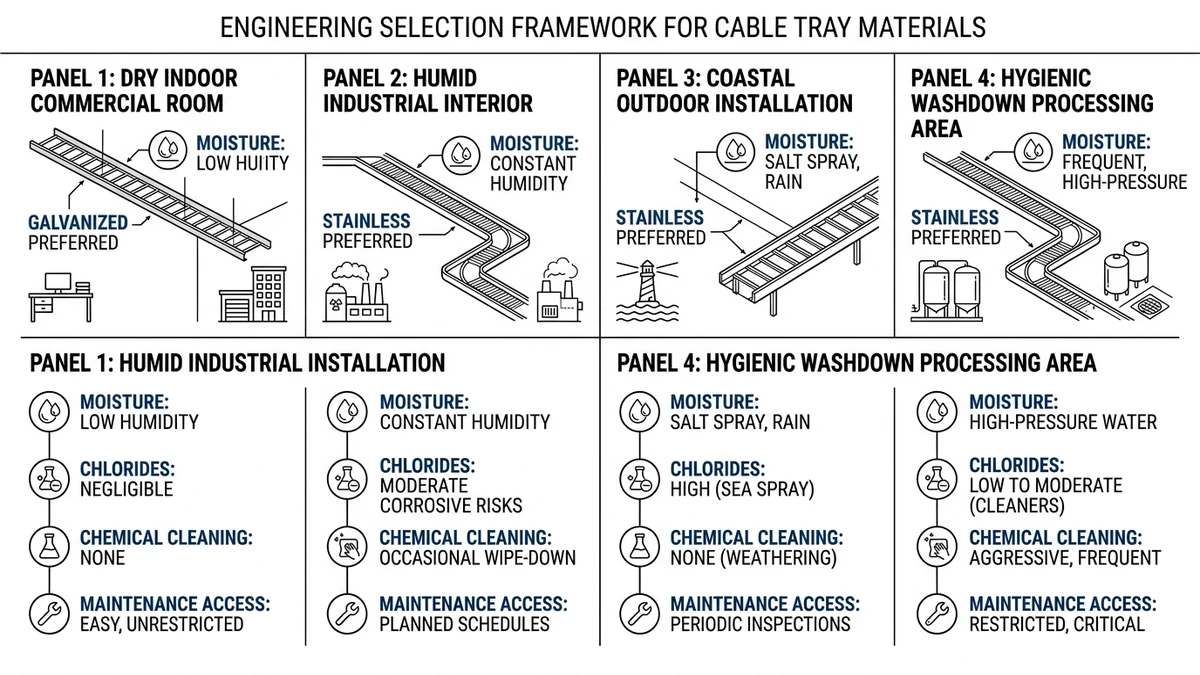
Environment is mainly a corrosion-rate and maintenance-access decision. Dry indoor service usually favors galvanized steel cable tray, while chlorides, washdown chemicals, H₂S-bearing moisture, or retained condensate usually favor stainless steel cable tray.
Environment-selection matrix
Environment
Typical exposure condition
Favor galvanized when
Favor stainless when
Main design consequence
Dry electrical room
Relative humidity typically below 60%, little chemical exposure
Standard indoor route, routine inspection possible
Owner standard requires stainless or contamination risk exists
Lowest installed cost often comes from galvanized
Commercial ceiling void
Occasional condensation, dust
No aggressive vapors and easy access
Repeated chemical cleaning or corrosive HVAC environment
Check cut-edge and hardware compatibility
Sheltered outdoor plant area
Wet-dry cycling, airborne dust
Drainage is good and moisture does not remain on tray
Standing moisture persists on horizontal runs
Drainage detail drives corrosion rate
Coastal outdoor site
Salt-laden air, chloride deposition
Short design life or low-criticality route only
Continuous exposure, difficult access, high uptime value
Stainless usually lowers replacement risk
Wastewater or tunnel
High humidity, condensate, possible H₂S
Exposure is confirmed mild and easy to inspect
Long service life is required in poorly ventilated areas
Hard-to-access routes usually favor stainless
Food or pharma washdown
Repeated alkaline or chloride-based cleaning, 40-80 °C washdown cycles
Only in dry packaging or segregated non-wash areas
Hygienic, frequently cleaned process areas
Smooth, corrosion-resistant surfaces matter
Chemical process area
Acidic or alkaline vapors, occasional spills
Mild, isolated exposure only
Exposure is regular or uncertain
Grade review matters more than appearance
Marine platform or desalination plant
Salt spray, conductive deposits, condensation
Generally limited use
316 stainless is often the safer baseline
Corrosion margin dominates lifecycle cost
How to apply the matrix
The common mistake is classifying a route only as indoor or outdoor. More useful questions are whether the tray sees chlorides, cleaning chemicals, wet deposits, or trapped moisture at joints and fittings.
Use when / avoid when / check before specifying
Use galvanized steel cable tray when
Use galvanized steel cable tray when the route is dry, accessible, inspectable, and replaceable without major operational impact.
Avoid galvanized steel cable tray when
Avoid galvanized steel cable tray when chlorides, caustic cleaning, condensate retention, or standing water can attack coating weak points faster than inspections can catch them.
Check before specifying stainless steel cable tray
Check the actual exposure and choose grade accordingly before specifying stainless steel cable tray. 304 may suit many indoor industrial areas, but 316 is usually preferred where chlorides are persistent; supports, fasteners, splice plates, and covers should follow the same corrosion strategy.
[Expert Insight]
Corrosion in wet service is usually localized at damp deposits, joints, and drainage interruptions rather than spread evenly.
Better drainage often improves galvanized performance more than simply increasing tray thickness.
If inspection intervals are long, material choice should assume hidden deterioration between visits.
Figure 3. Environment-based selection guide mapping dry indoor, humid industrial, coastal, and hygienic spaces to tray material preference.
How Tray Type Changes the Material Decision
Tray geometry changes the galvanized vs stainless steel cable tray decision because it affects drainage, ventilation, debris retention, and heat dissipation. The same project may justify galvanized ladder tray in one area and stainless perforated or solid-bottom tray in another.
Ladder tray
Ladder tray is the most forgiving form for galvanized steel because it drains and ventilates well. In coastal, wastewater, or washdown service, though, the open structure still sees direct chloride or chemical exposure, so stainless often becomes the safer choice.
Perforated tray
Perforated tray supports smaller control and instrumentation cables well but retains dirt and residue longer than ladder tray. In dirty or wet process areas, that longer moisture contact makes stainless more tolerant than galvanized.
Solid-bottom or trough tray
Solid-bottom or trough tray is the strictest case because it reduces airflow and can trap condensate. In humid or outdoor service, galvanized is best limited to controlled dry indoor areas, while stainless is usually safer where drainage is uncertain or cleaning is frequent.
Trade-off logic by tray form
Open ladder tray can make galvanized feasible by reducing retained moisture.
Perforated tray raises the penalty for contamination because deposits stay longer.
Solid-bottom tray increases both moisture retention and thermal uncertainty.
The more enclosed the cable management system becomes, the less useful low first cost is as the only selection criterion.
Material should be judged together with tray form, orientation, and inspection interval.
Common Failure Points: Where Material Selection Goes Wrong in the Field
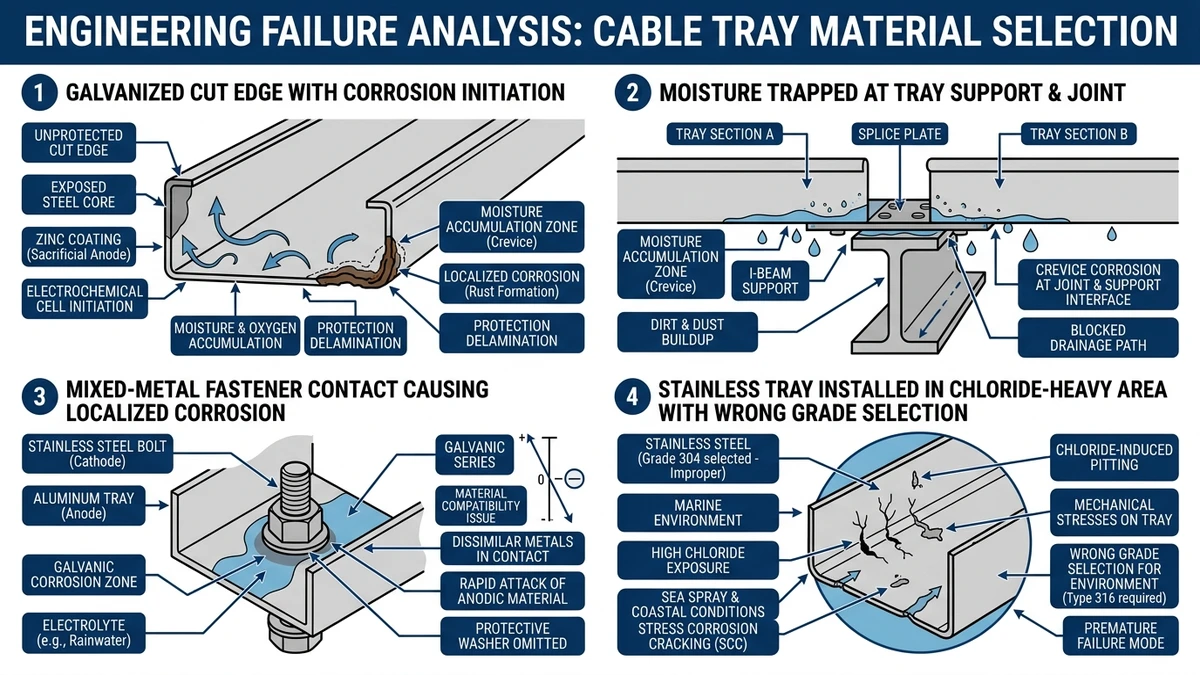
Most cable tray failures begin at details rather than straight sections. Typical weak points are cut edges, mixed-metal hardware, ponding locations, support interfaces, and fittings treated as generic accessories instead of part of the corrosion system.
Where galvanized tray commonly goes wrong
The usual error is assuming all zinc-coated tray performs the same outdoors. Pre-galvanized tray, hot-dip galvanized after fabrication, and repaired field cuts do not have equal durability, and failures often appear first at bolts, splice joints, and low points.
Where stainless tray commonly goes wrong
The main error is treating stainless as one material class. In chloride exposure, 304 may tea-stain or pit while 316 generally performs better, and carbon-steel contamination from tools or particles can reduce local corrosion resistance.
Field checklist before release
Check exposure realism
Do not classify the route by room name alone. Confirm whether the tray will actually see washdown, coastal salt deposition, H₂S condensate, fertilizer dust, or chemical mist.
Check water retention
Ask whether water can remain in the tray or on fittings for more than 24 h after rain, cleaning, or condensation. If yes, review geometry and material together.
Check hardware class
Supports, bolts, clamps, splice plates, and cover fixings should match the corrosion strategy. A durable tray with weak hardware still tends to fail at the joint.
Check service temperature
If tray metal regularly reaches 50-60 °C from process heat or solar loading, review both coating durability and cable thermal margin.
Check inspection access
If the owner is likely to inspect every 3-5 years rather than yearly, the selection should tolerate hidden deterioration between visits.
Figure 4. Field failure detail highlighting damaged galvanizing, trapped moisture at supports, mixed-metal contact, and incorrect stainless grade use.
How to Specify the System, Not Just the Material
Choosing between galvanized and stainless steel cable tray is only part of the specification. A reliable design coordinates tray, fittings, supports, covers, and maintenance access over the intended service life.
Corrosion environment versus material grade
Indoor dry areas may suit pre-galvanized or hot-dip galvanized tray. Washdown, chemical, wastewater, and coastal areas often push selection toward 304 or 316 stainless depending on chloride severity.
Load versus support span
A 3 m span carrying 50-75 kg/m should be checked with tray self-weight, cover weight, fitting weight, and cable mass included. For span and width planning, review the practical guidance in Xinma’s article on tray width and sidewall sizing.
Access versus protection
Frequent branch-outs, inspection points, or instrument cable changes may favor more open layouts and standard-radius fittings rather than maximum enclosure. For projects still comparing tray forms, Xinma’s overview of where tray systems are typically used helps narrow the route type before final material selection.
In many projects, the straight tray is chosen correctly but the fittings package is left generic. That usually shifts failures to bends, branches, and cover fixings.
Technical Closing: Make the Choice by Consequence
If the environment is mild, accessible, and cost-sensitive, galvanized steel cable tray is usually the rational specification. If the environment is chloride-rich, washdown-exposed, chemically aggressive, or difficult to maintain, stainless steel cable tray is usually the safer engineering choice.
The comparison should answer three practical questions:
Which material reaches the required service life?
Which material keeps fittings, supports, and access points workable through that life?
Which material avoids the most costly failure mode for this route?
When Xinma reviews a tray specification, the focus is system coordination: environment, tray type, support span, fitting continuity, and maintenance interval together. That approach helps avoid a common mistake in cable management systems—buying the cheaper tray when the real weak point is the joint, the hardware, or the access strategy.
Frequently Asked Questions
How do I choose between galvanized and stainless steel cable tray for outdoor use?
Start with the actual exposure, not just the fact that the route is outdoors. Sheltered inland runs with good drainage may suit galvanized tray, while coastal air, repeated wetting, or chemical washdown usually point toward stainless steel.
Is 304 stainless steel good enough for cable tray near the coast?
It can be acceptable in some lighter exposures, but chloride severity, distance from surf, and cleaning conditions matter. Many specifiers move to 316 stainless where salt deposition is persistent or maintenance access is limited.
Does galvanized cable tray need repair after field cutting?
Usually yes. Cut edges and drilled holes commonly need a zinc-rich repair method because the factory coating is interrupted, and those locations often become the first corrosion points in wet service.
Why does tray type affect material choice?
Tray geometry changes drainage, debris retention, and ventilation. Open ladder tray usually dries faster, while perforated or solid-bottom tray can keep contamination and moisture in contact with the metal for longer periods.
Can galvanized and stainless components be mixed in one cable tray system?
They can be mixed in some designs, but the interfaces need careful review. If hardware, supports, and fittings are not coordinated, joints may corrode or become difficult to maintain even when the main tray section remains sound.
How often should cable tray be inspected in corrosive areas?
Inspection intervals depend on exposure severity, accessibility, and owner maintenance practice. In harsher environments, shorter intervals are generally prudent, especially where fittings, supports, and cut edges are exposed.
What should I check before specifying stainless steel cable tray?
Confirm the stainless grade, the expected chemical or chloride exposure, and the compatibility of supports and fasteners. It is also worth checking whether tray geometry may trap moisture or raise cable temperature, since material choice does not solve every route problem.
Kevin Zheng
Kevin Zheng is a manager linked to Shanghai Xinma Busway & Cable Tray Co., Ltd. He writes technical content on cable tray systems, installation practice, sizing logic, load classes, and related standards for industrial and infrastructure applications.